July 25, 2026
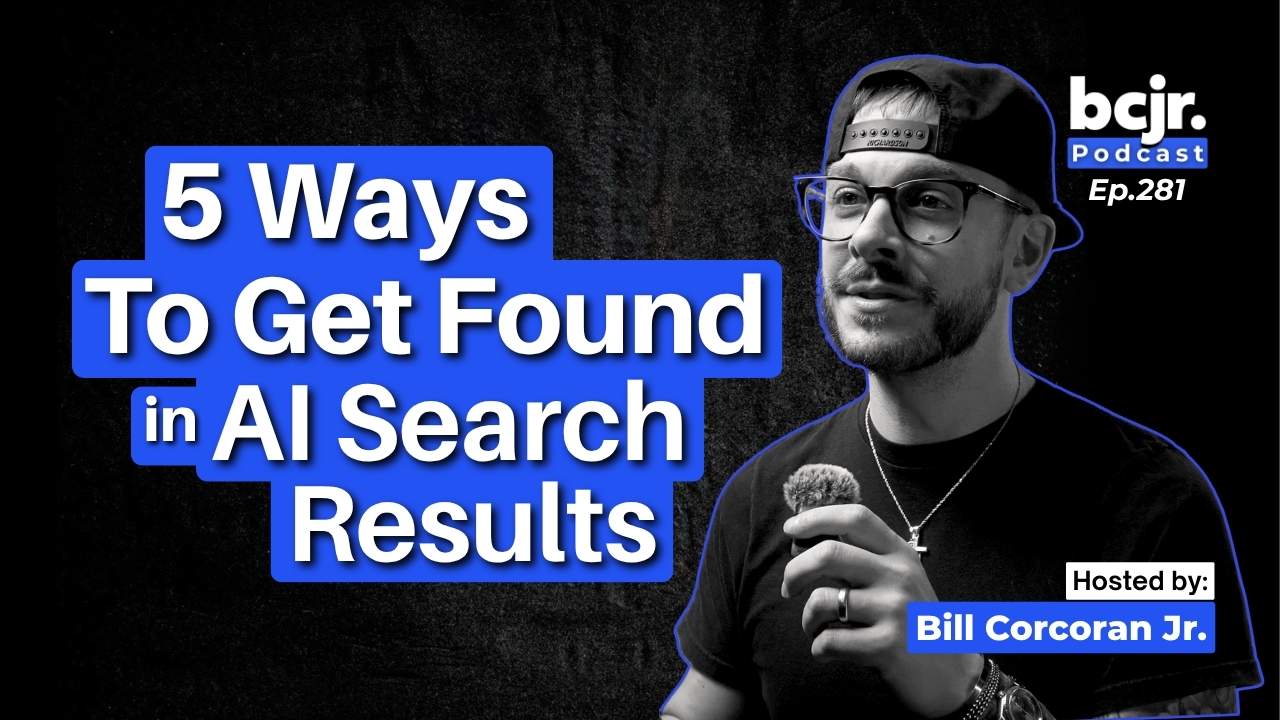
Getting your business found in AI search results starts with creating useful, searchable content that clearly demonstrates your industry expertise.
In this episode of the bcjr Podcast, Bill Corcoran Jr. breaks down five ways businesses can improve their visibility across ChatGPT, Google AI Overviews, Gemini, Perplexity, and other AI-powered search platforms.
This isn’t about chasing AI SEO hacks or trying to manipulate one platform.
It’s about answering real questions, building topical authority, repurposing video podcast content across multiple platforms, making your content easy to understand, and earning credibility over time.
These five strategies give search engines and AI systems more opportunities to discover your content, understand your expertise, verify the information, and potentially reference your business in AI search results.
Play5 Ways to Get Your Business Found in AI Search Results:
Frequently Asked Questions
How Do I Get My Business Found in AI Search Results?
Start by creating useful content that answers specific questions, building authority around your main areas of expertise, repurposing that content across multiple platforms, communicating clearly, and publishing consistently over time.
Can You Optimize Content Specifically for ChatGPT or Google AI Overviews?
There is no single strategy that guarantees your content will be cited by ChatGPT, Google AI Overviews, Gemini, Perplexity, or another AI platform. The best approach is to create high-quality, well-structured content that is easy to discover, understand, and verify.
Do Video Podcasts Help Businesses Show Up in AI Search?
Yes. One video podcast episode can be repurposed into a YouTube video, website transcript, short-form video clips, articles, social media posts, newsletters, and other searchable content.
That gives Google, search engines, and AI platforms more opportunities to discover your content, understand your expertise, and connect your business with a specific topic.
Why Does Topical Authority Matter for AI Search?
Consistently covering connected topics gives search engines and AI platforms more context about your expertise. A complete library of related content creates a stronger signal than one isolated article, video, or podcast episode.
How Long Does It Take to Show Up in AI Search Results?
There is no guaranteed timeline. Some content can appear within days, while other content may take months to gain visibility.
Consistency, content quality, authority, competition, and the size of your existing content library can all affect how long it takes.
Related Episodes
See how one original video podcast episode can become more than 100 pieces of searchable content across YouTube, your website, social media, email, and other online platforms.
See how personal injury attorneys can turn frequently asked questions, case results, and legal expertise into searchable content that improves their visibility across Google, AI search, YouTube, and other online platforms.
See how one podcast episode ranked number one on Google and appeared in AI-generated search results within its first 24 hours online.
Full Episode Transcript
Here are five ways to increase your chances of showing up in AI search results.
One, answer real questions.
Two, build topical authority.
Three, repurpose your content across multiple platforms.
Four, make your content easy to understand.
And five, earn credibility over time.
No gimmicks. No AI hacks. Just strategies that actually work.
I spend a lot of time paying attention to where my content shows up online.
Over the last few months, I’ve had quite a few people reach out after seeing my content show up in Google AI Overviews, seeing my podcast cited by AI, or hearing me talk about AI search.
And almost everyone asks me the same question…
“How do you actually get AI to cite your content?”
It’s a great question.
And honestly…I don’t think enough people are talking about it the right way.
Everyone wants some secret prompt. Some hidden SEO strategy.
Some AI hack that’s supposedly going to get them to the top overnight.
But the reality is, it doesn’t work like that.
So if anyone is trying to sell you some AI visibility service, it’s likely a scam.
From everything I’ve experienced over the last year, and from what I’ve learned by watching how AI search is evolving, there are a handful of tactics that consistently improve your chances of showing up.
No guarantees. No shortcuts.
Just solid content marketing principles that happen to work really well in an AI-first world.
Ironically, this whole conversation reminds me of what happened years ago with Google.
People became obsessed with trying to game the algorithm instead of creating genuinely useful content.
Then Google just got smarter.
Now we’re watching history repeat itself, but this time with AI.
People are chasing AI hacks instead of just focusing on becoming the best source of information in their industry.
They’re publishing vague content, promotional content, or random content that isn’t connected to any specific question or any area of expertise.
Then they wonder why Google doesn’t rank it and AI platforms won’t reference it.
Showing up in AI search starts long before AI ever sees your content.
It starts with what you create, how you create it, how clearly you communicate it, where you publish it, how you publish it, and whether you consistently demonstrate real expertise around the subject.
The platforms are changing, but the fundamental opportunity is the same:
Become one of the clearest, most useful, and most credible sources of information in your industry.
1. Create Genuinely Useful Content That Answers Specific Questions
Number one: Create genuinely useful content that answers specific questions.
This is probably the biggest one.
AI isn’t looking for marketing. It’s looking for answers.
If someone asks ChatGPT a question about real estate, personal injury law, accounting, financial planning, home services, or content marketing, AI needs content somewhere online that actually answers those questions.
The businesses creating educational content consistently are giving AI something useful to reference.
The businesses posting generic promotional content usually aren’t.
That’s one of the biggest reasons I always recommend building content around the actual questions your potential clients are already asking.
Let me give you a simple example…
If you’re a personal injury attorney, don’t just publish a page that says, “We handle car accidents.”
Instead, create content around questions like…
Should I talk to the insurance company after a car accident?
How long do I have to file a personal injury claim?
What happens if the accident was partially my fault?
Those are actually real questions people search for every single day.
They’re also the exact kinds of questions people are now asking ChatGPT, Google AI, Gemini, and Perplexity.
The same idea applies no matter what industry you’re in.
In episode two-hundred and eighty, I did a deep dive into content marketing for personal injury attorneys and how they can use one $5 million dollar verdict to create months of content that can potentially rank on Google, AI, and grow their firm.
You don’t even need to be an attorney or work at a law firm to understand the principles and strategy from that episode.
I’ll link episode 280 right here, and I’ll also drop the link to it in the comments here on YouTube.
Bookmark it and watch it later.
But for now, you need to stop asking yourself…
“What do I want to post today?”
And start asking yourself this…
“What questions does my ideal client have?”
When your content becomes the answer to those questions, you dramatically increase your chances of being discovered online and cited by AI.
2. Build Topical Authority
Number two: Build topical authority.
I know that sounds like mambo jumbo, so let me break it down for you in simple terms.
One blog post on your website isn’t enough.
One YouTube video is not enough.
One podcast episode ain’t gonna cut it.
AI has much more confidence when it sees you’ve consistently covered a topic over time.
So think about it this way…
If you published one article about personal branding three years ago, that doesn’t really tell AI much.
But if you’ve published twenty podcast episodes, videos, articles, LinkedIn posts, and short-form clips covering different aspects of personal branding…
Now you’ve built a body of work.
That’s authority.
That’s why I don’t create random podcast episodes.
Every episode connects back to a larger conversation around content marketing, business discoverability, SEO, AI search, video podcasting, and personal branding.
Individually, they’re helpful.
Collectively, they all reinforce one another.
And eventually, AI begins associating your business with those subjects because you’ve demonstrated consistent expertise over time.
You’re no longer just talking about a topic.
You’re becoming known for it.
3. Repurpose Your Content Across Multiple Platforms
Number three: Repurpose your content.
If you know me and you’ve been watching a lot of my content, you know how big I am on repurposing content.
One podcast episode should never stay in only one place.
That episode should be its own YouTube video, a written transcript on your website, several short-form video clips, LinkedIn posts, Instagram content, blog articles, email newsletters, and other searchable pieces of content.
You’re not creating every one of those pieces from scratch.
You’re taking one original conversation, repurposing it into different formats, and publishing that content across multiple platforms where people are already searching, watching, reading, and looking for answers.
That’s one of the biggest reasons video podcasts are so valuable for businesses.
You can sit down once, explain what you know in your own words, and turn that single episode into an entire library of content that can live across Google, YouTube, your website, social media, podcast platforms, Reddit, and AI search.
I actually did an entire episode explaining how to repurpose one podcast episode into over 100 pieces of content.
I’ll link that episode here on the screen, and I’ll also drop the link in the comments here on YouTube so you can watch it after this episode.
The important point is that every platform gives your content another opportunity to be discovered.
Your website turns the episode into written content that Google and AI platforms can crawl, understand, and reference.
YouTube adds more searchable context through your video’s title, description, chapters, captions, and transcript.
Short-form video clips create additional entry points through social media search and introduce the same topic to people across various platforms.
LinkedIn posts, articles, and newsletters reinforce your expertise in other places online where people like to read instead of watch or listen.
And if you do that, all of those pieces begin working together.
They give search engines and AI platforms more opportunities to find your content, understand what you know, associate your name or business with a specific subject, and potentially reference you and your content when someone asks a related question.
Now here’s the simple point:
AI can’t cite content that doesn’t exist.
The more high-quality content you repurpose and publish across relevant platforms, the more opportunities AI has to discover it, understand it, verify it, and potentially include it in search results.
4. Make Your Content Easy to Understand
Number four: Make your content easy to understand.
This one gets overlooked all the time, and I feel like it’s so obvious.
You need specific titles, specific topics, clear headings, simple language, well-organized website pages, and podcast transcripts.
The easier your content is to understand, the easier it is for search engines and AI systems to understand it too.
Here’s a mistake I see constantly.
And I’m guilty of this too. I’ve made these same mistakes in the past.
People try to sound too impressive instead of just being clear.
They create clever headlines that don’t actually explain what the content is about.
Or they’ll publish a video with a vague title because they think it sounds more creative.
Compare these two titles.
“My Thoughts on Marketing.”
Or…
“How to Repurpose One Podcast Into Over 100 Pieces of Content.”
Which one tells you immediately what you’re about to learn?
Which one do you think search engines and AI systems understand more easily?
Clarity always wins.
Don’t try to sound smarter.
Try to communicate better.
The easier you make it for humans to understand your content, the easier you make it for AI to understand it too.
5. Earn Credibility Over Time
And number five: Earn credibility over time.
Listen, I’m an impatient person. Just ask my wife.
I’m an entrepreneur. I have ADHD. I’m wired to move fast, and when I put time and effort into something, I want to see results immediately.
But content doesn’t work that way.
Sometimes you publish something and it ranks within a few hours or a few days.
Other times, it could take months for the content library around it to become strong enough for Google, AI platforms, and the people searching for that information to actually start finding it.
You have to be patient enough to keep building.
Keep answering questions.
Keep publishing.
Keep expanding on the topics you want your business to be known for.
Trust the process, but more importantly, give the process enough quality content and enough time to actually work.
This isn’t something you can fake.
Authority, trust, and content compounds over time.
The reason my content has started showing up in Google AI Overviews and other AI search experiences isn’t because I perfectly optimized one website page.
It’s because I’ve spent years creating quality content around related topics, publishing consistently, building a library of searchable content, and expanding on the same ideas from different angles.
That’s what builds credibility.
That’s what builds trust.
And that’s what AI systems tend to reward over time.
The businesses that consistently create valuable educational content are the ones building digital assets that continue working for them months and years later.
That’s why I always say…
Don’t think in terms of posts.
Think in terms of building a searchable library of expertise.
Because the longer you build that library, the easier your business is to find, the more credible it becomes, and the harder it is to ignore.
Now one last thing, because this is where people get it wrong.
You can’t directly optimize for AI citations the same way people used to optimize for Google rankings.
Different AI platforms retrieve, evaluate, and synthesize information differently.
There isn’t one universal rule or formula that guarantees ChatGPT, Google AI Overviews, Gemini, or Perplexity will cite your content.
And the best strategy is actually much simpler.
Create high-quality content.
Structure it well.
Answer real questions.
Build authority around your expertise.
Publish consistently.
Make your content easy to discover.
And make your content easy to verify.
If you do those things, you dramatically increase your chances of showing up across AI search platforms over time.
And that’s one of the biggest reasons I spend so much time talking about business discoverability instead of chasing the latest SEO trend or the newest AI buzzword.
You’re not trying to optimize for one algorithm.
You’re building content that can be discovered wherever people are searching online.
Google.
YouTube.
ChatGPT.
Gemini.
Perplexity.
And whatever comes next.
Because your business shouldn’t depend on one platform or one algorithm.
It should be discoverable everywhere.
If you found this episode helpful, I’d really appreciate it if you’d subscribe wherever you’re listening or watching.
And if you know another business owner or any marketing executive who’s trying to understand AI search and how to get their business discovered online, send them this episode.
I think it’ll help cut through a lot of the bullshit noise online.
And if all this sounds too overwhelming, and if you wanna learn more about how I can help your business be more discoverable online, shoot me a DM on Instagram @billcorcoranjr or drop me a line at billcorcoranjr.com.
Want Your Business to Be More Discoverable Online?
If you want to turn your expertise into searchable video content that helps your business get found across Google, AI search, YouTube, social media, and other online platforms, let’s talk.
Send me a DM on Instagram at @billcorcoranjr or visit billcorcoranjr.com/contact.
July 25, 2026
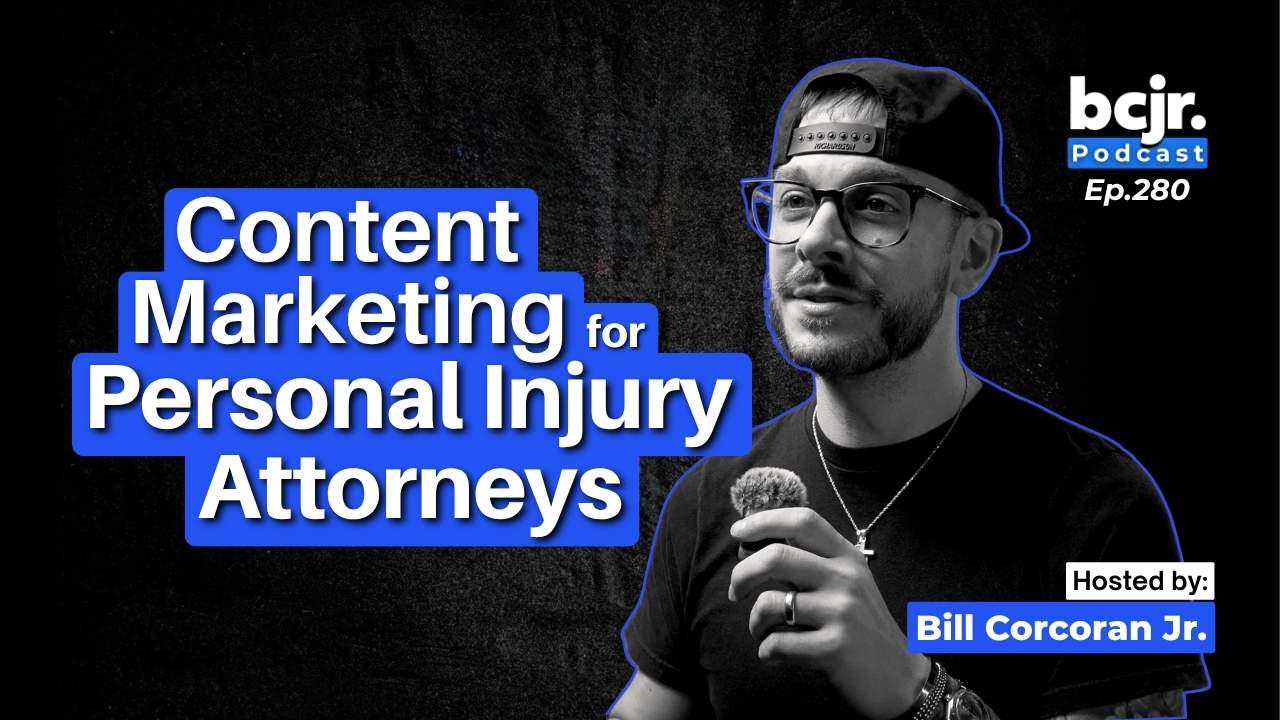
PlayContent marketing for personal injury attorneys is one of the biggest missed opportunities in legal marketing because most law firms are sitting on real cases, verdicts, settlements, client questions, and legal expertise that could help them get found online.
In this episode, I break down how one multi-million dollar personal injury verdict can become months of searchable content across Google, AI search, YouTube, social media, podcasts, and your website.
I also explain how educational content helps potential clients find your law firm earlier in the research process, why attorneys need to become the visible authority behind their content, and how video podcasts can create a repeatable content marketing system for law firms.
The bigger point is simple: your cases are the proof, your client questions are the topics, and your experience is the authority. When you turn that into useful, searchable content, your law firm becomes easier to find, easier to understand, and easier to trust.
Top 5 Content Marketing Mistakes:
Timestamps:
00:00 Content Marketing for Personal Injury Attorneys
01:45 Why a Case Win Is a Major Content Opportunity
04:07 Educate Potential Clients Instead of Just Promoting the Win
05:35 What Injured People Search Before Calling a Lawyer
07:59 Show Up Before They Search “Personal Injury Attorney Near Me”
09:26 Why Generic Law Firm Content Gets Ignored
11:23 Why Video Builds More Trust Than Generic Legal Content
13:15 Turn One Legal Topic Into a Searchable Content System
15:41 Build a Content Library That Helps Your Law Firm Get Found
Full Episode Transcript
Did you ever notice how personal injury law firm marketing all looks and sounds exactly the same?
It goes something like this…
“Attention: if you or a loved one was diagnosed with Mesothelioma, you may be entitled to financial compensation.”
And then somehow every commercial ends with the same three lines that go like this…
“We’ve recovered millions in compensation. Please don’t wait. Call now for a free legal consultation.”
Cool. You sound like every other law firm on the planet.
It’s 2026. We don’t want the generic 1999-sounding law firm marketing anymore. We want the real case, the real breakdown, and the real insight behind the $5 million verdict.
Let me show you how you can turn one multimillion dollar case into months of content that helps your law firm get found online.
So I recently saw a Facebook post that made me stop and think, ya know what, this is exactly what I’m talking about when I say businesses are missing so many opportunities when it comes to their content marketing. It’s absolutely ridiculous.
So there was this personal injury law firm that won a major multimillion dollar verdict in a case tied to a big company here in Pennsylvania.
Obviously, the verdict itself was pretty impressive, but the first thing I thought was not just, “Wow, great win.”
Yes, it’s definitely impressive, and it’s definitely a great win.
However, I also thought, “Wow, this is a massive content opportunity.”
And I don’t mean that in a cheesy way, like, “Let’s make some social media graphics that congratulate ourselves and our client.”
That’s not what I’m talking about here.
I’m talking about a real content opportunity where, for something like this, you can easily make hundreds of pieces of content around it.
And it would be pretty damn silly if you didn’t invest a few percent of that into a long-term content marketing plan.
I mean, you literally just won millions of dollars. I understand that all of that money doesn’t just go to one place. I get that.
But when I look at your website and your social media and you have little to no video content, and hardly any presence online, you should just stand in front of the mirror like Tom Green and keep repeating, “I’m the backwards man, the backwards man, the backwards man, the backwards man,” because that’s exactly what you are.
Backwards, man.
Haha, but before I jump into all the details of this example, I just want to say, it doesn’t even matter if you’re an attorney or work at a law firm to gain some value from this episode.
The general concept of everything I’m about to share with you still applies to whatever business or industry you’re in.
Because essentially, we’re talking about a client win here.
Think about it for a second. It’s a case study. A real live example of a success story with a client.
And it’s a major one.
And now all you need to do is share with the world, aka your future clients, how you did it, what it’s like to work with you, and why people should trust you if and when they need your services.
That’s it. That’s the whole game here.
But back to this specific example, a case like this could become an entire content series or multiple episodes on a podcast.
Let me break it down for you.
The firm could talk about what made the case complex, what people misunderstand about cases like this, what evidence mattered, what things didn’t matter that most people think would matter, what mistakes people make immediately after getting injured, how attorneys actually prepare for a serious case like this, what someone should know before talking to any insurance company, and why a verdict like that matters way beyond just the dollar amount.
Personal injury attorneys are probably sitting on some of the best content material out of any industry.
They have real cases. Real client questions. Real outcomes. Real stakes. Real expertise.
But most of the time, that gets reduced down to a single verdict post, a basic press release, or the classic $4,000 billboard that says, “WE FIGHT FOR YOU.”
Listen, the bigger opportunity here is not just telling people you won.
It’s showing people how you think. It’s showing people that you’re the expert and here’s why.
That’s really what this episode is about.
So yes, I’m going to use personal injury attorneys as the example, but this same idea applies to almost any service-based business.
If people need to trust you before they hire you, your expertise shouldn’t just live in your head, in your office, or your past results listed on your website.
It needs to live online in hundreds or even thousands of different ways so people can actually find you.
A huge win in a multimillion dollar personal injury case should not just be a single photo on Facebook or a billboard that says $5 million verdict.
A verdict is not just a number and it’s not just something to throw on social media with a caption and move on.
That result is proof. It’s authority. It’s a case study. It’s a trust-building asset.
And if you use it the right way, it can become way more valuable than one celebration announcement.
Most firms look at a result like that and ask, “How can we promote this win?”
And that’s fine. You should promote the win.
But the better question is, “How do we educate people through this?”
Because potential clients don’t just want to know that you won.
They want to know why it mattered. They want to know what made the case difficult. They want to know what someone in a similar situation should understand.
They want to know what mistakes could have hurt the case.
And they want to know how a serious injury case actually works.
That’s where the content is.
So instead of only saying, “We won a major verdict and here’s the dollar amount,” a firm could create content around what made the case complex, what evidence mattered most, what the other side argued, what injured people should learn from it, and why preparation made all the difference.
Now you’re not just posting a win.
You are showing expertise. You are building trust. You are giving AI tools, Google, YouTube, and potential clients more context around what you actually know.
Content should not just say, “Look what we did.”
Content should help people understand why you are good at what you do.
And this applies to way more than just attorneys.
A contractor can break down a complicated project.
A financial advisor can explain a planning mistake and the long-term consequences.
A realtor can break down first-time home buyer mistakes.
A dentist can explain a treatment decision.
A business consultant can break down a client problem and how they solved it.
The result is the proof. The content explains the proof.
That’s how you turn real experience into online visibility.
Now this is the part a lot of businesses miss.
People search before they reach out. They search before they trust you. They search before they know what solution they need.
And with personal injury, this is pretty obvious.
If someone gets injured, they usually don’t immediately know what to do.
They might be confused. They might be scared. They might be dealing with a few different insurance companies.
They might be missing work. They might be stuck in a hospital.
Now they might be fighting financial difficulties.
And even worse, they might not know if they even have a case.
So before they ever call a lawyer, they start searching. They’re looking online.
And this is your opportunity.
They search things like, “What should I do after a car accident?”
“What should I say to the insurance company?”
“How much is my injury case worth?”
“How long does a personal injury case even take?”
“What happens if I was partially at fault?”
“Do I need a lawyer if the insurance company already made me an offer?”
“What should I do if I got hurt at work?”
Those are not just content topics. Those are real people with real problems doing real searches.
And the firm that answers those questions clearly while someone is searching online has the best chance to get discovered before that person ever makes a phone call.
That’s why content marketing is not just about posting.
It’s about showing up during the research phase.
Because by the time someone fills out a form or makes a call, they may have already searched 10 to 15 different things. They may have already watched multiple videos. They may have already read a few articles.
They probably already asked ChatGPT or looked at Google’s AI results for answers to their questions.
And it’s questions, plural, not just a question.
So what does this mean for you?
I think the answer is pretty obvious.
Are you part of that research process or not?
That’s the real opportunity with content.
Not just showing up when someone searches your firm’s name. Not just showing up when someone searches for “personal injury attorney near me.”
But showing up earlier, when they are still trying to understand their own problem.
That’s where trust starts.
If you can help someone make sense of their problem, and if what you’re saying is a solution to their problem, they’re highly likely going to call you and only you.
And again, this is not just a personal injury thing.
Every service-based business is in the same boat.
Your prospects have questions before they buy. They have concerns before they book. They have doubts before they trust you.
They are searching before they ever become a lead.
The businesses that answer those questions with real expertise, look and sound like real humans, and none of that AI bullshit, and show people that they are the solution to their problem, those businesses are the ones who are going to be found and are going to be hired.
Most law firm content doesn’t just feel faceless.
It is faceless most of the time.
It’s the firm name, the logo, the stock images, the same generic blog voice, and the same legal phrases that everyone else uses.
“If you’ve been injured, contact an experienced attorney who fights for you.”
“We’ve won millions for the injured.”
Did you like my attorney voice?
Someone wanted to hire me recently for voice acting, but nah, that’s not my thing.
Anyway, those statements are everywhere.
And look, it’s not wrong. It’s just forgettable.
People do not hire a logo. They don’t hire your professional headshot.
They hire a person.
They hire the attorney they believe can help them.
They hire the attorney who makes complicated things feel less complicated.
They hire the attorney who sounds prepared, experienced, and trustworthy.
That is why the attorney’s voice matters.
And I don’t just mean voice as in audio.
I mean perspective.
How do you explain things? How do you think about cases? What do you wish more people understood? What mistakes do you see clients make before they call you? What do insurance companies not want people to know? What separates a simple case from a complex one? What questions should someone ask before hiring you?
That is the content people connect with.
Because now it’s not just legal information.
It’s your legal information. Your experience. Your insight. It’s your way of explaining the problem.
That matters for trust, and it matters for search as well.
Google and AI tools do not need another generic article that says the same thing as every other firm.
The internet is full of that and we’re all tired of it, brother.
What they need is clear, helpful, and specific content from people with actual expertise.
And this is where video becomes really powerful.
When an attorney sits down and explains a topic in their own words, it creates a much stronger trust signal than any generic post.
That video can live on YouTube. It can be embedded on your website. It can be cut into short clips. It can be turned into blog articles.
Hell, even though I think billboards are a waste of money, you can even repurpose it for an overpriced billboard.
Yep, I said it.
But on a serious note, this is what will support the search process when people are looking for answers on ChatGPT, on Google, YouTube, social media, and whatever other AI search people are using.
But this is why I love video podcasts as the engine behind your content marketing.
Not because every attorney needs to become a “podcaster.”
Trust me, that’s not what I’m trying to say here.
Don’t think about it like that. That’s not the point.
Let me reframe podcasting for you.
A video podcast gives you a repeatable format and a system for capturing your expertise, repurposing your content at scale, and distributing it across every platform online.
Show me a better way, I’ll wait…
Do you hear that? Yeah, me neither.
But that’s the beauty of it.
You sit down. You answer the questions your potential clients already have. You explain what they need to know. You turn your knowledge into content.
Then that content gets distributed everywhere people are already searching.
The podcast isn’t a sales pitch.
Don’t think of it like that.
The podcast is the content engine that feeds the internet the information it needs for you to be discovered.
That’s the goal here: discoverability.
Now this is where everything starts to connect.
Most businesses think content means creating more stuff. More videos. More posts. More captions. More blogs. More random things to feed the algorithm.
But the better move is not just more content.
It’s a better system.
For a personal injury attorney, one strong topic can become an entire content asset.
Let’s use this question as an example:
What actually makes a personal injury case valuable?
That is a real question people search for.
It’s also a question that lets the attorney show expertise without sounding like they’re selling anything.
Because the answer is not just, “Call us and we’ll tell you.”
The answer could include the severity of the injury, medical treatment, lost wages, liability, insurance coverage, long-term impact, documentation, evidence, expert testimony, and how the insurance company may try to minimize the claim.
Whew. That’s a lot.
But that’s the point.
That one question is an easy podcast episode.
Now that episode goes on YouTube.
The transcript can become a website post.
The best moments can become short-form clips.
Those clips can go on Instagram, Facebook, LinkedIn, and YouTube Shorts.
The main points can become website FAQs.
You can expand on it with a blog article on your website.
That blog article now supports Google and AI search.
The video can support YouTube search.
The short clips can support social media discovery.
And the full content can help AI tools better understand what the firm talks about and what the firm is known for.
Now that one idea is not just one piece of content.
It is part of a larger discoverability system.
That is the difference between content production and content strategy.
A content production company says, “Let’s make some videos. Sit here and talk about what you do and we’ll edit it for you.”
A business discoverability system says, “Let’s figure out what your ideal clients are searching for, what expertise you need to be known for, and how we turn that into content people can actually find.”
Completely different thing.
One is about making stuff.
The other is about making the business easier to find and easier to trust.
And if you do this consistently, the content starts to stack.
One episode becomes multiple assets. Twenty-five episodes become a library. A library becomes authority. Authority supports discoverability. Discoverability supports trust. And trust creates better leads.
That’s the formula.
Steal it if you want.
And no, this does not mean every piece of content is going to rank number one on Google.
And no, this does not mean AI tools are automatically going to cite you right away.
Nothing guarantees that.
But if your competitors have a few generic service pages and random posts, and you have a deep library of helpful content that answers real questions, explains real cases, and shows real expertise, you are giving search engines, AI tools, social media platforms, and potential clients a lot more to work with.
That’s the point.
Content is not the goal. Content is the tool.
Discoverability is the goal.
The reason I wanted to use personal injury attorneys as the example here isn’t just because of that post I saw on Facebook.
It’s because the opportunity is so easy to see.
The stakes are high. The questions are clear. The trust factor is huge. The client value is high. The cases create built-in content opportunities.
But this same system works in almost any service-based business.
The industry changes. The questions change. The examples change.
But the formula stays the same.
Find what your ideal clients are already searching.
Answer those questions with real expertise.
Use your results, stories, experience, and perspective.
Publish the content in formats that people and search engines can understand.
Repurpose it across the places people already search, watch, read, and research.
Then build a library over time.
That’s it. That’s the secret.
A personal injury attorney uses cases, verdicts, insurance questions, injury questions, and legal expertise.
A real estate brokerage uses market knowledge, buyer and seller education, agent recruiting content, and local expertise.
A financial advisor uses retirement questions, tax planning topics, investment concerns, and trust-building education.
A dentist uses treatment questions, patient concerns, cosmetic results, and common fears.
A contractor uses project breakdowns, pricing questions, before and afters, and homeowner education.
Different industry. Same system.
And this is where I think a lot of businesses need to change how they think about content.
Content is not decoration. It’s not just something nice to have. It’s not just something you post so people know you’re alive.
Content is becoming infrastructure.
It is part of how people find you.
It is part of how people understand you.
It is part of how people trust you.
It is part of how Google understands your business.
It is part of how AI tools may understand and reference your expertise.
And it is part of how your sales process starts before the first call.
That is the bigger shift here.
The businesses that win are not going to be the ones just posting the most.
They are going to be the ones creating the most useful, searchable, trust-building content around the problems their ideal clients care about and are searching for.
That’s business discoverability.
And that is the opportunity, no matter what business or industry you’re in.
So if you’re a personal injury attorney, here’s your takeaway.
Your cases are the content. Your verdicts and settlements are the proof. Your client questions are the topics. Your experience is the authority.
The opportunity is turning all of that into a content marketing system that helps people find you, understand you, and trust you before they ever reach out to you.
And if you’re not an attorney, the same idea applies to your business too.
Your content should not just promote what you do.
It should prove why someone should work with you.
That is how you build real discoverability online.
Not just more posts. Not just more videos. Not just more generic noise on the internet.
A system.
A system that connects your expertise to the questions people are already searching across Google, AI, YouTube, Reddit, and social media.
Because the businesses that win moving forward are not going to be the ones just creating content to stay busy.
They’re going to be the ones building a content library that makes them easier to find, easier to understand, and easier to trust.
That’s it. That’s the opportunity. And that’s what I’m building.
So if this episode made you think differently about your content, your podcast, or how your business gets discovered online, great.
If you want to chat with me personally about how I can help you, send me a DM on Instagram, @billcorcoranjr or drop me a line at billcorcoranjr.com
And as always, if you got value from this episode, share it with someone who needs to hear it.
Related Episodes
How My Podcast Ranked #1 on Google and Got Cited by AI in Less Than 24 Hours (linked)
How To Repurpose One Podcast Episode Into 100+ Pieces of Content (linked)
Beyond SEO: Content Is Key To Business Discoverability in 2026 (linked)
Listen and Connect
Want to learn more about building your brand with a video podcast?
Connect with me on Instagram or explore more at billcorcoranjr.com.
Watch the bcjr Podcast with Bill Corcoran Jr. on YouTube, or listen wherever you get your favorite podcasts.
July 25, 2026
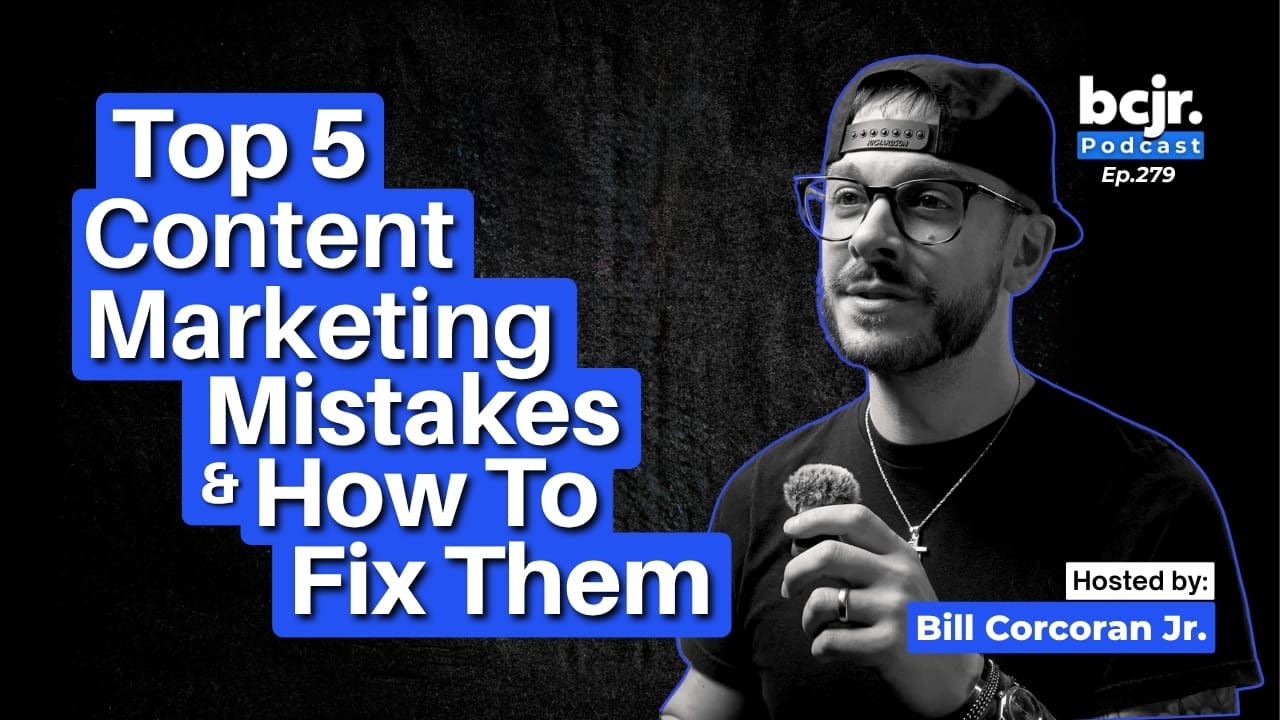
PlayThese top 5 content marketing mistakes can quietly limit your business discoverability, even when you’re creating good content.
I’ve made all of these mistakes myself, and fixing them changed the way I create, structure, repurpose, optimize, and promote content for my own business.
Search intent, content promotion, AI, optimization, and repurposing all play a role in whether your content gets found through Google, AI search, social search, YouTube, podcast platforms, Reddit, and everywhere else people search online.
In this episode, I break down the five biggest content marketing mistakes I see businesses make that keep their content from getting discovered online.
This is really about the small decisions that determine whether your content gets found, ignored, trusted, shared, buried, or connected back to your business.
Good content still needs structure, context, promotion, and a clear reason to exist.
Top 5 Content Marketing Mistakes:
Timestamps:
00:00 Top 5 Content Marketing Mistakes
00:01 Why Structured Content Marketing Matters
03:40 Mistake #1: Ignoring Search Intent
07:40 Mistake #2: Not Repurposing Content
09:45 Mistake #3: Publishing Content Without Promotion
12:58 Mistake #4: Monetizing Content Instead of Optimizing
16:00 Mistake #5: Using AI to Replace Original Content
19:10 How To Structure Content To Be Found OnlineFull Episode Transcript
Here are the top five content marketing mistakes I see businesses make online.
One, they ignore search intent.
Two, they don’t repurpose content.
Three, they barely promote it.
Four, they’re trying to monetize instead of optimize.
And five, they’re using AI to replace the content, not support it.
I’ve made these mistakes so you don’t have to. Here’s how to avoid them.
I’ve been thinking about this a lot lately because I keep seeing businesses put real effort into their content. But then the content kind of just sits there. It seems nobody finds it.
Nobody connects it back to their business. And then the owner and the marketing team just throw their hands up in the air and just say, well, content doesn’t work. It’s not that content doesn’t work.
The problem is the way it’s being built, titled, shared and connected online, or lack thereof. And to be clear, this episode is not only about podcasting. When I say content, I mean all of it.
Podcast episodes, regular video content, long form, short form, email newsletters, graphics, blog posts, pages on your website, social media posts, even down to the captions on social media. All of it matters. But the reason I talk so much about video podcasts is twofold.
Number one, obviously I speak from experience. I’ve been doing this podcast thing for over six years. And number two, because a podcast can give you the content and the source material for everything else I just mentioned.
And it acts as a home base or a hub for your content marketing, like no other form of content can do. One strong podcast episode can turn into several clips, social media posts, email newsletters, sales content and website content. But only if you actually plan it that way and use it the right way.
And I’ll be honest, this took me years to get right, and I’m not even ashamed to admit that. And for a long time, I was stuck in this weird place where I didn’t want to sound too salesy. I didn’t want to be too promotional, and I didn’t want to make content that felt like I was always pushing my own business.
But when I look back at it, that stuff held me back for so long. Because there’s a big difference between being annoying in your content and actually making content that is useful to others and supports your business at the same time.
So we’re going to address that funny gray line area in this episode, which I know a lot of people actually struggle with.
And it’s probably also one of the biggest reasons that it holds people back from sharing their expertise online. I posted something recently on social media asking what holds people back, and I got a lot of great responses. So if you’re watching this and you contributed, thank you.
I appreciate it. You know, it’s funny because I don’t think people realize how much of my genuine curiosity on social media actually fuels most, if not all of my content.
But at the end of the day, when you really think about it, someone with the same expertise as you is going to be doing it, and you’re going to be kicking yourself down the road for not doing it.
Because odds are you’re probably better than most of the other people who are actually doing it.
So how do you create content that feels real, sounds like you, helps people, gets you found online, and actually supports your business goals?
That’s where these five content marketing mistakes come in, because I’m pretty sure I’ve made all of them at some point.
I always say, you learn more from your mistakes than you do from your wins. The first mistake is ignoring search intent. And I know that phrase sounds a little SEO-ish, and I don’t want to sound like an old school boring SEO agency, because that’s not what I am, but it’s actually really simple.
#1. Ignoring Search Intent
All it means is this, are you making content around what people are actually searching for online? Or are you just making content around whatever you feel like saying? Or let’s take it one step further.
Are you making content around what you think people are searching, but aren’t actually searching online? Because there’s a big difference.
A business owner will post something like big announcement, or new episode, new content coming soon, or this changed everything for my business, or the classic motivational content.
You just have to keep going, or motivational this, or motivational that. Okay, cool. But what’s it actually about?
There’s nothing wrong with sharing motivational stuff every now and again. I do it myself sometimes, but it’s definitely not my main focus. Nobody is searching for big announcement, or motivation to be better.
Nobody’s going on YouTube, LinkedIn, Instagram, Tiktok, or Google, or any Al platform, and searching for thoughts on business and discovering you because of that.
You probably have a better chance at winning the lottery than someone finding you online and doing business with you, because you posted a few random videos about business or motivation.
That doesn’t tell people anything, and it definitely doesn’t tell these platforms anything.
That’s where a lot of content just gets buried online.
The idea and the intention might be good, the video itself might be good, the message might actually be valuable. But the way that it’s packaged gives nobody a reason to find it.
And this matters more now than ever, because search is no longer just on Google. People are searching on YouTube, Instagram, LinkedIn, Reddit, they’re asking ChatGPT.
And sometimes people even ask three different Al platforms and just compare the responses between the three to see which is most valuable and if it actually answered their question.
People are looking things up in all kinds of places. I think you’d be surprised to find out that people are actually searching on podcast platforms.
Think about a few key words that are relative to your business and your industry.
Those are the key words that will make you discoverable on these platforms if your content is created the right way. So think about things like the titles, the descriptions and even your captions on social media.
All of this matters.
The wording that you use in the content itself even matters.
So if your content is a bunch of rambling nonsense, take a guess how well it’s going to rank online. It might sound crazy, but Google, AI and all these other things on the Internet can decipher what you say in your content.
And that plays a big role in if your content is going to be discoverable or not. And now when you take the same idea and share it across multiple platforms like your podcast, YouTube, your website, your social media posts, all of it connects and starts to work together. This is what makes your content searchable.
It gives people, search engines, AI tools and social media platforms the context it needs to understand your content. It basically says this person or business keeps talking about this topic. Compared to most of the other content online, this person knows what they’re talking about, the content is quality, and it actually answers real questions that people are currently searching for. So we’re going to show this content to more people.
The fix is really simple, but most people just won’t do it. Make the title clear enough that someone instantly knows what problem your content solves.
If your ideal client would never search any of those words, your content is already harder to find.
With podcast content, this matters even more because the title of one episode can now become the foundation for your clips, blogs on your website, your email newsletter, and all your other social media posts.
So if the main title is vague, everything else built from it is going to be weaker as well.
Clear beats clever every time. Now the second mistake is not repurposing the content. I’m not going to fully repeat myself here because I already did a full episode on turning one podcast episode into 100 pieces of content.
#2. Not Repurposing Content
So with this episode, I want to look at repurposing a little differently. But if you want to check out that episode, it was episode number 277.
I’ll link it right here in this video and I’ll also drop the link in the comment section here on YouTube. Bookmark it and watch it after you finish this episode.
But for this conversation, it’s not just about how do I get more content out of one episode. Think about it like this.
How does repurposing my own content help my business get found online?
Because if you record one podcast episode, post it once, maybe cut one or two clips for Instagram, and then move on, you’re leaving a ridiculous amount of visibility on the table.
One idea should never die as just one or two posts. That’s crazy.
If the idea is strong, it should show up in multiple places across the internet.
At minimum, one episode should become several short form clips, one or two written blogs on your website, a few quote graphics, one or two email newsletters, and be in the featured section on your website.
You can use it as something you send to a prospect during a sales conversation, or even something that you actually include in the sales pitch itself. That’s how content starts working harder for your business. There’s a big difference.
And again, this isn’t just about posting more for the sake of posting more. I’m not saying take one clip and spam the internet with it in 40 different ways. I’m saying if you have a strong idea, don’t let it live in just one place.
Because people find content in different ways and people also consume content in different ways. Somebody might find you while searching on YouTube. Somebody might see a LinkedIn post.
Somebody might find you in a Google search. Somebody might see a short clip on Instagram. Somebody might ask AI a question and your content could help answer it.
But if the content only exists once or twice in one place with a weak title and no context, you’re making it nearly impossible to be discovered.
Repurposing your pillar content gives the idea more chances to be found. The third mistake is skipping content promotion.
#3. Publishing Without Promote Content
And when I say promotion, I don’t automatically mean paid ads. Let me say that clearly. You don’t need a paid ad budget to promote your content.
Can paid ads help? Absolutely.
But a lot of businesses use, we don’t have an ad budget as an excuse to not promote their content at all.
So share the shit out of your content. Share it more than once. Post it on different platforms.
Turn it into several clips for social media. Put it in your email newsletter. Don’t have an email newsletter?
That’s fine.
Use your episode as a reason to reach out and follow up with clients and prospects.
Personally, email 5 to 10 prospects each week with a short message and a link to one of your recent episodes.
I do this all the time myself. I send personalized emails to a handful of prospects each week with a link to a specific episode from my podcast that I think that they might actually benefit from. And I let them know that.
For example, I’d be like, hey Jeff, I know you’re interested in SEO and AI conversations, so I think you’d get some value out of my recent two episodes. That’s it. You don’t have to sell anything.
Just be a resource. Be the expert they need. Salespeople always say, I don’t know what to say when I fall up with prospects.
Well, now you have something to say and you’re not being annoying. This is the perfect excuse to follow up with prospects after a recent sales pitch. It’s also a great way to easily reconnect with old prospects without sounding desperate and using the cliché, just checking in or just circling back on my email.
Now you’re providing real value.
And here’s another thing. I said this to a friend of mine, Jerry Rizzo, several years ago, and I guess it stuck with him because he occasionally reminds me of it.
If you’re not excited about your own content, why should anyone else be?
I know it may sound a bit cheesy on the surface, but you gotta be a cheerleader for your own content. Because if you’re not shouting from the rooftops that you believe in the things you’re saying, you’re not giving anybody else a reason to believe it either.
There’s so many different ways to promote your content in your everyday conversations, and it costs you absolutely nothing to do it. And no, don’t think you’re being annoying by sharing it everywhere. You gotta look at it from a different perspective.
You have to think about it like you’re providing a resource and a solution to people who need your content. A lot of businesses don’t promote content. They just publish content.
And those two things are not the same. Publishing is hitting upload. Promotion is actually giving the content a chance to be seen.
A business will spend a ton of time recording something, editing it, putting all the pieces of the puzzle together, and then they just post it one time and forget about it. Then they wonder why it didn’t do anything. Bro, you barely gave it a chance.
It’s like opening a retail store and not telling anyone where it is, turning the lights off and then saying, well, retail doesn’t work. Uh, no? People just don’t know you’re there.
It’s the same thing with content. If the content matters, stop treating it like a one-time post. This is where a podcast can be really powerful because the episode itself gives you the main piece.
“But the promotion comes from everything else around it. The clips, the posts, the emails, the blog, your website, and all your follow ups. Oh, and then the conversations it creates afterwards.
That’s the machine. Use it to your advantage. All right.
#4. Trying to Monetize Content Instead of Optimizing Content
The fourth mistake is making content to monetize instead of optimize.
Because this is where I see a lot of people getting distracted. They start thinking like content creators looking for sponsorships instead of business owners looking to grow their revenue.
They’re out there chasing likes, comments, views, and small cash payouts from social media platforms. I see too many people chasing that 100 bucks a month from Facebook or whatever, while completely ignoring the fact that one good client could be worth thousands.
That’s backwards, my friend.
If you make money from monetizing your content, cool. Treat it like a bonus. But if you’re a business owner, that should not be your main strategy, unless the content itself is your job.
And that’s pretty rare. And when I say is your job, I mean the content itself needs to be generating like six figures in revenue and sponsorships and monetization.
Otherwise, it’s not a job. It’s just a hobby.
The real money is not in trying to become a content creator for the cool factor. The real money is made in using the content to build industry authority, attract better clients, and drive business growth.
I had a conversation once with a personal trainer who wanted to make content.
Great. Love that.
But he wanted to make content that had nothing to do with his business and he refused to even talk about personal training. Okay, buddy, just keep talking about pizza and collect your 100 bucks from Facebook.
And you know what? I see this all the time.
A business owner wants more leads, more clients, more trust, more authority, but the content that they want to create and the content they do end up creating has no connection to their business.
It might be trendy and it might feed your ego and it might be entertaining, but that doesn’t help the right people understand who you are and what your business is.
And look, I get why that happens. For a long time, I was the guy who always said, I don’t want to sound too salesy or too promotional in my own content. And that held me back from creating this kind of solo content that I make right now.
And if I’m being real, it probably held me back a lot longer than I’d like to even admit.
My old guest-based podcast was great for what it was at the time. It built relationships, it built awareness, it created opportunities, and yes, it did generate six figures in revenue from the content.
And when most people hear that, they think, oh shit, cool, I want to monetize my podcast too.
But listen, it took years to get to that point, and it’s not the playbook I would tell business owners to focus on. That’s a totally different business model than what we’re talking about right here.
Because if you use your podcast or your content as a business tool, you will make way more money from your clients than you will by chasing a few dollars and a couple hundred likes on Facebook. There’s a big difference.
So are you making content to look like a creator, or are you making content that helps grow your business?
Because chasing trends, likes, and stupid TikTok dances for a 100 bucks a month with no tieback to your business and little to no ROI makes zero cents if you’re actually trying to build something serious. Your content should work for your business, not just the algorithm and not just your ego.
#5. Using AI To Replace Content Instead of Using it To Support Content
The fifth mistake is misusing AI as a content replacement.
This is a big one.
And I know this is one that people are going to disagree with me on because every time you say something about AI now, people just get weird.
So let me be clear on this.
AI is useful. I use AI.
I think AI can help with ideas, research, outlines, organize your thoughts, find better angles, clean things up, speed up parts of the process for your business.
There are tons of different ways that AI can help. But AI should support your content, not become the content. And that’s where you lose me.
I keep seeing so many businesses use AI to pump out posters, flyers, random graphics, fake ass looking images, generic captions and all this cluttered junk, all because it’s fast and cheap.
And you know what they say about fast and cheap, right?
Well, maybe we shouldn’t go there.
But on a serious note, I’m sure you’ve heard of the good fast and cheap triangle. You only get to pick two out of the three. And with a lot of this AI content, it definitely falls within the fast and cheap part of the triangle.
And the craziest part about it, it’s not even that good. Some of y’all got poor taste, man. A lot of these AI generated flyers and graphics are just ugly as fuck.
They’re cluttered, generic, shit is spelled wrong. It’s just weird. And you look weird.
Almost everyone I know hates this AI generated shit. It feels fake, lazy, and like nobody actually thought about the message or the design. People just post whatever AI spits out.
And the same thing is happening with the captions I see people writing on social media.
All of a sudden, everybody became great writers.
Come on, man.
It’s so obvious when people use AI to write the whole caption. That shit is just too polished. Your writing literally sounds like a corporate blog had a baby with a motivational speaker.
Nobody talks like that. And I even see people leaving comments on other people’s posts that are clearly AI generated because they want to sound smart and weigh in on a topic they know nothing about.
Brother, listen.
I know you don’t know anything about that topic and I definitely know you don’t talk like that in real life. So let’s cut the crap, okay?
Stop pretending those are your own thoughts just because you want to impress people on LinkedIn and Facebook.
And the bigger issue isn’t even that you used AI. It’s that you look fake as hell, bro. I’m just being honest.
It doesn’t sound like you. It doesn’t show how you think, and it definitely doesn’t build trust. It just adds to more generic noise on the internet that everybody has to just scroll past.
And bad news, that’s not going to make your business more discoverable.
Sure, maybe you post more, maybe you fill the feed, and maybe you check that box.
But are people actually connecting with it?
Are they trusting it? Are they actually learning anything real from you?
Or are they just seeing right through your AI bullshit writing?
Because I can, and I tune those people and post out immediately.
Listen, AI can help you get to the idea. I believe in AI. I do.
But the idea still needs to be from your brain, it needs your voice, it needs to be your examples, your taste, your stories, and your actual experience. That’s the part you can’t fake.
So if your business is making content and it’s not getting found online, the reason probably isn’t one big thing. It’s usually the mix of a lot of little things.
You’re ignoring search intent, using titles and captions that probably don’t tell people or platforms what the content is about, you’re not repurposing your content, you might be publishing but you’re not promoting, you’re chasing monetization instead of optimization, and you’re probably using AI to replace your voice instead of using it to support your ideas.
You might have a good concept, but it still needs structure, context, promotion, and a clear connection back to your business.
And one other really important factor that I’m not even sure I mentioned yet, you got to give it time.
This stuff doesn’t happen overnight.
My content journey did not happen overnight.
The podcast did not create opportunities overnight.
The revenue didn’t show up overnight.
The visibility that I have didn’t happen because of one post, one episode, or one clip. It compounded over time. And that’s the part most people miss.
They want results without building the system first.
But if you build the system the right way, the content starts doing more than just getting views. It helps the right people find you, understand you, and trust how you think.
And eventually, it’s gonna help grow your business.
That’s why I believe so much in content and video podcasts as a marketing tool for your business.
Not because I think everyone needs to become a podcaster, but because a strong video podcast gives you the source material to create content that can work across your website, social media, YouTube, email, AI search, and basically everywhere else online.
So if you’re trying to build authority and attract better clients, that’s what I do.
I help business owners turn content into something that actually supports their business goals. If you ever want to chat about that, shoot me a DM on Instagram @billcorcoranjr or drop me a line at billcorcoranjr.com
Related Episodes
How My Podcast Ranked #1 on Google and Got Cited by AI in Less Than 24 Hours (linked)
How To Repurpose One Podcast Episode Into 100+ Pieces of Content (linked)
Beyond SEO: Content Is Key To Business Discoverability in 2026 (linked)
Listen and Connect
Want to learn more about building your brand with a video podcast?
Connect with me on Instagram or explore more at billcorcoranjr.com.
Watch the bcjr Podcast with Bill Corcoran Jr. on YouTube, or listen wherever you get your favorite podcasts.
July 25, 2026
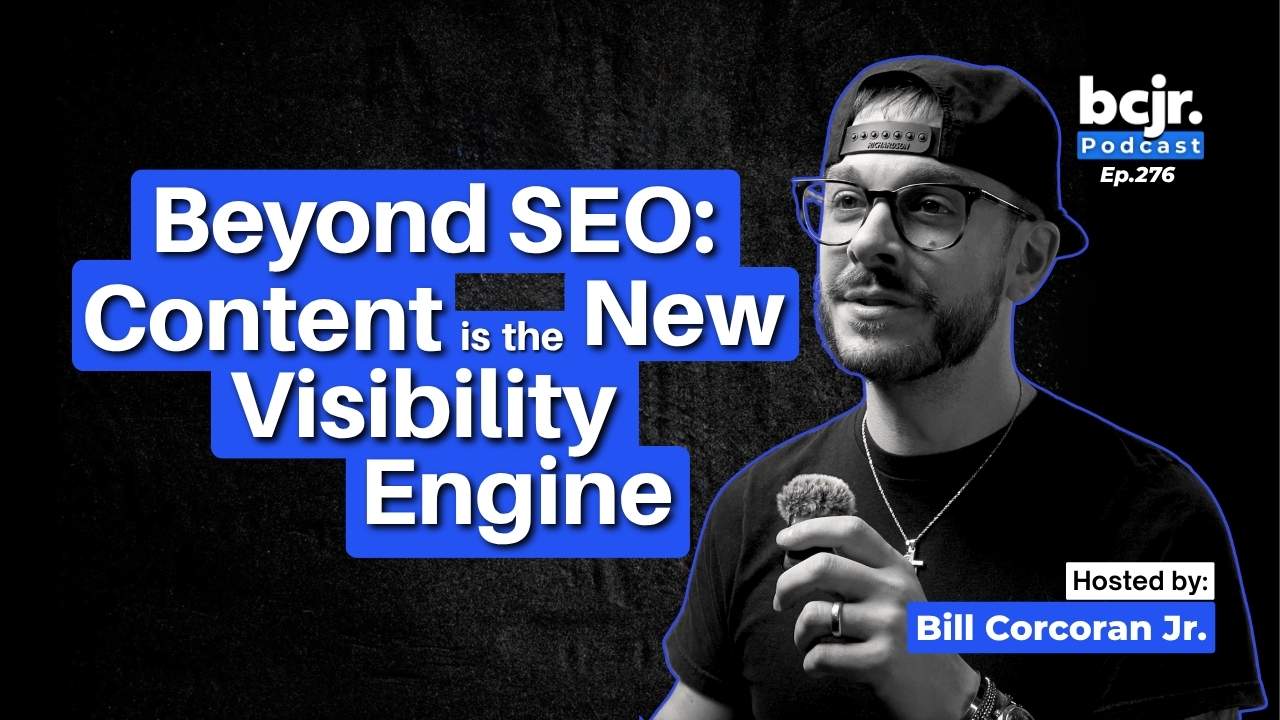
PlayBusiness discoverability in 2026 is no longer driven by SEO alone. AI search, social search, video content, podcasts, and online communities are changing how customers find, research, and evaluate businesses.
Content has become a critical part of the discovery process because people are no longer only searching on Google. They are searching across AI tools, social platforms, YouTube, podcast platforms, Reddit, and online communities to find answers, recommendations, and expertise.
In this episode, I break down why content is becoming one of the most important drivers of business discoverability, how search behavior is changing beyond traditional SEO, and what business owners need to understand about adapting their content marketing strategy for the way people search today.
Episode Key Takeaways
Full Episode Transcript
The last time someone recommended a business to you, did you read their website first, or did you look them up on Instagram?
And how many times have you asked AI a question instead of digging through 10 different articles online?
I’m not saying Google doesn’t matter anymore, I’m saying the way people discover businesses is changing.
And if your content strategy hasn’t changed with it, you’re gonna become harder and harder to find.
I still see too many people building their marketing around the way people searched 10 years ago.
Back in the day, you built a website, maybe hired someone to do SEO, and hoped Google sent people your way.
That worked for a long time, but the problem is people don’t discover businesses the same way they used to.
What matters now is this.
Content can’t be treated like the thing you post after the real work is done.
Content is how people find you, how they learn from you, and decide if they can even trust you.
So the conversation isn’t just about SEO anymore. It’s about how people discover your business, why content has become part of the search process, and what you need to change if you want people to find you before they find your competitor.
What’s really interesting is that I don’t think this is really an SEO conversation.
It’s a discoverability conversation.
And listen, yes, Google still matters, your website still matters, but people aren’t taking the same path they used to.
Someone might hear your name from a friend, watch one of your videos, check out your Instagram, listen to part of a podcast you were on, then Google you, and then finally end up on your website.
So unlike 10 years ago, your website isn’t the first impression anymore.
And in fact, sometimes it’s the last.
And I think that’s something that a lot of businesses still haven’t fully wrapped their head around yet.
And I catch myself doing this all the time.
If I want to figure out how to fix something, I usually go to YouTube.
If I’m checking out a business, I always look at their social media and their content before anything else.
If I have a random question, sometimes I’ll ask ChatGPT before Googling it.
And I’m willing to bet you’re doing some version of the same thing.
People are searching everywhere now.
Google, YouTube, Instagram, AI, Reddit, and even some podcasts.
People don’t just want information anymore, they want context.
And now that we’re in the age of AI, they want to see if you’re even a real person.
So the old model was pretty simple.
Someone had a problem, they searched Google for a solution, they clicked a website, filled out a form, nice and clean.
But that’s not how most people move anymore.
Nowadays, they might see a short clip or two on social media, forget about you for two weeks, then hear your name from someone else, see another post, search the topic again, watch a podcast, then finally decide if they’re going to reach out to you.
The path is super messy, and that’s exactly why content matters so much.
Every piece of content becomes another touch point, another reminder, and another chance to stay top of mind.
So the goal isn’t just to get that one click on Google.
The goal is to keep showing up throughout the entire decision.
And one of the biggest mistakes I see businesses make is treating content like random social media posts.
They post a few times a week because they feel like they have to.
And they’re not wrong about that.
But most people are just posting content for the sake of posting and not actually answering any questions or providing any real solutions.
And the businesses that are out there winning are answering questions every single day in their content.
Think about this for a second.
What do customers ask you every day?
What misconceptions exist in your industry?
What do you wish people understood before inquiring to buy your product or service?
Those are your content ideas.
It’s not as complicated as you think.
Because every single one of those answers becomes another opportunity for someone to find you and stay engaged with you.
That’s one of the reasons I’m such a big fan of long-form content and video podcasts.
Because having a podcast keeps you consistent, it holds you accountable, and gives you the ability to create content at scale that you cannot do otherwise.
One 10-minute episode can answer a dozen or more of those questions.
Then you turn that into short-form clips, those clips become searchable, the episode itself becomes searchable, and it snowballs from there.
You’re now building a library of answers and you created 15 different ways for someone to easily find you online.
And here’s another thing, a lot of businesses are stuck in what I call random mode.
Monday they post a team photo, Wednesday it’s a sales graphic, Thursday we got the cliche throwback Thursday, and then Friday it ends up turning into a post about the weekend.
Then they disappear for two weeks.
That’s not a content strategy.
It’s not even close.
And I’ll be honest, several years ago, I used to do that same thing myself.
And when I look back on it, it makes me cringe a little bit.
But now I can laugh about it.
Then in 2020, when I launched my podcast, I start to learn more and look at things totally different.
The businesses that build authority are usually talking about the same handful of topics over and over again every single day.
And that’s usually a good thing.
Repetition builds recognition.
Recognition builds trust.
And trust creates opportunities.
I talk about content, personal branding, and video podcasts all the time.
Not because I don’t have any other interests, but because I want people to know exactly what lane I’m in.
Consistency makes you easy to remember.
And it also makes you easier to be found online.
And here’s something else I’ve noticed.
Most businesses make the mistake of building everything around one social media platform.
That’s such an easy trap to fall into.
And it’s actually really dangerous because algorithms change, platforms evolve, and new technology is constantly showing up.
So instead of asking, how do I win on Instagram?
A better question might be, how do I create content that can live everywhere?
And the easiest and most cost effective way to do this is with a video podcast.
First you have your long form content, then it gets cut down into 10 to 15 short form clips.
Those clips become videos that can live across all social media platforms and your website.
Then after that, take one or two key points from the episode and that easily becomes a written blog for your website.
Now the blog helps with search and can show up in AI powered search experiences.
So right off the bat, that one podcast episode can easily turn into 15 to 20 pieces of content.
And if you really want to get nuts with it, you can actually repurpose one episode into 100 or more pieces of content.
And I’m not going to get into the weeds of that right now because I think I’m going to do a deep dive on that in my next episode.
But for starters, imagine doing just one episode per week and being able to turn out 60 to 80 pieces of content per month.
That’s how you scale your content and turn your podcast into an entire marketing engine for your business.
So if you’re paying attention, this is where we’re at right now.
We’re moving into a world where the businesses that consistently teach, document, and share what they know are going to have a massive advantage over everyone else.
Not because they figured out the algorithm and not because they’re trying to go viral, but because they’re creating more opportunities for people to find them.
The question isn’t whether people are searching.
The real question is when they search, can they find you?
And if they can’t, it’s not an SEO or a website problem.
It’s a content problem.
So I hope you found this episode valuable.
And if you want help building a content strategy that makes your business easier to find and easier to trust, shoot me a DM on Instagram @billcorcoranjr or hit me up at billcorcoranjr.com.
Related Episodes
How My Podcast Ranked #1 on Google and Got Cited by AI in Less Than 24 Hours
How To Repurpose One Podcast Episode Into 100+ Pieces of Content (linked)
Top 5 Content Marketing Mistakes Keeping Your Business From Getting Found Online (linked)
Listen and Connect
Want to learn more about building your brand with a video podcast?
Connect with me on Instagram or explore more at billcorcoranjr.com.
Watch the bcjr Podcast with Bill Corcoran Jr. on YouTube, or listen wherever you get your favorite podcasts.

Sign up for our newsletter:
Sign up for our newsletter:

© 2026 Bill Corcoran Jr. LLC • All Rights Reserved • Site by Nerdette Design, LLC