October 14, 2026
PlayTo get your business found in Google AI Overviews, start with two practical questions: can Google access your website, and does your content actually answer what your customers want to know? Your expertise needs to be available in readable text, organized clearly, and connected to the services you provide. Publishing a useful answer matters. Giving that answer an accessible home on your website matters too.
An AI Overview can include your page as a supporting source, and it can also mention your business. Those are different outcomes. A roofing company’s article about repair versus replacement might help explain the topic without the answer recommending that company for the job. Be clear about what you want the content to accomplish, and make sure a reader can understand who you help and how to work with you.
Key Takeaways
Website structure for AI starts with accessible information
Before creating more content, ask whoever manages your website whether Google can access your important pages, whether they’re indexed, and whether anything blocks them from appearing in AI-generated answers. A great explanation cannot serve its purpose if the page containing it is inaccessible. Getting those basics right gives your content a foundation for consideration; it does not guarantee Google will select it.
Your main services should have dedicated pages that are easy to find. Use descriptive headings, organize the information clearly, and put essential explanations in writing. A video can help communicate your expertise, but visitors and AI systems also need the important information as text. For local businesses, check that your service area and business details are accurate across your website and Google Business Profile.
Useful answers begin with real customer questions
AI visibility for local businesses starts with the questions you repeatedly answer before someone becomes a customer. Write down three to five questions about cost, comparing options, avoiding mistakes, or understanding the work. Then choose one you can answer from experience. A landscaper might explain what affects the cost of a paver patio. An accountant might explain what a new client should prepare before switching firms.
Give the reader the explanation you would give a real prospect. “Every project is different. Contact us” leaves the useful part unanswered. With a paver patio, explain how property access, preparation, drainage, materials, timeline, and project scope affect the estimate. You do not need to promise a price before seeing the property. You can explain what changes the price and what someone should ask when comparing estimates.
Make the next step easy to understand
Someone who finds that article may never have seen your homepage. Once you have helped them understand the project, help them understand how to work with you. Link to the relevant service page, make your service area clear, and provide a straightforward way to contact you or request a quote. Briefly explain what happens after they reach out. A useful answer should connect naturally to the next decision the reader needs to make.
Measure a pattern, then connect it to business results
Give Google time to discover the page, then periodically search the questions you are answering. Record the question, the date, and whether your page appeared as a source or your business was mentioned. One result cannot tell you the whole story. For a broader approach to repeated observations, read How to Measure AI Visibility.
Look beyond the appearance itself. Are people visiting the article, requesting estimates, or telling you the explanation helped them decide to contact you? Ask new prospects how they found you and which content they encountered along the way. Google Search Console’s Generative AI performance report can also show page impressions from AI Overviews and AI Mode over time.
You cannot control whether Google chooses your content. You can control whether your expertise is accessible, understandable, and useful, and whether people can take the next step after finding it. Start with the website foundation, publish one complete answer, and pay attention to what happens. The AI Visibility Assessment takes three minutes and can help identify gaps in your website and content so you know what to work on next.
Full Episode Transcript
Getting Found in Google AI Overviews
Getting your business found in Google AI Overviews starts by answering questions your customers actually ask and then turning those answers into accessible content on your website.
If your business relies on local customers, Google is probably already a big part of how they find you — and AI Overviews are now often the first answer they see.
But publishing great content alone won’t help you get cited in AI Overviews if your website isn’t structured for AI systems to be able to read, understand, and include you in their AI-generated answers.
So in this episode, I’m going to explain why it matters for your business, the technical foundation your website needs, and how to turn those everyday customer questions into content that can actually be cited in Google’s AI Overviews.
Why Accessibility and Customer Answers Matter
I’ve talked a lot about AI visibility more broadly, but I want to narrow the focus today and talk specifically about Google AI Overviews, because for a lot of businesses, especially local businesses, Google is still one of the main places customers go when they have a question, need a recommendation, or are trying to figure out who they should trust.
And nowadays that search typically starts with an AI-generated answer.
I’ve had several of my own podcast episodes and website articles cited inside Google AI Overviews, and there are some very clear reasons why certain content gets pulled into those answers and other content doesn’t.
And a lot of it comes back to the same principles I talk about all the time with AI visibility: your website needs to be accessible, your content needs to clearly answer real questions, and AI systems need to be able to understand what your business actually knows and what you’re relevant for.
Google has also been pretty clear about the technical foundation that needs to be in place in order for you to be included.
So let’s start with what showing up in Google AI Overviews actually means.
Source Citations and Business Mentions
A Google AI Overview is an AI-generated answer that appears at the top of Google above the traditional search results.
It can include links to sources with more information when you search something on Google, but it doesn’t always appear for every search.
For your business, there are different ways that could matter, especially as a small business owner.
Your page might be cited because it explains a topic well, and your business might also be mentioned in the answer. But those aren’t the same outcome.
Imagine you own a roofing company. Your article explaining roof repair versus replacement could appear as a supporting source.
But that doesn’t automatically mean the answer tells the person to hire your company.
So be specific about what you’re trying to accomplish.
Being a useful source can introduce someone to your expertise. Your website still needs to explain who you help and how they can work with you.
The Technical Foundation for Your Website
But before we talk about what content to publish, there’s a really basic, but important detail that a lot of businesses may actually miss.
And that’s knowing how to technically structure your website for both humans and AI to be able to read, navigate, and understand.
You could write a great article and have the best content in the world, but if Google can’t access certain pages on your website, it won’t qualify as a supporting source in Google’s AI Overview.
So start with the technical foundation.
Then make sure your website clearly explains what your business does using dedicated pages for your main services and a structure that makes those pages easy to find.
Within each page, use descriptive headings, organize the information clearly, and put the important explanations in readable text.
If you include a video, you also need to give people and robots the essential information in writing as well.
That helps visitors navigate your website and helps Google discover the content and understand your expertise.
For a local business, also check that your service area and business details are accurate across your website and your Google Business Profile.
You don’t need to handle the technical work yourself if you don’t know how to. And that’s totally fine, most people don’t.
Just ask whoever manages your website:
Can Google access all the pages on our website? Are they indexed? And is anything blocking them from appearing in AI generated answers?
Getting those basics right doesn’t guarantee you’ll just start showing up in AI Overviews tomorrow, but it gives the content we’re about to discuss a foundation to build on, so your content is eligible to be potentially included in Google’s AI Overviews.
Answering Real Customer Questions
Once you confirm your website is technically structured properly, here’s where I would go next: Write down three to five questions you repeatedly answer before someone becomes a customer.
Questions about cost, choosing between options, avoiding common mistakes, or understanding what the actual work involves.
For a landscaper, that might be: “What affects the cost of a paver patio?”
For an accountant: “What should I have ready before our first meeting before switching to a new accounting firm?”
And for a roofing company, it might be something like: “When does repairing a roof stop making sense? And what are the signs that I need a total roof replacement?”
Pick one you can answer from experience.
Then look at your website. Is that answer actually there? And do you have multiple pieces of content covering the topic from multiple angles?
And I don’t mean a sentence that says, “Every project is different. Contact us.” That’s not helpful to humans or AI. Explain exactly what makes it different.
For the paver patio example, you could walk through access to the property, preparation work, drainage, materials, timeline, and the scope of the project.
You don’t have to promise a price without seeing the property. You can explain what changes the price and what a customer should ask when comparing estimates.
That gives someone useful information before they contact you.
So my recommendation is to start with one complete answer and make it useful enough that you’d be comfortable sending it to a real prospect right now.
Giving Readers a Clear Next Step
And once you have that answer on your website, think about what someone should do after reading it.
Let’s stick with the paver patio example.
You’ve explained what affects the cost, and now someone thinks, “Okay, I’d like this company to look at my property and give me a quote.”
Can they easily figure out if your landscaping company serves their area and did you make it easy for them to contact you or request a quote?
They might have landed directly on that article without ever seeing your homepage.
So include a clear next step. Link to your patio service page, give them a way to contact you, and briefly explain what happens after they reach out.
You’ve already helped them understand the project, now make it just as easy to understand how to take the next step and work with you.
Measuring Visibility and Business Results
Once that’s in place, you can start checking whether people are actually finding it.
Give Google time to discover the page and periodically search the questions you’re answering.
See whether your content appears as a source in an AI Overview or whether your business gets mentioned. Keep a simple record of what you searched, the date, and what appeared.
You’re looking for a pattern over time, because one result doesn’t tell you the whole story.
Then connect that back to your business. Are people visiting the article? Are they requesting estimates? Are they telling you they read your explanation before reaching out?
And don’t forget to ask new prospects how they found you and what helped them decide to contact you.
I would explicitly ask them if they can remember the exact path they took before submitting a request.
I personally do that myself, track what pieces of content are working, then double or triple down on creating similar content.
And if you want to look a little deeper into it, Google Search Console now has a Generative AI performance report covering impressions from AI Overviews and Google’s AI Mode.
It can show which pages received impressions and how those impressions change over time. If your site hasn’t received enough impressions, the report may not appear yet.
That gives you a much better picture of both your visibility and whether the content is helping people take the next step.
Choosing What to Work on Next
You don’t need to tackle all of this at once.
Start by checking your website’s technical and structural foundation. If it’s wrong or there’s some gaps, fix them.
If you don’t know how to, find someone like myself or another reputable company that knows and understands how AI systems work and how to implement the structural foundation you need for Google and AI platforms to be able to read, understand, and use your content in AI generated answers.
Once you take care of all that, then start building useful content around the questions your customers are already asking.
Make the content easy to find, give the reader a clear next step, and pay attention to what happens over time.
You can’t control whether Google selects your content for an AI Overview, but you can control whether your expertise is available, understandable, and useful for when humans, Google, AI platforms, and AI agents are searching for recommendations and answers to the questions your customers are searching.
And if you’re wondering how visible your business is to AI platforms, take the AI Visibility Assessment at BillCorcoranJr.com/assessment.
It only takes three minutes and can help you identify gaps on your website and in your content, so you have a clear idea of what to work on next.
If you found this episode useful, send it to another business owner it might help.
And if you have any questions for me, drop ’em in the comments, send me a DM on Instagram @billcorcoranjr, hit me up on LinkedIn or drop me a line at BillCorcoranJr.com.
Related Episodes About AI Visibility
10 Questions About How to Get Your Business Found and Recommended by AI | Ep.287
Review the broader AI visibility foundation, including the distinction between being found, cited, and recommended and what your business can control.
Read next: 10 Questions About How to Get Your Business Found and Recommended by AI | Ep.287
Why Your Business Isn’t Showing Up in ChatGPT (3 Reasons) | Ep.286
Explore the clarity and expertise gaps that make a business harder for AI to understand, alongside this episode’s focus on Google AI Overviews.
Read next: Why Your Business Isn’t Showing Up in ChatGPT (3 Reasons) | Ep.286
How to Measure AI Visibility: Are You Getting Found by AI or Are Your Competitors? | Ep.285
Build on this episode’s measurement approach by recording relevant searches and comparing repeated visibility patterns with competitors.
Read next: How to Measure AI Visibility: Are You Getting Found by AI or Are Your Competitors? | Ep.285
What Is Podcast-Powered AI Visibility™ and How Can It Help Grow Your Business?
See how real business expertise captured through a recurring podcast can become structured, connected content people and AI can understand.
Read next: What Is Podcast-Powered AI Visibility™ and How Can It Help Grow Your Business?
October 14, 2026
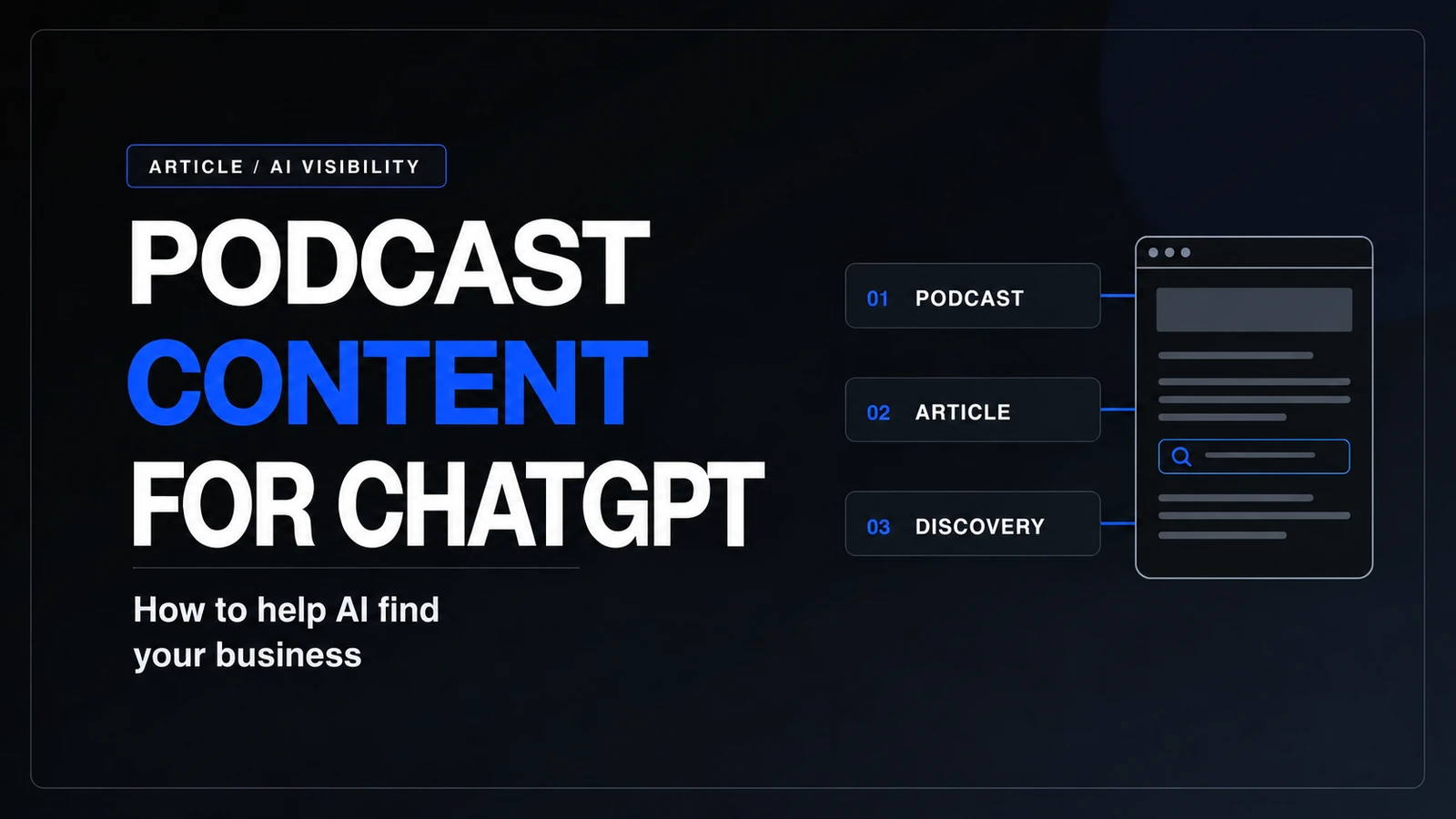
If you want to get your business found by ChatGPT, you need to publish useful answers to the questions your business knows how to answer.
A podcast is one of the most practical ways to do that.
Every episode gives you an opportunity to answer a real customer question, explain what you know in your own words, and publish that expertise under your name and business.
But recording the podcast is only the first step.
If you upload an audio episode to Spotify, publish the video on YouTube, write a two-sentence description, and move on, much of the value may remain buried inside the recording.
The episode also needs a useful page on your website. It needs a clear title, a strong written explanation, and an accurate transcript or detailed written version. It also needs enough context for people and AI systems to understand who is speaking, what the episode is about, and how it connects to your business.
That is the basic strategy.
Answer a question your customers already ask. Record it, publish it in formats people and machines can understand, and connect it to the rest of your expertise. Then watch whether your business begins appearing around that subject in ChatGPT, Google AI Overviews, Gemini, Perplexity, and traditional search results.
AI visibility is how easily tools like ChatGPT, Google AI Overviews, Gemini, and Perplexity can find, understand, and potentially show your business or expertise when someone asks a relevant question.
This cannot guarantee a citation or recommendation, but it gives these platforms more useful, accurate, first-party information to find and potentially use.
Key Takeaways
- A podcast can help your business get found by ChatGPT by putting your real expertise online in a useful, searchable format.
- Publishing the recording alone is not enough. Important episodes should also have dedicated pages on your website with meaningful written content.
- Clear titles, detailed explanations, accurate transcripts, and consistent information help people and machines understand what your business knows.
- Related episodes, articles, videos, and business pages should connect naturally instead of existing as isolated pieces of content.
- AI visibility should be measured across meaningful customer questions over time, not judged by one ChatGPT response or screenshot.
Can a Podcast Actually Help Your Business Show Up in ChatGPT?
Yes, but not simply because it is a podcast.
The value comes from the expertise inside the episode and how that expertise is published online.
ChatGPT does not sit in your sales meetings, listen to your customer calls, or hear the answers your team gives people every day. When ChatGPT searches the web for a current answer, it can only use information available through sources it can access.
For example, a financial advisor may explain what to consider before selling a company, while a roofer explains whether a damaged roof needs repair or replacement.
Those answers demonstrate real expertise, but private conversations disappear when they end.
A podcast captures those answers in a form that can keep working.
The next step is making sure the information does not remain trapped inside the recording.
Why Publishing the Podcast Alone Is Not Enough
Imagine someone records a useful episode, uploads it to podcast platforms and YouTube, then gives it a vague title and description.
Existing followers may listen, but people searching for the answer may never realize the episode contains what they need.
ChatGPT and other AI systems may encounter the same problem. The answer exists, but the title and surrounding information do not clearly explain what the episode covers.
Compare these two titles:
Some Thoughts on Retirement Planning
What Should a Business Owner Do Financially Before Selling a Company?
The second title immediately identifies the person the episode is for, the situation they are facing, and the question being answered.
That clarity matters everywhere the episode appears.
It matters on your website, YouTube, your podcast feed, and in Google search results.
It also matters when AI systems are trying to understand whether your content is relevant to someone’s question.
Clever titles can be memorable. Clear titles are findable.
Start With Questions Your Customers Are Already Asking
A strong business podcast should not begin with, “What should we post this week?”
Start with the customer.
What are they trying to understand?
What are they comparing?
What usually confuses them?
What do they ask before they hire someone?
What mistakes are they trying to avoid?
What question comes up during almost every sales call?
These are also the types of questions people bring to ChatGPT and Google.
Someone may ask ChatGPT:
- How do I know whether my roof needs to be replaced?
- What should I look for when choosing a financial advisor?
- What should a manufacturer consider before automating a production line?
- How long does it take to sell a business?
- What questions should I ask before hiring a marketing company?
If your business has a useful answer, that answer can become a podcast episode.
This does not mean finding a popular phrase and forcing an episode around it. The question still needs to matter to the audience and connect to something the business genuinely understands.
Human expertise comes first.
The search behavior helps you decide which parts of that expertise may be most useful to publish.
Turn Every Important Episode Into a Useful Website Page
YouTube, Spotify, and Apple Podcasts are important distribution channels. But your business should also have a first-party home for its most valuable episodes.
That means publishing a dedicated episode page on a website you control.
A useful episode page should quickly help someone understand:
- What question the episode answers
- Who is providing the answer
- What the person or business knows about the subject
- What the reader or viewer will learn
- Where to watch or listen
- Where to find the complete written information
- Which related resource may help them next
The page does not need to be complicated.
It could include the embedded video, a direct introduction, five key takeaways, several descriptive sections, an accurate transcript, relevant internal links, and clear information about the person or business behind the content.
Write enough to answer the question clearly, not to hit an arbitrary word count.
The better question is:
Does this page contain enough useful information for someone to understand the answer without having to guess what the episode is about?
If the answer is no, the page probably needs more than a video player and two sentences.
Transcripts Help, but They Are Not the Entire Strategy
A transcript makes an episode searchable, skimmable, quotable, and more accessible. It also gives the website page a written record of the discussion.
But a raw transcript should not be confused with a complete episode page.
Automatic transcription software can misspell names, confuse technical terms, misidentify companies, or create walls of text that are miserable to read.
Long sections should be separated into reasonable paragraphs. Speaker names should be accurate. Important topic changes can be organized under descriptive headings without changing what the person said.
For many episodes, the most useful approach is to provide both:
- A clear written explanation for someone who wants the answer quickly
- The complete transcript for someone who wants the full depth of the conversation
The written explanation gives the reader a direct path through the subject. The transcript preserves the detail, language, and context from the original episode.
Make It Obvious Who Is Behind the Answer
Getting information found is only part of the opportunity.
The information also needs to connect back to the right person and business.
An episode page should make the basics clear:
- The name of the show
- The episode title
- The host or participating expert
- The company connected to the content
- The publication date
- The main subject
- The video or audio episode
- The author of the written page
Businesses are often inconsistent across their website, YouTube channel, podcast platforms, social profiles, and business listings. Company names, titles, and roles may change from one platform to another, making it harder to connect an answer to the right source.
Clear, accurate, and consistent information makes it easier for people to understand the source. It also reduces ambiguity for search engines and AI systems trying to connect the content with the person or business behind it.
Structured data can reinforce this by describing the page, author, video, and other visible details in a standardized way. It should match what readers can already see.
Connect the Episode to the Rest of What Your Business Knows
One strong podcast episode can answer one important question.
A connected library can show the larger picture of what your business knows.
Suppose a financial advisor publishes an episode about preparing financially before selling a business.
That episode may naturally connect to:
- Another episode about taxes after a business sale
- An article about determining how much money someone needs to retire
- A page explaining how the firm works with business owners
- A video about common financial mistakes after a major liquidity event
- A biography showing the advisor’s relevant experience
Those links help a reader continue learning.
They also help search engines discover related pages and understand how the subjects connect.
Google recommends using internal links to help people and Google make sense of a website. It also says there is no magical ideal number of links a page should contain.
Add them when they help the reader understand the subject, answer a related question, or reach the next useful resource.
The goal is a connected body of expertise that makes sense as someone moves from one question, episode, or page to the next.
ChatGPT Is the Entry Point, but It Is Not the Only Opportunity
This article focuses on ChatGPT because that is where many business owners are beginning the conversation.
They want to know why their company is not appearing when someone asks for advice, compares providers, researches a problem, or requests a recommendation.
But the same work can support visibility beyond ChatGPT.
Google AI Overviews, Gemini, Perplexity, YouTube, and traditional search all offer additional ways for useful podcast content to be discovered.
Traditional Google search still matters because many of the fundamentals that help a webpage get crawled, indexed, and understood also support its eligibility for Google’s AI features.
Google says there are no additional technical requirements or special AI optimizations needed to appear in AI Overviews or AI Mode. Its existing recommendations still apply, including allowing crawling, making important content available in text, using helpful internal links, and ensuring structured information matches the visible page.
OpenAI also says that public websites can appear in ChatGPT search. Publishers who want their content available for summaries and snippets should make sure they are not blocking OpenAI’s search crawler.
You do not need to become an expert in every crawler. The larger point is simple: useful business information must be online in forms these platforms can access and understand.
Do Not Turn One Human Episode Into Fifty Pieces of AI Sludge
A good idea can go bad when a business turns one thoughtful episode into dozens of generic AI-generated articles, captions, summaries, and posts. More content does not automatically mean more useful content.
The value comes from the person’s experience, judgment, stories, examples, and ability to explain what they genuinely understand.
AI can help organize a transcript, support research, identify themes, create a first draft, or adapt an idea for another format.
Someone still needs to decide what is accurate, useful, relevant, and worth publishing.
My philosophy is simple: AI should support the content, not become the content. Use it to get more value from real expertise without stripping away the voice and judgment that made the original answer useful.
How Do You Know Whether the Strategy Is Working?
Publishing the content is not the end.
You also need to look at what happens after it goes online.
Look for meaningful signals: whether your business appears for relevant questions, whether AI platforms describe it accurately, whether your content appears as a source, how competitors compare, and whether people arrive from ChatGPT, Perplexity, Google, YouTube, or other platforms.
Do not judge the strategy by one result or a search for your company’s name. One screenshot is an observation; repeated visibility across meaningful customer questions begins to show a pattern.
I experienced the potential of this firsthand when one of my podcast episodes ranked first organically on Google for its exact topic and was cited by AI within 19 hours of publication.
That was meaningful, but it does not prove every episode will perform the same way or that one isolated change caused the result.
The episode had a focused subject, a clear title, a dedicated webpage, useful written information, and connections to content I had already published.
Where Podcast-Powered AI Visibility™ Fits
This broader idea is the foundation of the system I created, Podcast-Powered AI Visibility™.
At a high level, the system captures genuine human expertise through podcasting and turns it into searchable, connected content that people, search engines, and AI platforms can understand. The podcast is the source; AI visibility is the objective.
Podcast-Powered AI Visibility™ does not guarantee that any platform will cite or recommend a business. It is designed to improve the quality, clarity, structure, accessibility, and connectedness of the business’s information, then observe how visibility changes over time.
What Should You Do First?
Do not begin with a hundred-episode plan.
Begin with one important customer question.
Choose something your business understands well and your customers genuinely need help with.
Record a focused answer that includes your experience, examples, and point of view.
Give the episode a title that clearly explains the question.
Publish it on YouTube and the appropriate podcast platforms with accurate titles and descriptions.
Create a dedicated page on your website with the episode, a useful written explanation, exactly five key takeaways, descriptive headings, and an accurate transcript or detailed written version.
Connect it to a few genuinely relevant pages or episodes.
Make sure the page is available to search engines and AI search crawlers.
After publishing, monitor whether the content appears around the questions it answers and how AI platforms describe the subject and your business. Record what you observe without exaggerating what it proves, then use those findings to improve the next episode.
That is how a podcast becomes a growing library of real expertise that can help your business become easier to find, understand, trust, and potentially recommend.
Related Posts
October 14, 2026
PlayAI agents are changing what happens after AI finds your business. AI visibility gets your company into the conversation, while agentic visibility is about whether an agent can understand what you offer, evaluate your fit, compare you with other options, and take the next step toward doing business with you.
In this episode, I break down what that means for B2B companies and marketing teams as AI agents research providers, evaluate expertise, gather information, compare options, and take action. Being found or recommended by AI is still important, but that alone does not mean an agent has enough information to evaluate your company or know what to do next.
Your website and content are a big part of that. I walk through what an agent may need to understand about your business, why a website that works for people may still create problems for agents, and why getting more of your real expertise online matters beyond simply getting mentioned in an AI answer.
Key Takeaways
Episode 288 Timestamps
00:00 Agentic Visibility: What Happens After AI Finds Your Business?
01:30 Observing, testing, measuring AI agents
02:19 AI agents are moving from answers to actions
03:18 AI Visibility vs. Agentic Visibility
04:14 How AI agents evaluate businesses and providers
05:25 Can an AI agent understand your business?
06:42 Where does content fit into agentic visibility and why is it important?
08:00 How do agents experience your website and business online?
09:05 Business owners and marketing teams: where to start
Full Episode Transcript
What Is Agentic Visibility?
Agentic visibility is about what happens after AI finds your business. Can an agent understand what you offer, evaluate whether you fit its assignment, compare you with other options, and move toward the appropriate next action?
AI visibility gets your business into the conversation. But when someone sends an AI agent to research companies and compare options, being visible is only the starting point. The agent still needs to figure out what you provide, whether you’re a good fit, and how to take the next step with your company.
I’ve been spending a lot of time observing, testing, and measuring how AI systems and agents interact with businesses online. I’ve built multiple smaller products to learn how machines interact with other machines, and that work has expanded into a larger system we’re preparing to test more broadly.
I’m not ready to fully break that system down yet. But working directly on this has changed how I think about AI visibility. The question is no longer only whether an AI platform can mention your company in an answer. It’s what happens next.
How Is Agentic Visibility Different From AI Visibility?
AI visibility asks whether AI can find your business, understand what it does, connect it to a relevant question, and potentially cite or recommend it. Agentic visibility asks whether an agent can use that understanding to evaluate your company and move toward the next action.
AI visibility is still the foundation. If your business never enters the conversation, an agent has no opportunity to consider it. Agentic visibility takes that foundation further: can the agent determine whether your business fits the assignment and understand how it compares with other options?
The next action depends on the business. It might be buying a product. For a B2B company, it could mean gathering information, comparing providers, identifying the correct contact, requesting a proposal, preparing a shortlist, or reaching the point where a meeting can be booked.
AI visibility gets the business considered. Agentic visibility helps determine whether the agent can evaluate the business and successfully move toward the appropriate next action.
What Can AI Agents Do After They Find Your Business?
AI agents can research a problem, compare companies, gather information, prepare recommendations, and, when properly authorized and capable, take the next action. That does not mean every agent can reliably complete every assignment.
The larger shift is from answering a question to working toward an objective. Research this problem. Compare these companies. Find the best option. Collect the necessary information. Prepare a recommendation. Those are assignments that require more than producing a single answer.
Some agents have access to computers, browsers, connected applications, identities, and permissions. Businesses also have ways to expose structured capabilities, so an agent does not always have to rely entirely on the same page-clicking experience a person uses.
The specific products will continue to change. The direction is what matters. Some agents can complete a particular assignment today and some can’t. Businesses should pay attention to what agents need from them as those capabilities improve.
How Do AI Agents Compare and Evaluate Businesses?
An agent needs clear information about what each company provides, whom it helps, how its approach differs, what supports its claims, what working together involves, and what should happen next. That information helps it evaluate whether a provider fits the assignment.
Let’s say a marketing executive gives an AI agent this assignment: find three companies that could help us improve our AI visibility. Determine which ones work with businesses like ours, compare their approaches, identify useful proof, and recommend who we should contact.
The agent now has to understand the actual offer. Is it software, consulting, managed services, content production, or some combination? Who is it designed for? What makes the approach different? Are there examples, evidence, or useful explanations that support the company’s claims?
It also needs information about the process, pricing and capabilities where available, and the right next step. If it cannot confidently understand one company, it may recommend another whose information is clearer, more complete, and easier to use.
What Does “Doing Business” Mean for AI Agents in B2B?
Doing business does not necessarily mean an agent signs a contract or completes a purchase. In B2B, it can mean researching providers, comparing options, preparing a shortlist, identifying the right contact, requesting a proposal, or reaching the point where a meeting can be booked.
In the marketing executive example, the agent may not be authorized to hire a company or sign an agreement. But it could still complete much of the research, evaluate the available options, and identify the right next step for the executive.
That’s already a big part of doing business. The relevant question is whether the agent can move the assignment forward using the information your company makes available, within its capabilities and the permissions it has been given.
Can AI Agents Understand and Use Your Website?
An agent needs clear business information, accessible expertise, useful evidence, and a clear path forward. A website that a person can navigate may still leave an agent unable to distinguish your services, evaluate your fit, or identify the correct next step without assumptions.
Imagine an agent has never heard of your company and has one assignment: determine whether this company is the right fit and explain exactly what should happen next. How far could it get?
Could it explain what your business does and who your services are designed for? If you offer several services, could it distinguish between them? Could it find evidence that supports your claims and information about your approach, process, pricing, capabilities, and locations?
A human might click through several pages, interpret vague marketing language, open a PDF, watch a video, and eventually call someone when an answer is still unclear. An agent comparing several companies may simply move to the next option.
That’s why a website being usable for a person is not necessarily the same as the business being usable by an agent. The information and the path forward both need to be clear.
Why Does Your Content Matter to AI Agents?
An agent cannot properly evaluate expertise that never makes it online. Your content gives it something useful to work with: how you approach problems, who you’re suited to help, what supports your claims, and how your business compares with another provider.
If your website only contains a few generic service descriptions, it may not explain your actual approach. And if you never explain who you’re best suited to help, an agent has less information to judge whether your company fits the assignment.
That’s one reason a recurring video podcast can be useful. Each episode gives you a place to focus on one core idea and answer the related questions needed to explain it clearly. One episode might cover your approach to a problem. Another might cover pricing, comparisons, common mistakes, or what changes the final recommendation.
That source material can then be rewritten, organized, and structured for both humans and machines. The podcast captures the knowledge. The connected content and intelligence system helps people and AI understand your business. Agentic visibility asks whether an agent can then use that understanding to evaluate the company and move toward the next action.
That’s also part of what we’re testing through the larger system we’re building. The goal is to help a business see where an agent succeeds, where it struggles, and what may be preventing it from properly understanding and interacting with the business. I’ll share more once it’s ready for people to use.
How Can You Test Your Business for Agentic Visibility?
Start by reviewing your website, social channels, and other published content from an agent’s perspective. Give it one assignment: determine whether this business is the right fit and explain what should happen next.
Could it accurately explain what you do, who you help, why you’re relevant, and what supports that conclusion? Could it reach the correct next step without getting lost or making assumptions?
Being found and recommended by AI still matters. But the next competitive advantage may belong to businesses that AI systems and agents can find, understand, evaluate, trust, and ultimately transact with.
If this episode was useful, send it to a business owner or someone on your marketing team who’s asking for more content without being able to explain what that content should accomplish or how it can be made available to AI platforms and agents.
If you have a question for me, leave a comment, send me a DM on Instagram @billcorcoranjr, or drop me a line at BillCorcoranJr.com.
Related Episodes About AI Visibility
10 Questions About How to Get Your Business Found and Recommended by AI | Ep.287
Start with the AI visibility foundation: what it means to be found, cited, or recommended, how useful content helps, and what businesses can actually control.
Read next: 10 Questions About How to Get Your Business Found and Recommended by AI | Ep.287
Why Your Business Isn’t Showing Up in ChatGPT (3 Reasons) | Ep.286
Explore the clarity, expertise, and relevance gaps that can make a business difficult for AI to discover and understand before an agent can evaluate it.
Read next: Why Your Business Isn’t Showing Up in ChatGPT (3 Reasons) | Ep.286
How to Measure AI Visibility: Are You Getting Found by AI or Are Your Competitors? | Ep.285
Connect visibility to meaningful customer questions and competitor comparisons. Learn why repeated observations are more useful than one screenshot.
Read next: How to Measure AI Visibility: Are You Getting Found by AI or Are Your Competitors? | Ep.285
What Is Podcast-Powered AI Visibility™ and How Can It Help Grow Your Business?
See how a recurring video podcast captures real business expertise and turns it into structured, connected content that people and AI can understand.
Read next: What Is Podcast-Powered AI Visibility™ and How Can It Help Grow Your Business?
October 14, 2026
PlayIf you’re a business owner or part of a marketing team trying to figure out how to get your business found and recommended by AI, this episode answers 10 of the questions I hear most often about AI visibility. I break down what AI visibility actually means, what helps, how to measure it, what type of content works, where SEO fits, and what nobody can honestly guarantee.
I also explain the difference between an AI platform simply knowing your company exists and actually finding, citing, comparing, or recommending it when someone asks a relevant question. Those are different outcomes, and understanding that difference changes how you should think about content, search, and AI visibility.
More importantly, I explain what businesses can actually control if they want to improve their chances of being found, understood, cited, and recommended more consistently over time. The goal is not to chase one lucky citation or publish more content just for the sake of publishing. It is to make your real expertise clear, useful, publicly available, connected to the questions customers are already asking, and measurable over time.
10 Common AI Visibility Questions for Business Owners and Marketing Teams
- What does AI visibility actually mean?
- How do I help ChatGPT and other AI platforms find my business?
- How is AI visibility different from SEO?
- Where do AEO and GEO fit into AI visibility?
- Why does AI know my company’s name but not recommend it?
- How can I tell whether my AI visibility is improving?
- Will publishing more content help me get found by AI?
- What is Podcast-Powered AI Visibility™ and how does it work?
- How long does improvement take?
- Can anyone guarantee AI citations or recommendations?
Episode 287 Timestamps
00:00 Getting found by AI
01:57 What does AI visibility actually mean?
03:10 How do I help ChatGPT and other AI platforms find my business?
04:43 How is AI visibility different from SEO?
05:54 Where do AEO and GEO fit into AI visibility?
07:28 Why does AI know my company’s name but not recommend it?
09:31 How can I tell whether my AI visibility is improving?
11:45 Will publishing more content help me get found by AI?
13:38 What is Podcast-Powered AI Visibility™ and how does it work?
15:28 How long does improvement take?
17:09 Can anyone guarantee AI citations or recommendations?
18:28 Business owners & marketing teams: Where to start
Related Episodes About AI Visibility
Why Your Business Isn’t Showing Up in ChatGPT (3 Reasons) | Ep.286
A legitimate business can have years of experience and still be difficult for ChatGPT to find or understand. This episode explains three common gaps: unclear business information, expertise that is not visible enough online, and content that does not answer the questions customers are asking.
Read next: Why Your Business Isn’t Showing Up in ChatGPT (3 Reasons) | Ep.286
How to Measure AI Visibility: Are You Getting Found by AI or Are Your Competitors? | Ep.285
Learn how to evaluate your visibility across meaningful customer questions, compare what appears for competitors, and distinguish company-name recognition from independent discovery. This episode explains how repeated checks reveal patterns that one screenshot or lucky result cannot establish.
Read next: How to Measure AI Visibility: Are You Getting Found by AI or Are Your Competitors? | Ep.285
What Is Podcast-Powered AI Visibility™ and How Can It Help Grow Your Business?
This episode introduces Podcast-Powered AI Visibility™ and explains how a recurring video podcast captures real business expertise. See how that knowledge becomes structured, searchable, connected content that helps Google and AI platforms understand what a business does and where its expertise applies.
Read next: What Is Podcast-Powered AI Visibility™ and How Can It Help Grow Your Business?
How My Podcast Ranked #1 on Google and Got Cited by AI in Less Than 24 Hours
Walk through a documented example of focused expertise becoming structured, searchable, connected content, followed by measurement after publication. The results describe what happened in this specific example. They do not guarantee that another episode or business will produce the same result.
Read next: How My Podcast Ranked #1 on Google and Got Cited by AI in Less Than 24 Hours
5 Ways to Get Your Business Found in AI Search Results
Explore practical ways to make your business and its expertise easier for ChatGPT, Google’s AI experiences, Gemini, Perplexity, and other AI and search platforms to find and understand. This episode connects useful answers, clear content, and consistent business information to the questions potential customers bring online.
Read next: 5 Ways to Get Your Business Found in AI Search Results
Full Episode Transcript
In Episode 286, I covered three reasons your business might not be showing up in ChatGPT. For this episode, I want to zoom out a little and answer the bigger questions people keep asking about AI visibility.
Because you shouldn’t have to work in AI, SEO, or tech to understand what any of this actually means for your business.
What Does AI Visibility Actually Mean?
AI visibility is how your business appears and is represented when someone uses an AI platform to research a problem, compare options, or decide whom to hire. A mention, a citation, an accurate description, a comparison, and a recommendation are different outcomes.
But “showing up” can mean different things. Maybe an answer mentions your company. Maybe it cites an article you published. Maybe it includes you in a comparison. Or maybe it recommends your business for a particular need. Those are all completely different outcomes, and it matters which one we’re talking about.
Let’s say you run a commercial cleaning business. AI might correctly identify your name and website. That’s useful. But if it describes you as a residential house cleaner, it has the wrong picture of your business. Or it might cite your explanation of how medical offices should evaluate cleaning providers, without actually recommending your company.
So when I talk about getting your business found by AI, I’m also asking whether the information is accurate, whether you appear for relevant questions, and what role you play in that answer. Your podcast and the content developed from it can help explain those details: what you know, who you help, and where your experience applies.
The objective is useful, accurate visibility around the work you actually do.
How Do I Help ChatGPT and Other AI Platforms Find My Business?
Make clear, current information about your business publicly available, then answer the questions customers ask before they hire you. Explain what you do, whom you serve, where you work, and which problems you solve.
Your business profiles online and other public information should agree with that explanation. Then look at the questions people ask before they hire you. A commercial cleaning company could explain how to compare proposals, what changes the price, or more specifically, what to ask about cleaning a medical office. Those answers reveal much more than “We deliver exceptional service.”
This is where original expertise becomes very useful content. As a business owner, you can use a podcast to explain these answers at scale. Then repurpose each episode as a useful page on your website with supporting content that points people toward the full explanation. Give those pieces clear titles, connect related pages, and make it ultra clear who provided the information.
Don’t forget to keep your services, locations, and contact details current. Those little details matter more than you think and a lot of people tend to overlook them. Credible references from other organizations can also support the bigger picture, whether that’s an industry association, relevant coverage, or a customer describing their actual experience with your business.
If you need a manageable starting point, choose one important customer question. Check whether your website already answers it properly. If it doesn’t, start there.
How Is AI Visibility Different From SEO?
SEO helps search engines find, understand, and rank pages in traditional search. AI visibility also asks what happens inside an AI-generated answer: whether your business is mentioned, described accurately, cited, compared, or recommended.
There’s a lot of overlap here and strong SEO still matters. An AI search experience may use a web search to find information. And if your useful content is difficult to access, poorly organized, or unclear, that can limit its usefulness in that process. Think about a podcast episode on choosing a commercial cleaning provider.
Traditional search might display the episode page as a result someone can click. An AI answer from ChatGPT might draw on the explanation from within that page and include a citation, or it might use other sources entirely. Ranking well for a search doesn’t guarantee that the page will be selected for an AI answer.
And an AI citation doesn’t automatically mean your business has been recommended. For a marketing team, the practical move is to keep the search foundation strong while also checking how the company and its expertise appear in AI-generated answers. You don’t have to throw away your existing SEO work to start taking AI visibility more seriously, you just build on top of it.
Where Do AEO and GEO Fit Into AI Visibility?
AEO, or answer engine optimization, emphasizes content that clearly answers a question. GEO, or generative engine optimization, focuses on whether a business and its content appear or are used in AI-generated answers. Both overlap with SEO and with the broader goal of AI visibility.
These two terms overlap with each other and with SEO. People don’t always use them in exactly the same way, so I wouldn’t treat them as three separate switches you turn on, and you definitely shouldn’t focus on just one or two of the three. You need to continuously work on all three. Here’s how they can relate to a podcast episode.
You record a useful explanation of what affects the cost of your service. You publish it on a page that search engines can access. The page has a clear question, a direct answer, and multiple supporting details that actually make the answer meaningful. Then you evaluate whether that information is appearing in relevant search and AI responses. That’s a practical connection between the terms.
You don’t need to memorize every acronym or become some SEO or AI visibility expert, but you do need to understand what someone is proposing to change and why. If the explanation stops at “We’re doing GEO,” ask what that actually means for your content, your website, and the way results will be evaluated.
Why Does AI Know My Company’s Name But Not Recommend It?
Recognizing a company when you ask for it by name is different from finding it as a relevant match for an unbranded customer question. A recommendation depends on the specific need and on what the available information actually supports.
When you ask AI about your company by name, you’ve already told it which company to look for. You gave AI the company name instead of seeing whether it would find your company on its own. But imagine a dentist asking, “Which commercial cleaning companies in Wilkes-Barre clean dental offices after hours, so the office is ready before patients arrive the next morning?”
Now that question is about a specific service, for a specific business, in a specific location, with a specific scheduling requirement. Your cleaning company might offer exactly that. But if your website only says “commercial cleaning services,” it doesn’t explain that you serve dental offices in Wilkes-Barre or offer your cleaning service after hours when patients aren’t there.
This is why I care about the substance of your content. If your company actually does that work, explain it. Now take it a step further. What does your team clean in a dental office? What is included in the cleaning agreement, and what remains the dental staff’s responsibility?
How do you arrange access to the dental office after closing and finish your work before the first appointment the following day? A podcast episode can walk through those questions using an actual example you have permission to share.
Then you take that episode and you write a detailed supporting article on your website that can explain the services, the area you cover, and the scheduling options through the answers to all of those questions. Now publishing those details doesn’t guarantee AI will automatically recommend your cleaning company. But it gives AI specific information connecting your services to what that dentist is asking for.
So ask yourself: does your published information show that you clean dental offices in Wilkes-Barre and can accommodate their after-hours schedule? AI recognizing your company name alone doesn’t tell you that.
How Can I Tell Whether My AI Visibility Is Improving?
Document a baseline for customer questions that do not contain your company name, then repeat the same checks under similar conditions over time. Record the exact question, platform, date, answer, and whether you were mentioned, cited, accurately described, or recommended.
Let’s stay with the cleaning company example. You could test something like, “Which companies clean dental offices after hours in Wilkes-Barre?” Then test related questions about comparing dental office cleaning services or choosing a cleaning provider. Keep a detailed record of the exact questions, the platform, the date, and the response. So what you’re gonna do is look at things like…Did your company appear?
Which competitors appeared? Did the answer link to your website or cite an article developed from your podcast? Did it correctly describe your services and the area you cover? Those details matter. AI mentioning your company, citing your content, and recommending your service are three different results. And make sure to keep the search platforms separate.
If Google’s AI Mode cites your article or a podcast episode, record that as a Google AI Mode citation. It doesn’t tell you whether ChatGPT is recommending your company. Then repeat those same questions under similar conditions and document what you changed between those checks to determine if what you changed actually made a difference.
Maybe you published a podcast episode answering a few of those questions, added a supporting article, or corrected some outdated service information on your website. Now compare those results to where you started. Are you appearing more consistently? Is the information more accurate? Are you showing up for relevant questions where only competitors appeared before?
One screenshot records one result. Repeated checks help you understand whether there’s a pattern. A change after publication is worth tracking, but timing alone doesn’t fully prove your content caused it. The purpose is to use what you learn to decide which answers to improve, which topics to cover next, and where your business still needs stronger information online.
That’s just the quick overview, but I did a whole episode on measuring AI visibility and seeing how you stack up against your competitors in episode 285. If you wanna learn more about what to track and what those results actually mean, go check that one out.
Will Publishing More Content Help Me Get Found by AI?
It can help when new content answers a useful question or adds original expertise. More versions of the same generic advice do not automatically make a business more visible or authoritative.
So before creating more content, ask if what you’re about to create actually adds more value, but more specifically, is the content you’re creating actually original knowledge? What I mean by that is, does it show how you approach a problem? Does it challenge or correct something people commonly misunderstand?
Are you giving real world examples of what you do, how you do it, and who it helps? That’s why a video podcast can significantly improve your AI visibility because it gives the person with the expertise a regular opportunity to explain those things.
One episode might cover what affects pricing, another might explain how to compare providers, and another could walk through a real situation and what changed the recommendation. Those are related subjects, but each has a different purpose. AI can help organize that material, but the business’s knowledge needs to remain at the center.
My philosophy on AI is simple: AI should support the content, not become the content. So don’t publish more just for the sake of publishing more. Focus on consistently turning what your business actually knows into useful content that gives people and AI something specific to understand, cite, and use.
What Is Podcast-Powered AI Visibility™ and How Does It Work?
Podcast-Powered AI Visibility™ is the system I created to turn a business’s existing expertise into connected content that can improve how it is found, understood, cited, and potentially recommended by AI. The podcast captures the knowledge; AI visibility is the objective.
The problem is, most of your business expertise never makes it online. It stays trapped in sales calls, internal meetings, emails, everyday conversations, or in the heads of the people doing the actual work. So the first step is getting that knowledge out of those conversations and into a format we can actually build from. That’s where the recurring, solo-hosted video podcast comes in.
Each episode focuses on one core idea and answers however many related questions are needed to explain it clearly. From there, we turn that episode into connected content, including an episode page, website and LinkedIn articles, shorter videos, email newsletters, social content, and more. But we’re not just copying and pasting the exact same content everywhere. That isn’t real repurposing.
Real repurposing means keeping the original core idea intact, but rewriting, reorganizing, and reformatting it to fit each platform in a way that both humans and robots can clearly understand. A podcast episode transcript, a website article, a LinkedIn article, and a short video should not all look or sound exactly the same.
Each one should make the core idea useful in a different way while staying connected to the original topic of the episode itself. From there, we track where and how accurately the business appears across relevant AI platforms, then use those results to identify gaps, strengthen content, and decide what the business should do next. The podcast is the source. AI visibility is the objective.
How Long Does Improvement Take?
There is no reliable timeline that applies to every business. Starting position, website quality, existing public information, competition, and the questions being tested all affect what changes and when.
A business with clear positioning and a useful website may have a different starting point from one with outdated information and very little published expertise. Some early changes can happen quickly though if the content is done right. I’ve shared a bunch of examples from my own podcast and other client work where we observed AI citations within twenty-four hours of publication.
That’s an observation from those examples. It isn’t a twenty-four-hour promise for the next episode or the next business. The more useful question is whether relevant visibility becomes stronger and more consistent over time. If an episode gets cited once, document it. Then check again. Does it continue to appear? Does the answer remain accurate? Are you appearing for other relevant questions?
There’s a lot more to look at here. That’s why a baseline matters. You need to know where you started before you can judge what changed or if it changed.
So yes, early movement can happen within twenty-four hours, but building stronger, more consistent AI visibility may take a few months, and in some cases several months, depending on your starting point and the quality and consistency of the content being published. AI Visibility isn’t a one-and-done type thing.
AI platforms, search results, competitors, and the information available online are constantly changing, which is why improving your visibility requires consistent publishing and ongoing measurement.
Can Anyone Guarantee AI Citations or Recommendations?
No company can honestly guarantee that an independent AI platform will cite or recommend your business in a particular answer. What you can control is the quality, clarity, accuracy, accessibility, and relevance of the information you publish.
But what we can control is the work that gives your business a better opportunity to be found and accurately represented. That means making sure your information is clear, accurate, and easy to access.
It means bringing more of your real expertise online, publishing useful content around the questions your customers are asking, connecting that content back to your business, and measuring what happens over time.
Podcast content can be a big part of that because it gives you a consistent way to capture what you know and turn it into useful information across your website, YouTube, LinkedIn, and other platforms.
If you hire someone to help with AI visibility, you should understand what they’re creating, which questions and platforms they’re testing, how they’re measuring progress, and what they’ll adjust when something isn’t working. The goal isn’t one exciting screenshot or one lucky citation.
The goal is to build a stronger, clearer connected body of information that improves your chances of being found, cited, and recommended more consistently over time.
Where Should Business Owners and Marketing Teams Start With AI Visibility?
So if you’re a business owner or part of a marketing team, here’s where I’d start. Identify three or four pillar topics that sit at the center of what your business does and what you want to be known for. Then list the questions your customers ask around each one. Look at what your business already says about those topics online.
Is the information clear, accurate, and specific? Does it reflect what you actually know, or is most of that expertise still missing? That gives you a practical starting point and a much better content plan than publishing random topics just to stay active.
That’s also what makes a podcast so useful: it gives you a consistent way to turn those pillar topics into connected content that helps AI understand what your business knows and where it’s relevant. And if you want to evaluate where your business stands today, go to the free AI Visibility Assessment.
No sign up required and it literally only takes 3 minutes to complete. You already have the knowledge. Now it’s about making sure AI can find it, understand it, and connect it to the people looking for it.
October 14, 2026
Article / AI Visibility10 min readBill Corcoran Jr.September 21, 2026
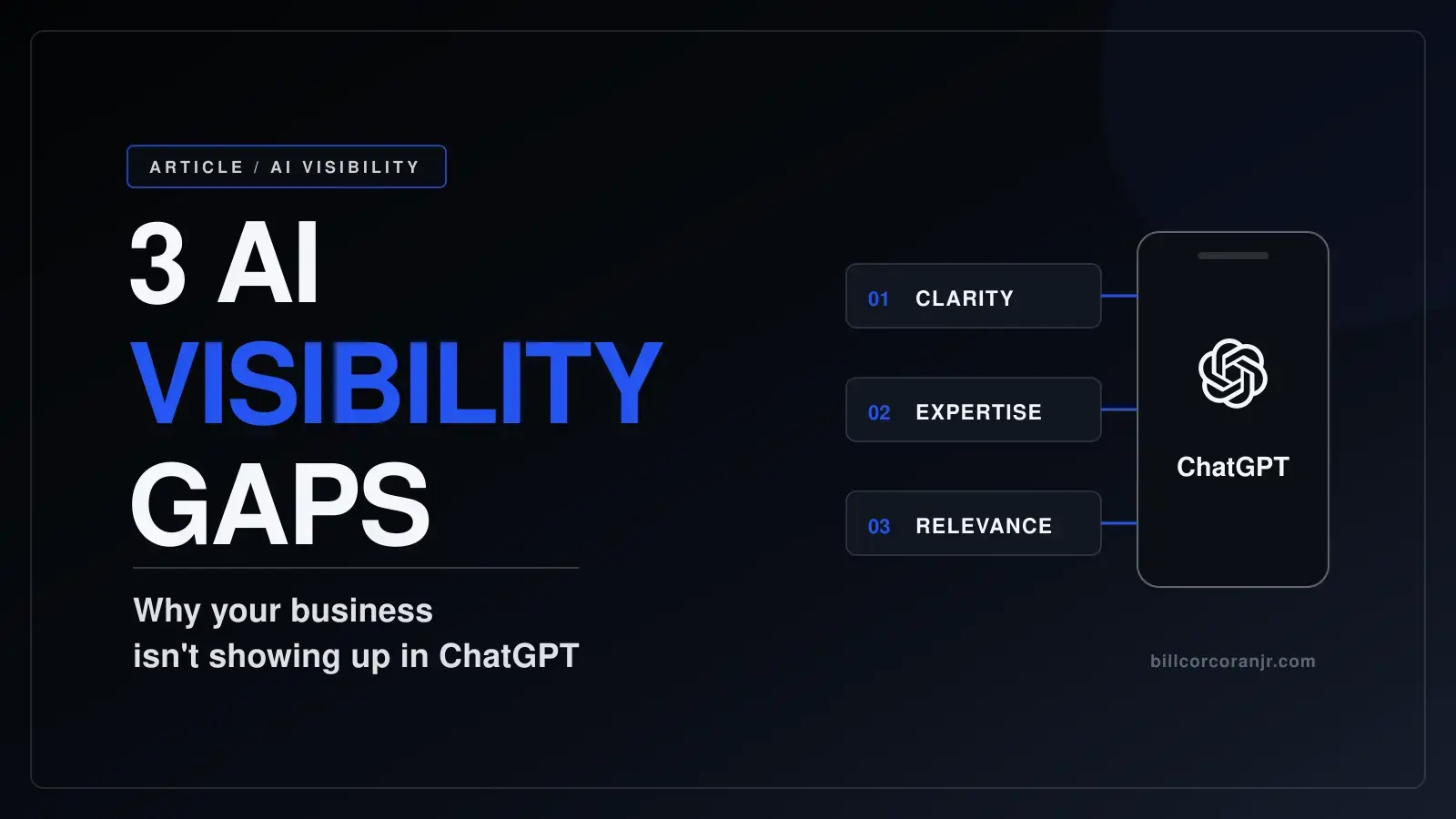
If your business isn’t showing up in ChatGPT, one or more of three visibility gaps may be getting in the way: ChatGPT cannot clearly understand what your company does, find enough public evidence of your expertise, or connect your business to the questions your customers are asking.
Those are three different problems, and each one requires a different fix. That is why publishing more content is not automatically the answer.
Technical problems can also limit visibility, and I cover those later in this article. But if your website is accessible, these three gaps are the right place to start.
What Does It Mean for a Business to Show Up in ChatGPT?
Showing up in ChatGPT can mean several different things.
ChatGPT might know your company exists when someone searches for it by name. It might use something you published as a source. It could describe your business accurately, include it while comparing possible solutions, or recommend it for a particular situation.
Those are related, but they are not the same.
The more important test is not whether ChatGPT recognizes your business after someone types its name. It is whether your business becomes part of the answer when people ask about the problems you solve, the topics you understand, and the decisions you help customers make.
There is no single switch that adds a business to every ChatGPT answer. Results can change based on the exact question, the context of the conversation, the information available online, and whether ChatGPT searches the web. OpenAI also says placement in its search results is not guaranteed.
If your business is consistently missing, start by looking at these three areas.
Reason 1: ChatGPT Does Not Clearly Understand What Your Business Does
You understand your business because you live inside it every day. Your employees understand it. Your customers and referral partners probably do too.
Someone encountering the company for the first time only has the information you have made public. ChatGPT is working from that public record too.
Many business websites never give a direct answer to basic questions:
- What does the company actually do?
- Who does it help?
- What problems does it solve?
- Where does it operate?
- Why would someone choose it instead of another option?
Instead, the website relies on broad claims about service, innovation, quality, or results. The language may sound polished, but it does not give a person or an AI system much useful context.
The problem gets worse when the company has changed over time. The website may describe an older version of the business while LinkedIn reflects the new direction. A Google Business Profile might use one category, YouTube might emphasize another, and third-party directories could still contain services or locations that are no longer accurate.
None of those descriptions has to be completely false to create confusion. They only need to be inconsistent enough that the full picture becomes difficult to assemble.
This is not about repeating an identical sentence everywhere. It is about making sure the facts and positioning support one clear explanation of the business.
How to Check Whether ChatGPT Understands Your Business
Review your homepage, primary service pages, Google Business Profile, LinkedIn presence, YouTube channel, and important directory listings as if you have never heard of the company.
Would you come away with one accurate explanation of what the business does, who it serves, and which problems it is qualified to solve?
If not, clarity is the first gap to address.
Reason 2: Your Real Expertise Is Not Visible Enough Online
Experienced business owners often know far more than their websites reveal.
They explain complicated decisions during sales calls. They warn customers about expensive mistakes. They know which option works in one situation but fails in another. They can explain costs, timing, risks, tradeoffs, and questions a buyer should ask before making a decision.
But much of that knowledge disappears as soon as the conversation ends.
It remains inside meetings, estimates, emails, presentations, internal documents, and years of personal experience. That knowledge may be extremely valuable, but it cannot help someone discover your business if it has never been captured and made publicly accessible.
Visible expertise does not mean filling a website with generic articles that could have been published by any competitor. More content is not automatically better evidence.
Useful expertise is specific. It includes your examples, experience, opinions, warnings, processes, and the distinctions you have learned from doing the work.
The format can vary. It might become an article, video, detailed service page, comparison, case study, or answer to a common customer question. For people who explain ideas more naturally by speaking, a recurring video or podcast can be an efficient way to capture that knowledge. The recording is only the source, though. The value comes from turning the answer into clear, searchable, connected information that people and AI systems can understand.
That is the reasoning behind Podcast-Powered AI Visibility™: use real human expertise as the source, then make that expertise useful and discoverable across the places people search.
How to Check Whether Your Expertise Is Visible Online
Think about the five questions you answer most often during sales calls or customer conversations.
Can someone find your best answer to each of those questions on your website today?
If the answer is no, you may have plenty of expertise without enough visible evidence of it.
Reason 3: Your Business Is Not Connected to the Questions Customers Ask
A business can have a clear website and a growing content library and still remain disconnected from the questions that matter.
That usually happens when the company publishes what it wants to announce instead of what customers are trying to understand.
Service pages, company news, event photos, awards, and general industry updates all have a purpose. But they may not answer questions such as:
- Should I repair this problem or replace the entire system?
- What should this type of project realistically cost?
- What is the difference between these two options?
- What warning signs should I look for before hiring someone?
- Which solution makes sense for a business our size?
These are not simply keyword variations. They are decisions.
People bring those decisions to Google, ChatGPT, YouTube, Gemini, Perplexity, and other discovery platforms. If your business has not published useful answers, the connection between your company and the subject may be weak.
A competitor with less real-world experience can sometimes appear more relevant because it has made its knowledge easier to find. It may have one focused comparison, a useful video, a detailed cost explanation, or several connected pages that address the question from different angles.
That does not prove the competitor is better at the work. It shows that the competitor has made its relevance more visible.
This is also why one enormous service page rarely solves the problem. No single page can thoroughly answer every comparison, concern, cost question, use case, and buying decision connected to a service.
The goal is to build a useful body of connected answers over time. One page addresses the basic question. Another explains a common mistake. Another compares two options. Another shows how the decision changes under different circumstances.
That is how content begins to reflect the actual depth of the business instead of becoming a collection of disconnected posts.
For a broader starting point, see these five ways to get your business found in AI search results.
How to Check Whether Your Content Answers Customer Questions
Look beyond the phrases used on your service pages.
What do customers ask before they know which solution they need? What are they comparing? What makes them hesitate? What do they misunderstand? What questions come up immediately before they call, request a quote, or choose a provider?
If your content does not address those decisions, relevance is the third gap.
Original Episode
Prefer the episode format?
The original episode covers the same three visibility gaps. Its page includes the video, audio links, and full transcript.
What Should You Fix First?
Do not begin by ordering a hundred new articles or publishing a pile of AI-generated content.
Start with three straightforward questions:
The order matters.
More content built on vague positioning creates more confusion. Clear positioning without visible expertise leaves the business making unsupported claims. Strong expertise that never addresses a customer’s real question can remain difficult to discover.
Identify the gap before choosing the fix.
Can Technical Issues Also Keep ChatGPT From Finding a Business?
Yes. Content and positioning are not the only possible causes.
A page still needs to be accessible and indexable. Important information should appear as visible text, not only inside graphics or scripts that some crawlers may not process reliably. A website, firewall, or content delivery network can also block the crawlers used by AI search systems.
For ChatGPT search specifically, OpenAI says websites should allow OAI-SearchBot and traffic from its published IP ranges. OAI-SearchBot affects eligibility for search results, while GPTBot is a separate control related to model training. You can review the distinction in OpenAI’s crawler documentation.
Google offers similar practical guidance for its AI features: allow crawling, make important information available in text, use descriptive internal links, and ensure structured data matches what visitors can actually see. Google also says there is no special AI schema or machine-readable file required to appear in AI Overviews or AI Mode. Its current guidance is available through Google Search Central.
These technical foundations matter, but they do not replace the three issues above. A perfectly crawlable website can still be vague, thin, or irrelevant to the question being asked.
How Do You Know Whether Your AI Visibility Is Improving?
Do not judge progress by asking ChatGPT one branded question and saving the first encouraging screenshot.
Start with a small group of meaningful questions tied to the problems your business solves and the decisions customers make. Record whether the business appears, how accurately it is described, which competitors appear, and which sources are being used. Repeat the same test over time.
One answer is an observation. Repeated results across meaningful questions are more useful evidence.
I have documented an example where a focused podcast episode ranked on Google and earned AI citations within 24 hours. That result was encouraging, but it was not a universal timeline or a guarantee. It was one measured result under specific conditions. You can review what happened and how the result was evaluated.
If you want to establish a more useful baseline, this guide explains how to measure AI visibility against competitors without relying on one prompt, one screenshot, or one unexplained score.
Why a Strong Reputation Is Not Enough for ChatGPT Visibility
Your business may already have the knowledge, experience, and customer trust needed to deserve attention.
The problem may be that the public information does not make those strengths clear enough to find, understand, or connect to the question someone is asking.
Start with clarity. Make real expertise visible. Answer the questions customers are already trying to solve. Then measure whether the pattern changes.
There is no secret formula that guarantees ChatGPT will cite or recommend a business. But these are meaningful gaps you can identify and improve.
October 14, 2026
PlayYour business may not be showing up in ChatGPT for three fundamental reasons: AI does not clearly understand what your company does, your real expertise is not visible enough online, or your content is not connected to the questions customers are asking.
A strong reputation, years of experience, and satisfied customers do not automatically create AI visibility if that evidence has not been clearly captured, published, and connected across the web.
AI visibility is the practical question of whether platforms such as ChatGPT can find and use your content, understand and describe your company accurately, cite your content, or potentially recommend your business when somebody asks a relevant question.
In this episode of the bcjr Podcast, I explain each of the three gaps, why creating more content is not automatically the solution, and what businesses and marketing teams should evaluate first.
I also discuss recent evidence from my own podcast and client work. Multiple bcjr Podcast episodes and multiple Real Estate Right Now Podcast episodes began receiving multiple AI citations within 24 hours of publication.
These observations are early signals, not guarantees, but they reinforce why clear positioning, visible expertise, relevant answers, disciplined execution, and connected content matter when you are trying to get your business found by AI.
The 3 Reasons Your Business Isn’t Showing Up in ChatGPT
1. AI Does Not Clearly Understand What Your Business Does
Vague positioning, conflicting descriptions, outdated information, and missing details about who you help or where you operate can prevent people and AI systems from forming one clear picture of your business.
2. Your Expertise Is Not Visible Enough Online
Years of knowledge trapped inside sales calls, meetings, estimates, emails, and private conversations cannot become searchable evidence until that expertise is captured and published in a useful form.
3. Your Business Is Not Connected to the Questions Customers Ask
A service page or collection of company updates may not answer the comparisons, costs, concerns, and real buying questions that people bring to ChatGPT, Google, and other AI platforms.
Key Takeaways
Related Episodes
How to Measure AI Visibility: Are You Getting Found by AI or Are Your Competitors?
Learn how to evaluate AI visibility across meaningful customer questions, compare your visibility against competitors, and distinguish a repeatable pattern from one lucky result or screenshot.
Read next: How to Measure AI Visibility Against Your Competitors
See how a recurring video podcast can capture real business expertise and turn it into structured, searchable, connected content that helps Google and AI platforms understand a business.
Read next: What is Podcast-Powered AI Visibility and How Can It Help Grow Your Business?
See a real example of how focused expertise, structured publishing, connected content, and intentional distribution helped an episode rank on Google and get cited by AI within 24 hours.
Read next: How My Podcast Ranked #1 on Google & Got Cited by AI in 24 Hours
5 Ways to Get Your Business Found in AI Search Results
Explore five practical ways to make your business and its expertise easier for ChatGPT, Google AI Overviews, Gemini, Perplexity, and other AI platforms to find and understand.
Read next: 5 Ways to Get Your Business Found in AI Search Results
Top 5 Content Marketing Mistakes Keeping Your Business From Getting Found Online
Creating content is only useful if people (and increasingly AI platforms) can actually find and understand it.
In this episode, I break down five common mistakes that can limit business discoverability: ignoring search intent, failing to repurpose content, publishing without promoting it, trying to monetize before optimizing, and using AI to replace original content instead of supporting it.
This is a natural next step after the skilled-trades conversation because getting your expertise online is only part of the equation. How that content is structured, repurposed, optimized, and distributed can determine whether AI platforms, Google, YouTube, social platforms, and potential customers ever find it.
Read next: Top 5 Content Marketing Mistakes Keeping Your Business From Getting Found Online
Full Episode Transcript
Why Can a Successful Business Still Be Invisible in ChatGPT?
Your business could be well known in your industry, have decades of experience, hundreds of happy customers, and still not show up when somebody asks ChatGPT a question that you are completely qualified to answer.
And when that happens, it’s easy to assume that there must be some hidden setting, missing keyword, or technical trick that your competitors figured out and you didn’t.
But most of the time, the problem is a lot more fundamental than that.
If your business isn’t showing up in ChatGPT, AI just may not have enough clear, consistent, and credible information to understand what you do, connect your business to the question being asked, and confidently include you in the answer.
So today, I’m breaking down the three biggest reasons that may be happening, and what you can actually do about it.
What Does AI Visibility Mean for a Business?
So last week I talked about how to measure AI visibility and compare your visibility against your competitors without getting fooled by one lucky answer or one impressive screenshot.
And one thing that I’ve noticed recently is after talking to a lot of business owners and just a bunch of different people that I know that work in marketing for some small and large companies, is that a lot of them still don’t understand what the term AI visibility means, specifically the word visibility.
I think that’s throwing a lot of people off.
And honestly, it makes sense. It’s still a relatively new term, and it’s probably just used more as an industry term in what I do. So let me clearly define it for you.
The simplest version is getting your business found by AI.
But it goes a little further than simply appearing once. Does an AI platform like ChatGPT understand what your business does? Can it find and use your content? Does it cite your content, describe your business accurately, or potentially recommend you when somebody asks a relevant question?
That’s what I mean when I say AI visibility.
What Did the 24-Hour AI Visibility Tests Show?
Before that episode was published, I ran a test using twelve random searches and compared what changed within twenty-four hours.
Before releasing the episode, only 1 of the 12 showed any visibility for my personal brand, Bill Corcoran Jr., or the bcjr Podcast. Within 24 hours of releasing the last episode, I ran the same 12 searches, and billcorcoranjr.com and the bcjr Podcast showed up in 11 out of those same 12 searches, and 6 of the 12 used last week’s exact episode as a source in Google AI Overview or was cited in Google’s AI Mode.
I’ve also seen similar movement with client content.
Recent Real Estate Right Now Podcast episodes with host Dave Wychock from Wychock Real Estate began appearing in Google search results and earning multiple citations in AI-generated answers within a twenty-four-hour period of publication.
Together, those results are strong directional evidence. They are not proof that one episode permanently changed everything, and I’m not gonna pretend that they are.
But they do show why this conversation matters.
The information a business makes available online can change how that business is understood and surfaced across search and AI.
And if your competitors are appearing while you aren’t, there is probably something we can learn from the difference.
Why Does AI Visibility Start With Fundamentals and Discipline?
Now, when most business owners hear that, their first reaction is usually like, “Okay cool, so I need more content.”
Maybe.
But before you run out and publish a hundred blog posts, twenty videos, and a pile of AI-generated junk, you need to figure out what problem you are actually trying to solve.
Because not showing up can mean several different things.
Maybe AI doesn’t clearly understand what your business does.
Maybe your expertise exists, but very little of it is available online.
Or maybe you have plenty of content, but none of it clearly connects your business to the questions your customers are actually asking.
Those are three different problems. And they require three different kinds of fixes.
That’s why I keep coming back to the fundamentals.
I trained in karate for more than ten years growing up and earned my black belt when I was sixteen.
And one of the things that gets drilled into you from day 1 is that the basics never stop mattering.
Your stance. Your form. The proper technique behind every punch and every kick.
You don’t practice those things only when you’re new or when you have some extra time. You practice them constantly, even as you advance, because everything else depends on them.
And that takes discipline.
And AI visibility works the same way. It isn’t enough to clearly explain your business once, answer one customer question, or publish one strong piece of content.
You need the discipline to keep capturing your expertise, structuring it clearly, and connecting it to the questions your customers continue to ask online.
That disciplined repetition is what turns individual answers into a growing body of connected evidence.
And one more thing before we get into this.
ChatGPT does not publish a simple checklist that says, “Do these seven things and we will recommend your company.” Its answers can depend on the exact question, the context of the conversation, the information available to it, and whether current web information is being used.
So I am not presenting this as a secret formula.
These are practical reasons a legitimate business can be difficult for AI systems to understand, connect, and surface. And they are areas that a business can actually control.
Reason 1: AI Does Not Clearly Understand What Your Business Does
The first problem is clarity.
You know exactly what your company does because you live inside the business.
Your team knows. Your existing customers probably know. People who have been referring business to you for fifteen years know.
But that does not mean that ChatGPT knows.
And it definitely does not mean that the information available online gives it one clear, consistent explanation.
Go look at the way a lot of businesses describe themselves.
They say things like this:
“We deliver innovative solutions.”
“We help our clients reach the next level.”
“We provide unmatched service and exceptional results.”
Okay. But what do you actually do?
Who do you do it for?
What problems do you solve?
Where do you provide the service?
And what should somebody understand that makes your company different from the next ten options?
If your website forces a human being to dig around for those answers, an AI platform may have the same problem.
This is especially common when a business has changed over time.
Maybe your homepage describes what the company did five years ago, your LinkedIn page uses a newer description, your Google Business Profile lists a different service category, and your YouTube channel talks about something completely different.
Each individual piece may be technically true, but together they do not tell one clean story.
I have had to deal with this in my own business.
OnTheStacks started in one place and evolved. The bcjr Podcast evolved. My personal positioning evolved. Podcast production is part of my history and still part of the mechanism, but AI visibility is now the objective.
If I leave the old story everywhere and only explain the new direction once, I cannot reasonably expect people, or AI, to immediately understand the difference.
The same thing happens to accounting firms that expanded into advisory services, contractors that added new service areas, healthcare practices that brought in new specialties, and B2B companies that changed the type of customer they serve.
Your real-world business can evolve faster than the information explaining it online.
So the first question is not, “How do I rank in ChatGPT?”
The first question is this:
“If somebody reviewed everything publicly available about my business, would they come away with one clear and accurate explanation of what we do, who we help, and what problems we solve?”
If the answer is no, that is your first gap.
Reason 2: Your Expertise Is Not Visible Enough Online
The second problem is that your expertise may be real, but most of it is invisible.
This is probably the most frustrating part for experienced business owners.
You might have twenty or thirty years of knowledge. You have solved difficult problems. You know what mistakes customers make. You know what works, what doesn’t work, what costs more, what takes longer, and what people should ask before they make a decision.
But where does all of that knowledge actually live?
Usually, it comes out during sales calls, client meetings, estimates, presentations, emails, and conversations with your team.
Somebody asks a great question. You give a great answer. Then the call ends, the meeting ends, and that answer disappears.
ChatGPT wasn’t sitting in the meeting.
Google wasn’t on the sales call.
The rest of the market never heard the explanation either.
You cannot expect an AI platform to understand expertise that has never been captured and made available online.
And this is where I want to make an important distinction.
Visible expertise does not mean stuffing your website with generic articles that say the same thing everybody else says.
If an article could have been published by any company in your industry, it does very little to show what your business actually knows.
Real expertise includes your experience, your process, your examples, your opinions, your warnings, your tradeoffs, and the way you explain a complicated decision to a real customer.
That is one of the reasons I believe a recurring video podcast can be so effective.
For a lot of founders, executives, business owners, and subject-matter experts, speaking is a much more natural way to capture knowledge than staring at a blank document and trying to write a two-thousand-word article.
The podcast is the source. AI visibility is the objective.
One focused episode can capture an answer in your actual voice. Then that answer can become a video, a structured page on your website, a transcript, supporting written content, clips, and related content that connects back to the same subject.
But the podcast itself is not magic.
Uploading a vague video with a clever title and two sentences in the description is not the same thing as making the expertise clear, searchable, and connected.
The value comes from capturing something useful and publishing it in a way that helps people and machines understand what the answer is, who it came from, and how it connects back to the rest of the business.
So if your company has real expertise but almost none of it exists in a useful public form, that is your second gap.
Reason 3: Your Business Is Not Connected to the Questions Customers Ask
The third problem is relevance.
A lot of businesses create content entirely around what they want to say instead of what their customers are trying to figure out.
They have a page that lists services. They post company announcements. They share holiday graphics. They upload pictures from an event. They may even publish a few broad articles about the industry.
None of that is automatically bad.
But it may not answer the questions that lead somebody toward a buying decision.
Think about how people actually use ChatGPT.
They do not always ask, “Give me a list of companies that sell this exact service.”
They ask things like, “How do I know whether I need a roof repair or a full replacement?”
“What should I ask a financial advisor before I hire one?”
“What is the difference between these two dental procedures?”
“How much should this type of project cost?”
“What are the warning signs that I chose the wrong provider?”
“Which option makes more sense for a company our size?”
Those are not just keywords. Those are real decisions.
And if your business has never clearly answered those questions online, the connection between your company and the answer may be weak.
Meanwhile, a competitor with less experience may have a focused page, a useful video, a detailed comparison, or several connected answers around that exact subject.
That does not necessarily mean the competitor is better at the work.
It may mean the competitor has made its relevance easier to see.
This is also why publishing one massive page about everything you do usually is not enough.
One service page cannot completely answer every question, comparison, concern, cost issue, and decision connected to that service.
You build the connection over time.
One answer covers the basic question. Another explains the common mistake. Another compares two options. Another shows a real example. Another addresses cost or timing. And each one connects back to the broader expertise of the business.
That is how individual pieces of content begin to form a body of evidence instead of a pile of disconnected posts.
And listen, this is not about trying to manipulate ChatGPT into mentioning you.
It is about becoming genuinely useful around the questions your customers are already asking.
If your content helps somebody understand the problem, evaluate the options, avoid a mistake, or make a better decision, it has value whether that person finds it through Google, ChatGPT, YouTube, your website, or somebody sending them a link.
And when that useful information consistently connects back to your business, you give AI platforms more context for understanding why your company may be relevant.
So that is your third gap: your business may exist online, and your content may exist online, but the connection to the customer’s actual question has not been made clear enough.
How Should You Start Improving Your AI Visibility?
If your business is not showing up in ChatGPT, do not automatically assume that you need some secret tactic or another hundred pieces of content.
Start with the fundamentals.
That’s the same lesson karate taught me: you never outgrow the fundamentals.
You need the discipline to keep practicing them because everything else is built on top of them.
Does your online presence clearly explain what you do, who you help, and what problems you solve?
Is your real expertise available in useful content that people and AI platforms can actually access and understand?
And have you clearly connected that expertise to the questions your customers are already asking?
If you want help identifying where those gaps may exist, take the free Podcast-Powered AI Visibility™ Assessment at BillCorcoranJr.com/assessment.
I’ll put the direct link in the description, the show notes on Apple Podcasts and Spotify, and I’ll drop the link in comments here on YouTube.
If you found this episode useful, or you know a business owner or marketing leader who keeps asking why their competitors are showing up instead of them, send them this episode.
If you have a question for me, drop it in the comments, shoot me a DM on Instagram @billcorcoranjr, or drop me a line at BillCorcoranJr.com.
Listen on Spotify: AI Visibility for Business Owners & Marketing Teams | bcjr PodcastAI visibility is changing how business owners and marketing teams think about getting found, understood, and recommended across ChatGPT, Google AI Overviews, Gemini, Perplexity, and search. Listen on Spotify to AI Visibility for Business Owners & Marketing Teams, the bcjr Podcast, hosted by Bill Corcoran Jr., for practical episodes on AI search, content strategy, online discoverability, measuring AI visibility, and turning real-world business expertise into useful, searchable content.
October 14, 2026
PlayMeasuring AI visibility requires more than checking whether ChatGPT knows your company name, taking a screenshot when your business appears, or trusting a single visibility score.
The more important question is whether your business is consistently showing up around the problems you solve, the topics you want to be known for, and the questions potential customers are asking before they know who they want to hire or buy from.
And when your competitors are showing up instead, the goal should not simply be to create more content. You first need to understand where they are appearing, what types of questions they are being associated with, where AI is getting its information, and whether your business is even being considered as part of the answer.
In this episode of the bcjr Podcast, I explain how businesses and marketing teams can measure AI visibility across ChatGPT, Google AI Overviews, Gemini, Perplexity, and other AI platforms; compare their visibility against competitors; distinguish between being mentioned, cited, considered, and recommended; and determine whether their visibility is actually improving over time.
AI visibility is not one ranking or one lucky result.
It is a pattern.
Good measurement helps you understand that pattern, identify what may be missing, and decide what to do next.
Key Takeaways
Related Episodes
Podcast-Powered AI Visibility uses a recurring video podcast as the starting point for turning real business expertise into structured, searchable content that AI platforms can find and understand.
In this episode, I explain how the podcast becomes the source for a larger 360 content engine across your website, YouTube, social media, and other online platforms — and how that connected content can improve the way your business is understood, surfaced, and recommended online.
Read next: What is Podcast-Powered AI Visibility and How Can It Help Grow Your Business?
5 Ways to Get Your Business Found in AI Search Results
Getting found by AI starts with giving AI platforms useful information they can actually discover, understand, and connect back to your business.
In this episode, I break down five ways to improve your AI visibility: answer real customer questions, build topical authority, repurpose your expertise across multiple platforms, make your content easy to understand, and build credibility over time.
Read next: 5 Ways to Get Your Business Found in AI Search Results
This episode is a real-world example of what can happen when useful expertise is turned into structured, searchable, connected content.
Less than 24 hours after publishing a podcast episode, it ranked #1 organically on Google for its topic and was also cited by AI.
I break down the strategy behind the result, including topic selection, content structure, titles, descriptions, repurposing, and the role searchable content played in helping the episode get discovered.
Read next: How My Podcast Ranked #1 on Google & Got Cited by AI in 24 Hours
Top 5 Content Marketing Mistakes Keeping Your Business From Getting Found Online
Creating content is only useful if people (and increasingly AI platforms) can actually find and understand it.
In this episode, I break down five common mistakes that can limit business discoverability: ignoring search intent, failing to repurpose content, publishing without promoting it, trying to monetize before optimizing, and using AI to replace original content instead of supporting it.
This is a natural next step after the skilled-trades conversation because getting your expertise online is only part of the equation. How that content is structured, repurposed, optimized, and distributed can determine whether AI platforms, Google, YouTube, social platforms, and potential customers ever find it.
Read next: Top 5 Content Marketing Mistakes Keeping Your Business From Getting Found Online
Full Episode Transcript
How Do You Know If Your Business Is Actually Getting Found by AI?
I think we’re asking the wrong question about AI visibility. Everyone wants to know, “How do we get our company found by AI?” And that’s an important question.
But there’s another one that marketing teams need to start asking: “When people ask AI questions about the problems we solve, the topics we’re experts in, and the decisions we want to be part of, are we actually showing up?”
And when our competitors are showing up instead, how do we know why? More importantly, how do we know whether anything we’re doing is actually changing it? Not one-off results. Not one lucky ChatGPT response. And not one random win.
The real questions are this: Where did we start? What did we change? And did our visibility actually move?
Because the next phase of AI visibility isn’t just measuring whether you’re showing up. It’s knowing whether you’re measuring the right things in the first place, whether the change you’re seeing is real, and what to do next.
AI visibility is getting a lot of attention right now, and understandably so. Businesses are realizing that discovery is changing. People aren’t only opening Google, typing a few keywords, scanning the search results, and deciding where to go next.
They’re asking ChatGPT. They’re using Gemini. They’re seeing Google AI Overviews. They’re asking Perplexity to research something for them. And a lot of the time, they’re not even searching for a company yet. They’re searching for an answer.
They have a problem. They’re trying to understand something. They’re comparing different ways of doing something. They’re trying to figure out what their options are before they even know who they should hire or what product they should buy.
And that changes the visibility conversation.
The first phase of this whole AI search conversation was basically: Can we get mentioned? Can we get cited? Can we get our company to appear somewhere inside an AI answer?
But I think we’re moving pretty quickly into the next phase: Can we actually tell whether we’re winning?
And when I say winning, I don’t mean typing your company name into ChatGPT and getting excited because it knows who you are. I don’t mean asking one perfectly worded question where your company happens to appear.
And I definitely don’t mean staring at one number on a dashboard when nobody can really explain what that number even means.
What I mean is this: Across the questions that actually matter to your customers, like the ones they’re actually asking, the problems you solve, the topics you want to be known for, and the decisions you want to influence, are you becoming easier to find?
Are competitors showing up more consistently than you?
Is AI using your content or information about your company?
Is it describing your business correctly?
Are you becoming part of the research and consideration process?
And most importantly, is any of that getting better over time?
That’s what I want to unpack.
Is AI Knowing Your Company the Same as AI Helping People Discover It?
One of the easiest mistakes to make with AI visibility is confusing recognition with discovery.
Let’s say I type something like, “Tell me about ABC Manufacturing,” and ChatGPT gives me a big beautiful answer about ABC Manufacturing.
Great.
But I gave it the company name. That doesn’t tell me much about whether someone who has never heard of ABC Manufacturing could actually find them.
The more interesting questions are things like this:
“What should a manufacturer look for when choosing an automation partner?”
Or, “How can a manufacturer reduce downtime on a production line?”
Or, “What are the biggest mistakes companies make when upgrading industrial equipment?”
Those questions are happening around the company’s expertise, not around its name. And that’s where this starts getting much more interesting.
Because the bigger opportunity isn’t simply getting AI to recognize your company. It’s becoming part of the answer before the buyer even knows your company exists.
And I think we need to separate a few things that are getting lumped together right now.
AI knowing your company exists is one thing.
AI using something you published as a source is another.
AI connecting your company with a certain problem or area of expertise is another.
AI bringing you into the conversation when somebody is looking at possible solutions is another.
And AI actually recommending your company for a specific situation is another.
Those things are connected, but they are not the same thing.
So when somebody tells me, “Our AI visibility is great,” my next question is: Great where? For what? And in what context?
Because not all visibility is equal.
Which Customer Questions Should You Use to Compare AI Visibility Against Competitors?
Now let’s bring competitors into this, because comparing yourself against competitors can be incredibly useful. But only if you’re comparing the right things.
You could make a list of a hundred questions tomorrow, run them through a tool, create a score, compare yourself with three competitors, and have a beautiful chart by lunchtime.
That doesn’t automatically mean the chart tells you anything useful.
The questions underneath all of this matter more than the pretty report.
If I’m looking at a business, I want to understand what potential customers are asking before they know they need that company, while they’re figuring out their options, and when they’re getting closer to making a decision.
Take a financial advisory firm.
The important question isn’t only, “Who are the best financial advisors near me?”
Sure, that matters.
But people are also asking things like, “How should I prepare financially before selling my business?”
“What should I do with the money after I sell my company?”
“How much do I realistically need to retire early?”
Or, “What tax issues should I think about before I sell a business?”
Those can be incredibly valuable questions.
And if the same competitor keeps appearing throughout those types of questions while your company is nowhere to be found, that tells you something.
Maybe they have better information around those topics. Maybe more websites are talking about them. Maybe AI has a much clearer understanding of what they’re an expert in.
Or maybe there’s an entire area your customers care about where your company simply hasn’t built much of a presence yet.
That is useful information.
So I don’t think about AI visibility as one ranking. I think about it as a pattern across a meaningful group of questions.
And there’s another thing to understand here. The exact question somebody types isn’t always the whole story.
AI can go off and look at a bunch of different information behind the scenes before it gives you an answer. So even if we build a really thoughtful list of questions to test, we’re still only seeing part of a much bigger discovery process.
That’s another reason I care a lot more about patterns than I do about one perfect prompt.
What problems do your customers have? What are they trying to understand? What are they comparing? What questions come up before they buy? What are they asking when they know they need help but they still don’t know who they want to call?
That’s the world you actually want to understand.
Because you can win one question and still be mostly invisible. And you can lose one question while still having a really strong presence across a much larger group of questions that matter to your business.
What Should Marketing Teams Measure for AI Visibility?
This is usually where a lot of people just want a checklist. And there are definitely things worth paying attention to.
But I want to be careful here because I don’t think there’s one magic number that tells every company whether its AI visibility is good or bad.
So what do I actually look at?
First, are you even showing up at all? Pretty simple, right?
And when you’re not showing up, who keeps showing up instead? Is it the same two or three competitors over and over again? Or is it completely different depending on the question?
Then I’d want to know where AI seems to be getting its information. Is it finding useful information on your website? Is it using other websites that mention your company? Are third-party websites constantly backing up your competitors while there isn’t much out there supporting your company?
I’d also want to know whether AI actually gets your business right when you do show up.
Does it understand what you do? Does it understand who you serve? Does it understand what you’re actually good at?
Because being visible for the wrong thing isn’t much of a win.
Then there’s the type of question you’re showing up for, because not every AI question has the same value to your business.
Somebody might be asking AI because they’re trying to learn something. Somebody else might be comparing possible solutions or getting ready to make a buying decision. And somebody else might simply be asking AI to write something or do a task for them.
Those are very different situations.
Maybe you show up everywhere when people are just learning about a topic, but the second they start comparing real options or getting closer to making a decision, you disappear.
Or maybe the opposite is true.
That difference tells you something.
And then the biggest one for me: Is any of this actually getting better over time?
Where did we start? What did we do? What happened after that?
That sounds simple, but AI doesn’t behave exactly like an old-school Google ranking. You can ask the same question more than once and get different wording, different sources, or even different companies in the answer.
ChatGPT might tell you one thing. Gemini might give you something different. Google could surface something else. And all of these platforms keep changing.
So one result can be interesting. But one result isn’t a pattern.
One response is an observation. Repeated patterns become evidence.
That’s why I keep coming back to measuring this over time.
What Should You Do When a Competitor Has More AI Visibility Than You?
Let’s say you do all of this. You put together a meaningful group of questions, figure out where you currently stand, and then discover something you really don’t want to see.
A competitor keeps showing up where you don’t.
Now what?
This is where I think a lot of the AI visibility conversation gets way too shallow, because the answer can’t automatically be, “Create more content.”
Maybe you do need more content. But first you need to figure out what the actual problem is.
What are they beating you on?
Are they strongly connected with a topic that you’re barely connected with? Do they have a much deeper body of useful information? Are other websites talking about them more? Does their website make it much easier to understand what they actually do?
Are they publishing something useful and original? Are they getting better reviews? Is their positioning clearer? Do they have more proof behind what they’re saying? Are they simply doing a better job answering a specific problem that their customers have?
Or maybe they’re not beating you everywhere at all. Maybe they’re only much stronger around one small group of questions.
Those are completely different situations, so they shouldn’t automatically get the same solution.
And before you even ask why a competitor is beating you, there’s an even simpler question: Are you showing up and losing, or are you not even being considered in the first place?
Because those are two very different problems.
If your company is showing up but another company keeps getting recommended ahead of you, that’s one thing.
If your company never even makes it into the conversation, that’s something else.
So before you try to move up, you need to know and understand whether you’re even in the game.
And that’s why I think the future of AI visibility gets much more interesting than watching mentions or staring at a score.
The valuable question becomes: What is everything we’re seeing telling us to do next?
Maybe you need a new piece of content. Maybe something that already exists needs to be updated. Maybe your website isn’t the problem at all.
Maybe you need stronger outside proof. Maybe there’s an important customer question nobody in your company has ever even created a piece of content around.
Maybe the way you describe your business is too vague. Maybe there just isn’t enough consistent information across the web for AI to clearly understand what your company should be known for.
The point is, what you do next should come from what you actually found. Not from chasing a score. And after you make the change, you look again.
Not because you’re trying to manufacture a prettier report, but because you want to know whether the thing you did actually helped.
That’s when this becomes something you can actually manage and improve instead of another dashboard you check once a month.
Can You Trust AI Visibility Screenshots and Scores?
This is probably the part that I want marketing teams and business owners to hear the most: be careful with AI visibility screenshots.
Somebody asks ChatGPT a question, their company appears, they take a screenshot, throw it on LinkedIn, and say, “Oh hey look! ChatGPT recommends us!”
Okay. Maybe that’s encouraging.
But what does it actually prove?
What happened when they asked again? What happened in Gemini? What happened when the question was worded a little bit differently?
What happens when somebody asks a broader question about the actual problem instead of asking the question in a way that basically leads AI straight to your company?
What if your competitor appeared eight times and you appeared once?
We need a higher standard than that.
And this is why testing questions matters, but the list of questions can’t tell you the whole story by itself.
If all I know is that you appeared in 37 percent or 62 percent or whatever percentage of some list of questions, I still want to know which questions they were.
I want to know who else appeared. I want to know where the information came from. I want to know whether you were just mentioned or whether you were actually being considered as part of the answer. And the other thing I want to know is whether that pattern is changing.
The same thing goes for AI visibility scores.
Let’s say somebody tells you, “Your AI visibility score is 73.”
Okay.
Seventy-three based on what?
What questions did they test? Who picked those questions? Are those actually questions your customers care about and are genuinely searching online? Did every question count the same?
Which AI platforms did they test? How often did they test them? What counted as showing up? What counted as being cited? What counted as being recommended? Did they measure your competitors exactly the same way?
I’m not saying a score is useless. A score can be extremely helpful.
But I need to understand how you got the number before I’m going to make a business decision because of it.
Otherwise, we’re just creating another vanity metric.
Marketing has already spent years watching companies obsess over impressions, followers, traffic, rankings, clicks, and engagement without always stopping to ask whether any of those numbers actually meant something for the business.
We don’t need to make the same mistake with AI visibility.
How Do You Know If Your AI Visibility Is Actually Improving?
And here’s another place where I don’t want people fooling themselves.
Let’s say we figure out where we currently stand, publish some new content, clean a few things up, and thirty days later our visibility improves.
Awesome.
But did what we did actually cause it?
Maybe.
Maybe a competitor lost visibility. Maybe another website published something about us. Maybe Google changed something in their algorithm. Maybe an AI platform changed. Maybe an industry publication mentioned our company.
So yes, I absolutely want to see those numbers moving in the right direction.
But I’m not going to automatically take credit every single time the number goes up. And I’m not automatically going to assume we screwed something up every time that number goes down.
And before we even start trying to explain why a number moved, let’s make sure we can trust the number in the first place.
Sometimes a platform has a reporting problem. Your chart can suddenly drop even though your visibility actually didn’t.
So sometimes your visibility changed.
And sometimes the measurement changed.
Those are obviously not the same thing.
None of this means measurement is pointless. It means we need to be smarter and understand how we use it.
So what you need to do is figure out where you started. Keep track of what you changed. See what happens next. Look for patterns instead of isolated wins. Pay attention to what competitors are doing around you.
And over time, you start building better evidence around what seems to actually be improving your visibility.
That is a much higher standard than claiming victory because of one screenshot.
What Is the Goal of Measuring AI Visibility?
I believe this is where the AI visibility conversation is heading next.
The first phase was, “Look, our company showed up in ChatGPT.”
Now the next phase is figuring out whether we’re actually getting better at this.
Are we showing up around the questions our customers actually care about and are currently searching for online? Are competitors showing up where we aren’t?
What changed?
And did anything we do actually move the needle?
Because businesses don’t need another marketing metric nobody can understand or explain. They need to know whether the work they’re doing is actually making them easier to find, understand, and trust across Google and AI platforms.
If you want to see how your business currently stacks up, go to BillCorcoranJr.com/assessment/ and take the free Podcast-Powered AI Visibility™ Assessment.
If there’s anything that you take away from this episode, I want you to understand this:
AI visibility isn’t just a ranking. It’s a pattern. And the goal isn’t just to show up once.
It’s to understand the pattern, improve it, and know exactly what to do next.
Listen on Spotify: AI Visibility for Business Owners & Marketing Teams | bcjr PodcastAI visibility is changing how business owners and marketing teams think about getting found, understood, and recommended across ChatGPT, Google AI Overviews, Gemini, Perplexity, and search. Listen on Spotify to AI Visibility for Business Owners & Marketing Teams, the bcjr Podcast, hosted by Bill Corcoran Jr., for practical episodes on AI search, content strategy, online discoverability, measuring AI visibility, and turning real-world business expertise into useful, searchable content.
October 14, 2026
PlayAI visibility for skilled trades may be one of the biggest opportunities in local business right now. Roofers, contractors, home builders, electricians, HVAC companies, plumbers, landscapers, and other trades already have years of real-world expertise, but much of that knowledge still lives inside job sites, estimates, phone calls, and customer conversations instead of online where AI platforms can find and understand it.
In this episode of the bcjr Podcast, I explain how skilled trades businesses can start changing that without becoming influencers or professional content creators. Your customers already give you the topics.
They ask about repairs, replacements, costs, timelines, warning signs, materials, maintenance, and what they should know before hiring someone. Those everyday questions can become useful online content that builds AI visibility and helps your business get found by AI.
I also talk about why word of mouth still matters, but why the referral is increasingly only the beginning. Customers can now use AI platforms, ChatGPT, Google, reviews, websites, and video content to confirm whether a company understands their problem before they ever make the call.
Your competitor may not have more experience than you, but if their expertise is easier to find online, they may become the company your potential customer learns from first.
That same idea is behind Podcast-Powered AI Visibility. A recurring video podcast gives us a simple way to capture the knowledge already inside your business and turn it into videos, website content, articles, social content, and other searchable information that helps AI platforms better understand what your business knows and the problems you solve.
You already did the hard part. You learned the trade, built the reputation, solved the problems, and earned the experience. The opportunity now is making more of that expertise visible when your next customer goes looking for it.
Key Takeaways
Related Episodes
Podcast-Powered AI Visibility uses a recurring video podcast as the starting point for turning real business expertise into structured, searchable content that AI platforms can find and understand.
In this episode, I explain how the podcast becomes the source for a larger 360 content engine across your website, YouTube, social media, and other online platforms — and how that connected content can improve the way your business is understood, surfaced, and recommended online.
Read next: What is Podcast-Powered AI Visibility and How Can It Help Grow Your Business?
5 Ways to Get Your Business Found in AI Search Results
Getting found by AI starts with giving AI platforms useful information they can actually discover, understand, and connect back to your business.
In this episode, I break down five ways to improve your AI visibility: answer real customer questions, build topical authority, repurpose your expertise across multiple platforms, make your content easy to understand, and build credibility over time.
Read next: 5 Ways to Get Your Business Found in AI Search Results
This episode is a real-world example of what can happen when useful expertise is turned into structured, searchable, connected content.
Less than 24 hours after publishing a podcast episode, it ranked #1 organically on Google for its topic and was also cited by AI.
I break down the strategy behind the result, including topic selection, content structure, titles, descriptions, repurposing, and the role searchable content played in helping the episode get discovered.
Read next: How My Podcast Ranked #1 on Google & Got Cited by AI in 24 Hours
Top 5 Content Marketing Mistakes Keeping Your Business From Getting Found Online
Creating content is only useful if people (and increasingly AI platforms) can actually find and understand it.
In this episode, I break down five common mistakes that can limit business discoverability: ignoring search intent, failing to repurpose content, publishing without promoting it, trying to monetize before optimizing, and using AI to replace original content instead of supporting it.
This is a natural next step after the skilled-trades conversation because getting your expertise online is only part of the equation. How that content is structured, repurposed, optimized, and distributed can determine whether AI platforms, Google, YouTube, social platforms, and potential customers ever find it.
Read next: Top 5 Content Marketing Mistakes Keeping Your Business From Getting Found Online
A video podcast doesn’t have to become just one more piece of content you publish and forget about. In this episode, I explain how one intentionally structured podcast can become short-form videos, website content, blog articles, LinkedIn posts, email newsletters, quote graphics, social campaigns, and dozens of other assets.
The bigger idea is building a repeatable content system around the expertise you already have.
Instead of constantly asking what to post next, one strong episode can give your business weeks of useful content and create more opportunities for that expertise to be discovered across AI platforms, Google, YouTube, social media, and other places customers search for answers.
Read next: How to Repurpose One Podcast Episode Into 100+ Pieces of Content
Full Episode Transcript
Why Skilled Trades Have an AI Visibility
I wanna speak directly to people who work in skilled trades, because I believe the businesses in these industries have the biggest advantage over almost every other industry when it comes to AI visibility.
Roofers. Landscapers. Home builders. Electricians. HVAC companies.
Think about how much knowledge exists inside these businesses. Years of experience. Thousands of jobs. Questions answered for customers constantly. Problems solved every single day.
But most of that knowledge never makes it online. And that matters because the way people choose who to do business with has already changed.
Yes, word of mouth still matters. Yes, referrals still matter. But people don’t just want a recommendation anymore. They want confirmation before they ever pick up the phone and call you.
Even if somebody hears about your company from a friend, they’re probably still gonna look you up online, search the problem they’re having, read your reviews, look at your content on social media, and maybe even ask ChatGPT who they should call.
And here’s where the opportunity gets really interesting. Historically, a lot of businesses in these industries have operated without much of a digital presence. And I’m not knocking them when I say that, because honestly, what looks like the weakness is actually your greatest opportunity.
Once you start putting your knowledge online and answering the questions your customers are already asking, you can almost immediately stand out, build AI visibility, and separate yourself from your competitors. Give me 15 minutes, and I’ll show you exactly how.
The AI Visibility Opportunity for Skilled Trades
So I want to stay focused specifically on the skilled trades in this episode because I genuinely believe there’s a huge opportunity sitting in front of these businesses right now.
And I’m talking about a pretty big group here. Roofers, home builders, general contractors, electricians, HVAC contractors, landscapers, plumbers, remodelers, concrete companies, excavation companies, masons, flooring contractors, restoration companies, construction companies, and plenty of others.
I briefly touched on this in Episode 283, but I wanted to come back and expand on it because I believe this deserves its own conversation.
These businesses have a ton of real-world knowledge. Maybe you’ve been doing this for 10 years. Maybe 20. Maybe it’s a family business and you’ve been around the trade your entire life.
You can walk onto a job and recognize something in five minutes that the average homeowner wouldn’t even know to look for. That’s valuable.
The problem is that a lot of that knowledge still only exists inside the business. It comes out when somebody calls, during an estimate, standing in somebody’s driveway, walking through a construction project, or sitting at the kitchen table explaining what’s wrong and what needs to happen next.
You give somebody a great answer. They understand the problem. Then the conversation ends. And that answer basically disappears.
Another homeowner can’t find it. Google can’t point somebody towards it and AI has no idea that conversation ever even happened.
And that’s where I believe this gets really interesting. It’s also the idea behind what I call Podcast-Powered AI Visibility.
We use a structured recurring video podcast as the starting point to capture your expertise that already exists inside a business, and then we take that and turn that expertise into useful, searchable content that people, Google, and AI platforms can actually find and understand.
So this isn’t about trying to turn a roofer, builder, or contractor into a professional podcaster.
The podcast is simply a way to get what’s already in your head out into the digital world.
Your Customers Already Tell You What Content to Create
A lot of businesses struggle with content because they don’t know what to say.
I don’t believe that’s the problem with most people in the trades.
Your customers tell you what to talk about every single day.
Let me give you an example.
Someone might search, “I have a leak in my roof. Do I need a whole new roof or can I just have it fixed?”
A roofer answers questions like that all the time. And an experienced roofer could probably talk about that for ten minutes without planning anything at all.
It depends where the leak is. How old is the roof? What caused it? Is it flashing? Damaged shingles? Something around the chimney? Is there damage underneath that you can’t see from the ground? A good roofer understands all of that.
Now take that same idea across all the other trades. A home builder gets asked about building versus buying, construction timelines, materials, budgets, energy efficiency, change orders, and what somebody should know before they ever even break ground.
An electrician gets questions about electrical panels, generators, EV chargers, outlets, flickering lights, and breakers that keep tripping. An HVAC contractor gets questions about furnaces, heat pumps, air conditioners, maintenance, efficiency, and why one room in the house never seems to get cold.
A landscaper gets questions about drainage, grading, retaining walls, hardscaping, plants, and why parts of somebody’s yard keep dying or filling up with water.
A plumber gets questions about leaks, water heaters, water pressure, sewer lines, clogged drains, and whether something needs to be repaired or replaced.
A contractor or remodeler gets questions about kitchens, bathrooms, additions, permits, materials, budgets, and what can go wrong during a renovation.
An excavation company knows things about drainage, grading, septic systems, site preparation, and problems most homeowners wouldn’t even think about until something goes wrong.
These businesses are surrounded by topics. You don’t need to sit in an office and brainstorm 50 content ideas. Pay attention to the questions your customers are already asking.
For example, should I repair this or replace it? How long should this last? How much should something like this cost? What are the warning signs? What should I know before hiring somebody? Should I build or renovate? What caused this? What happens if I wait another year? How long can I stretch this problem without it becoming a major problem?
Those are the real questions from real buyers and they’re asking them everyday.
You don’t have to invent content. You need to capture the conversations that are already happening inside your business.
That’s why I believe these industries have the biggest advantage. The knowledge already exists. The questions already exist. The customers are already asking them.
A lot of that information just hasn’t been made visible yet.
AI, Word of Mouth and the New Buying Process
Now listen…I already know what some people listening to this are saying. “Bill, we’re busy. We don’t advertise. We don’t need content. We don’t need a website. All our work comes from word of mouth.”
That’s great. Seriously. I genuinely mean that. That’s a great position to be in and you should be proud of that.
Because if you’ve built a business where customers trust you enough to recommend you to their closest friends and family, that’s an incredible asset.
I’m not telling you word of mouth is dead. It isn’t…But there’s a ceiling to how much you can grow relying on word of mouth alone. And there’s another part of the buying process that I believe most people are underestimating right now.
People don’t just want a recommendation anymore. They want confirmation before they even call you. Think about what happens now. Somebody says, “Call this guy. He did my roof. He was great.” Or, “Use this builder. They built our house. Great quality, we love it.”
You’re probably still gonna look them up.
Read reviews. Check out the website. Look at photos. Maybe watch some videos, if they have any. Search the problem you’re already having. Maybe ask ChatGPT or another AI tool a question about whatever problem you’re trying to solve.
So now you’re looking for other things that back up what your friend just told you. And it’s not because they don’t trust their friend’s recommendation. It’s because technology and AI has changed consumer buyer behavior. It made it easier to find solutions to their problems in a matter of seconds.
Your customers might search something like…
Is this company legitimate? Do they actually know what they’re doing? Do they understand my problem? Have they done this type of work before? Are their other customers happy? Can I trust these people with my house or with a major project?
That’s why word of mouth and online visibility aren’t competing against each other. In fact, they work together, and that’s what I want everyone to understand.
The referral gets your name into the conversation. What somebody finds after that, helps confirm whether they feel comfortable making the call or not.
And if what they find is your competitor answering all their questions instead of you, that likely can change their decision.
When Your Competitor Becomes the Expert Online
Let’s go back to that roofing example for a minute. Somebody has water coming through the ceiling. Their neighbor already told them, hey this company is great, you should use them.
But they go online and search, “I have a leak in my roof. Do I need a whole new roof or can I just have it fixed?”
And when they do that search, your business doesn’t come up, but your competitor across town keeps showing up.
They have a video explaining how a roof leak can be repaired. Then they have another piece explaining when a roof replacement might make more sense. Their website answers common roofing questions. Their reviews are great. Their service area is clear. And maybe Google surfaces something they’ve published. Maybe AI uses something from their website to help answer the homeowner’s question.
Now look at what’s happening.
That person heard about you from somebody they trust. But they’re learning from the other company.
The other company is answering their questions before anybody has even picked up the phone. And there’s a good chance they end up calling them instead.
Not necessarily because they’re a better roofer. And that’s the part that should really get your attention.
They might not know half of what you know. But their expertise is visible. And yours isn’t.
And this isn’t just roofing.
It’s the family researching whether they should renovate their house or just build new. The homeowner trying to figure out why the basement floods every time it rains. The person trying to decide whether cracks in a driveway can be repaired.
It’s the business owner wondering if their electrical service needs to be upgraded. The homeowner trying to compare different heating systems before replacing a furnace.
People have a lot of questions before they buy.
If your company can help answer those questions, you’re building trust before the first phone call ever happens.
AI Can’t See What Happens on the Job Site
Now here’s the simplest way I can explain AI visibility to somebody in the trades or anyone that just doesn’t understand it.
AI can’t see what happens on your job site.
It wasn’t standing next to you when you figured out why that furnace kept shutting off. It didn’t hear you explain why replacing one section of pipe just made more sense than tearing the entire thing apart.
It wasn’t there when you found the electrical problem three other people missed. It didn’t watch you solve a drainage problem that had been flooding somebody’s property for years.
It wasn’t walking through the house when you showed the homeowner why moving one wall would completely change their home renovation. It didn’t see the mason recognize why a retaining wall was starting to fail.
It doesn’t automatically know that you’ve built 200 homes, installed thousands of roofs, wired hundreds of commercial buildings, or spent decades doing this work.
And it definitely doesn’t automatically know that you’re the company everybody in town recommends.
There can be a huge difference between the reputation you’ve earned in the real world and the amount of evidence of that expertise that exists online.
I believe those two things should be much closer together.
If you’re really good at what you do, somebody researching your industry should be able to see that.
The questions you’ve answered a thousand times should become information somebody can find at 11 o’clock at night while they’re sitting in their kitchen or in bed trying to figure out why there’s water coming through the ceiling.
Or wondering how much an addition might cost. Or why their basement keeps flooding. Or whether they actually need a new electrical panel or not.
That’s useful to the customer. And every time you make that knowledge visible, you’re creating a clearer picture of what your business actually knows and the problems that it solves.
You Don’t Need to Become a Content Creator
Now there’s another hurdle I know some of you already have. “I’m not getting on camera. I hate being on video. I wouldn’t know what to say.”
Maybe the second somebody points a camera at you, everything you’ve ever known suddenly leaves your brain.
I get it.
But here’s what I want you to consider.
If you can sit across from a homeowner at their kitchen table and explain what’s wrong with their roof, you can do this. If you can walk somebody through a construction site and explain why something needs to be done a certain way, you can do this.
If you can show somebody why their electrical panel needs to be upgraded or explain why their property needs to be graded differently, you can do this.
You already know the information.
And that’s the beauty of what we built.
We figure out the structure, the format, and the direction ahead of time so you can focus on the part you already know — your business.
You’re not sitting there trying to figure out what to talk about. You’re not staring into a camera wondering what you’re supposed to say next.
Your job is to bring the expertise. We make it as simple as possible to get that expertise out of your head and onto camera.
And I believe that distinction matters.
You don’t need to become a content creator. You don’t need to become an influencer. You don’t need to chase followers. You don’t need to sound like a broadcaster.
You need to sound like yourself.
Talk about what you already know. Talk about the questions your customers already ask you. Talk about the problems you already solve.
That’s the whole point.
Turn Your Expertise Into AI Visibility
So if you own a business in the skilled trades, I want you to start looking at your expertise differently. Every question somebody asks you is potentially something another customer is searching for. Every problem you diagnose represents knowledge somebody else needs. Every explanation you give could become something useful that keeps working long after that conversation ends.
You already did the hard part. You learned the trade. You built the reputation. You solved the problems. You earned the experience. Now the question is whether enough of that expertise is visible when somebody goes looking for it.
Because there’s a window open right now and a lot of companies in these industries still aren’t doing this consistently. That won’t always be the case.
More businesses are going to figure this out sooner than later. And once your competitor across town has built a huge library of useful information around the exact problems your customers are searching for, catching up gets a lot harder. That’s your opportunity.
Take the Free AI Visibility Assessment
And if this episode has you wondering how clearly AI platforms and Google actually understand your business today, I created a free AI Visibility Assessment to help you start looking at that.
Go to BillCorcoranJr.com/assessment and take the free assessment. It’s 10 simple multiple choice questions that you already know the answers to and it literally takes 3 minutes to complete.
It’ll give you three takeaways.
Number one: Your AI visibility score.
Number two: the biggest gaps that are currently making you invisible to AI
and number three: A 90-day Roadmap with a practical sequence of priorities for turning scattered or no content into a repeatable 360 content engine that will make your business more visible to AI.
I’ll put that link in the description and the show notes from this episode.
So go over and take the three minute assessment, sit with the results for a bit and see what stands out to you.
I’m not trying to sell you anything here. If you look at those results and decide you’re good where you are, great. But if you see some gaps and think this is something you want to take more seriously, then reach out to me.
Either way, at least you have a better idea where you business stands.
Follow Bill Corcoran Jr.
Thanks for watching until the end. I cover a lot here, but the conversation doesn’t stop with the podcast. I post daily on Facebook, Instagram, and LinkedIn @billcorcoranjr with quick hits, behind the scenes, and the raw stuff that doesn’t always make it into the podcast.
Follow along there, and for deeper dives head over to billcorcoranjr.com.

October 14, 2026
On Saturday, September 12, I’ll be joining the Electric City Music Conference at the Ritz Theater in Scranton, Pennsylvania, for a live conversation about AI and human creativity.
The discussion is called “Let AI Do the Boring Stuff,” and I think the title captures the opportunity pretty well.
AI can make a lot of things easier.
It can improve workflows, increase efficiency, organize information, help develop ideas, speed up research, and make it easier to scale.
And when we use it well, that creates more room for people to focus on the things humans are uniquely good at.
Creating. Thinking. Making decisions. Developing ideas. Applying taste and judgment.
That’s the part of AI I’m most interested in.

Bill Corcoran Jr. joins the 2026 Electric City Music Conference for “Let AI Do the Boring Stuff,” a discussion about using AI to support creativity, save time, and simplify non-creative work.
A Human-First Approach to AI
My philosophy on AI is simple:
AI should support the content, not become the content.
I talked about this recently on the bcjr Podcast during an episode about the biggest content marketing mistakes I see businesses making.
One of the ideas I discussed was the difference between using AI to support your own thinking and using it as a substitute for your voice and ideas.
I use AI every day.
For me, its value comes from what it allows people to do better, faster, and with greater leverage.
It can improve workflows, increase efficiency, and make it easier to scale.
But the creativity, judgment, and original thinking still come from the person.
That’s what makes the work valuable in the first place.
Using AI to Create More Time for Creativity
This is where I think AI for creatives becomes especially interesting.
For a musician, AI could help with scheduling, research, planning, emails, organizing information, marketing ideas, administrative work, or any number of things happening behind the scenes.
Those things matter, but they aren’t necessarily why someone became a musician.
If technology can make some of that work easier, the result is more time and energy available for the music itself.
That same idea applies to artists, filmmakers, designers, entrepreneurs, marketers, and just about anyone doing creative or knowledge-based work.
The best use of AI isn’t necessarily doing the creative work for us.
It’s giving us more capacity to create.
Human Expertise Still Comes First
That philosophy also plays a major role in what I’m building at OnTheStacks.
Through our proprietary Podcast-Powered AI Visibility™ system, we work with business owners and marketing teams to improve how their business is discovered, understood, and recommended across AI platforms.
And the foundation of that system is still human expertise.
A recurring video podcast gives someone the opportunity to explain what they know, answer real questions, share experiences, develop ideas, and communicate in their own voice.
That original expertise can then become structured, searchable content that helps AI platforms better understand who that person or business is, what they know, and where their expertise may be relevant.
AI and technology help extend the value of the original thinking.
They don’t have to replace it.
How Can AI Create More Leverage for People?
That’s ultimately why I’m excited about AI.
I don’t look at it as a choice between technology and people. I look at it as an opportunity to give people more leverage.
Better tools can help someone organize their ideas more effectively. They can make repetitive work faster, help teams operate more efficiently, and give creators and business owners more time to focus on doing what they do best.
AI is a tool. It can make expertise easier to share, distribute, and build upon.
The technology becomes most valuable when there’s still a strong human being behind it. That’s the version of AI I’m interested in building around.
Let AI Do the Boring Stuff
I’ll be joining Electric City Music Conference founder Joe Caviston for an informal discussion followed by audience Q&A.
Let AI Do the Boring Stuff
Saturday, September 12, 2026
1:00–2:00 PM
The Ritz Theater
Scranton, Pennsylvania
Free and open to the publicI’m looking forward to talking with a room full of musicians and creatives about where AI can make their lives easier, help them work smarter, and ultimately create more time for the work they care about most.
Because for me, it always comes back to the same idea:
AI should support the content, not become the content.
More on AI, Content and Online Visibility
If you want to explore these ideas further, I’ve covered several related topics on the bcjr Podcast that connect AI, original content, human expertise, and online discoverability.
Top 5 Content Marketing Mistakes Keeping Your Business From Getting Found Online
Creating more content does not automatically make a business easier to find. The way that content is structured, positioned, distributed, and supported by original expertise matters just as much as the volume being published.
In this episode, I break down five common content marketing mistakes that can limit online discoverability, including using AI to replace your voice and original thinking instead of using it to support the ideas, experience, and expertise behind the content. It also connects directly to the philosophy behind this article: AI should support the content, not become the content.
Read next: Top 5 Content Marketing Mistakes Keeping Your Business From Getting Found Online
What Is Podcast-Powered AI Visibility?
AI visibility starts with giving AI platforms enough useful, original, and structured information to understand who you are, what you know, and the topics your business has genuine expertise around.
In this episode, I explain how Podcast-Powered AI Visibility uses a recurring video podcast as the source for a much larger content engine. Original human expertise is captured through the podcast, then developed into structured, searchable content that can help strengthen how a business is understood, surfaced, and recommended across AI platforms.
The goal is not to replace the expert with AI. It is to use technology to extend the reach and value of the expertise that already exists.
Read next: What Is Podcast-Powered AI Visibility?
How My Podcast Ranked #1 on Google & Got Cited by AI in 24 Hours
October 14, 2026
PlayPodcast-Powered AI Visibility™ is a proprietary system that uses a recurring video podcast to power a full 360 content engine, creating the structured, searchable, answer-ready content that AI platforms and Google need in order to understand, surface, and recommend your business.
In this episode of the bcjr Podcast, I’m officially introducing the system, explaining how it works, who it’s for, and how it can help improve your business’s AI visibility and online discoverability.
Take the Free Podcast-Powered AI Visibility Assessment
Most businesses already have valuable expertise. The problem is that this knowledge is often trapped inside sales calls, client meetings, presentations, emails, and internal conversations—or scattered across disconnected content that fails to communicate the complete picture.
A recurring solo-hosted video podcast gives business owners, executives, marketing teams, and subject-matter experts a structured way to answer the questions their customers, prospects, and buyers are already asking.
Those answers can then be developed into connected website pages, YouTube videos, written content, social media posts, email content, frequently asked questions, supporting articles, and other searchable assets.
In this episode, I break down the five-step Record, Build, Multiply, Connect, and Measure process. I also explain how Podcast-Powered AI Visibility differs from traditional podcast production and content repurposing, where SEO, AEO, and GEO fit into the system, and why recurring, connected content matters more than simply producing more content.
The podcast is the source. The connected 360 content engine is the system. AI visibility is the objective.
Take the free Podcast-Powered AI Visibility Assessment to evaluate how clearly your current website and content communicate what your business does, who it helps, what it knows, and where potential AI visibility gaps may exist:
5 Key Takeaways about Podcast-Powered AI Visibility™
Related Episodes
See a real example of how a structured video podcast content engine helped one episode rank at the top of Google and get cited by AI in less than 24 hours.
Read next: How My Podcast Ranked #1 on Google & Got Cited by AI in 24 Hours
Learn how to turn a single podcast episode into videos, articles, social media posts, website content, emails, and more with a repeatable content repurposing system that increases your visibility across Google and AI search.
Read next: How to Repurpose One Podcast Episode Into 100+ Pieces of Content
5 Ways to Get Your Business Found in AI Search Results
Discover five ways to make your business and content easier for ChatGPT, Google AI Overviews, Perplexity, and other AI platforms to find and understand.
Read next: 5 Ways to Get Your Business Found in AI Search Results
Top 5 Content Marketing Mistakes Keeping Your Business From Getting Found Online
Discover the common mistakes that prevent your content engine from building visibility, authority, and long-term discoverability across Google and AI search.
Read next: Top 5 Content Marketing Mistakes Keeping Your Business From Getting Found Online
Full Episode Transcript
Introducing Podcast-Powered AI Visibility™
I’m going to make a bold statement right now.
I believe that a recurring video podcast is one of the most powerful tools a business can use to improve its AI visibility.
That’s why I created the Podcast-Powered AI Visibility™ system—and I’m finally ready to share it with the world.
Podcast-Powered AI Visibility™ is a proprietary system that uses a recurring video podcast to power a full 360 content engine, creating the structured, searchable, answer-ready content that AI platforms and Google need in order to understand, surface, and recommend your business.
Here’s how it works.
I’ve been quietly building this thing that I named Podcast-Powered AI Visibility™ behind the scenes for a long time.
And I don’t just mean coming up with a name for it.
I’ve been developing the proprietary system itself, the strategy behind it, the content workflows, the assessment tool, and the way all of those pieces fit together.
This is the first time I’m publicly introducing the entire concept under one clear and official name.
And this launch is only the beginning.
The core system is already in place, but we’re continuing to build the technology, measurement, reporting, and assessment components into something much more powerful that I believe doesn’t exist in the market right now.
At the center of Podcast-Powered AI Visibility™ is a simple idea.
Most businesses have valuable expertise, but the problem is that their expertise usually isn’t being captured, structured, connected, and published in a way that AI platforms and Google can easily understand.
That’s where the Podcast-Powered AI Visibility™ system comes in.
In plain English, you answer the questions your customers are already asking.
I’ve been saying this for so long now.
With a solo-hosted video podcast at the core, those answers are turned into a connected body of content and repurposed across your website, YouTube, social media, email, and other platforms.
That way, Google and AI platforms can better understand what your business knows, who it helps, what it does, and why it’s relevant.
And that distinction is really important because this system isn’t a podcast production service with some AI terminology slapped onto it.
This is an AI visibility system where the recurring video podcast serves as the source that fuels the full 360 content engine.
AI visibility is the objective.
The purpose isn’t simply to help somebody say, “Hey, look. I have a podcast.”
The purpose is to create structured, searchable, answer-ready content that helps AI platforms and Google understand what a business does, who it helps, and what it knows.
That way, when somebody asks ChatGPT a question or types a question into Google, those platforms have more of the content and context they need to potentially surface your business as a relevant solution.
In this episode, I’m going to explain what Podcast-Powered AI Visibility™ is, why I created it, who it’s for, how the system works, and what makes it distinctly different from traditional podcast production, SEO agencies, and other AI visibility services.
Once you understand the system, you’re probably going to wonder how clearly AI platforms and Google currently understand your own business.
That’s why I also created the free Podcast-Powered AI Visibility™ Assessment.
You can take the free assessment at BillCorcoranJr.com/assessment.
I’ll put the direct link in the YouTube comments, the description, and the show notes.
This is the first public version of the assessment, so right now it focuses on the fundamentals.
We’re already working on expanding it into a much more robust part of the AI visibility system.
And if you run into anything that doesn’t work the way it should, please let me know.
I’d rather hear about it now, fix it, and make the next version better than sit here and pretend this is version ten.
You don’t have to leave this episode right now and take the assessment.
First, let me explain how the system works.
The assessment will help you begin identifying whether your current website and content clearly communicate who you are, what your business does, what you know, who you help, and where some of your potential AI visibility gaps may be.
Why Most Businesses Are Difficult for AI to Find and Understand
Let’s start with the problem.
Why are most businesses difficult for AI to find and understand?
Most businesses already have the expertise.
The problem is that it hasn’t been clearly captured, organized, and made visible online.
That expertise comes out during sales calls, client meetings, presentations, internal conversations, and maybe some emails.
When somebody asks a great question, somebody inside the business gives a great answer.
And then that answer completely disappears.
Maybe parts of the answer make it online, but they’re scattered everywhere.
There’s one idea on the homepage, another idea buried in a blog post from three years ago, a useful answer inside a random social media post, and a decent YouTube video with almost no supporting information.
Maybe there’s even a podcast episode about the topic, but it has a vague title, a two-sentence description, and no structured webpage connected to it.
You and I both know the expertise exists.
But the complete picture doesn’t.
AI platforms and Google aren’t sitting inside your sales calls or listening to your internal meetings.
They don’t know what you meant to explain.
They can only work with the information that has actually been made available to them.
When someone asks an AI platform a question like, “Who’s the best attorney for this type of personal injury case?” the platform needs enough information to formulate an answer.
The same thing applies when somebody asks, “What should I look for when choosing a financial advisor who can help me plan for retirement at 55?”
Or, “How do I know whether I need a new roof or just a repair?”
Or, “What’s the difference between these two cosmetic dental procedures?”
The same thing applies when a marketing executive asks, “Which company can help our team build AI visibility using a video podcast?”
Before your business can be surfaced or recommended, the platform first has to understand that your business is connected to that subject.
It has to understand what you do, who you help, what you know, which questions you can answer, and why your business may actually be relevant.
That understanding doesn’t happen because you threw a few keywords onto a service page.
It doesn’t happen because you posted 50 disconnected social media clips.
And it doesn’t happen because you mentioned a topic once in a podcast episode three years ago.
AI visibility requires clarity, depth, consistency, structure, and connected content.
It requires a growing body of information that repeatedly reinforces what your business knows and what it should be associated with.
That’s the gap the Podcast-Powered AI Visibility™ system is designed to address and solve.
Your expertise already exists.
This system helps turn that expertise into information that people, Google, and AI platforms can actually find, understand, and connect back to your business.
Who Is Podcast-Powered AI Visibility™ For?
So, who is Podcast-Powered AI Visibility™ for?
It’s for businesses and marketing teams that have real knowledge inside their organizations but need a smarter, more consistent way to turn that knowledge into useful, connected content.
That includes established small business owners, founders, entrepreneurs, marketing leaders, in-house marketing teams, B2B brands, professional firms, and larger organizations with multiple subject-matter experts.
These businesses may already know what they want to be known for, but they don’t have the time, internal resources, or complete process required to turn that knowledge into a recurring 360 content engine.
It can also be a strong fit for a company that already has a capable marketing team.
The internal team may understand the brand and audience extremely well, but it may still need to outsource the strategy, production, structured publishing, distribution, and ongoing management of this kind of connected system.
The common thread is that the business has real expertise and needs a better way to make that expertise visible.
This can work for professional services such as financial advisors, wealth management firms, attorneys, dentists, consultants, and accounting firms.
It can also work incredibly well for healthcare, aesthetics, real estate, insurance, B2B companies, and internal marketing teams trying to build visibility around a company and its experts.
And listen, don’t think this isn’t for my blue-collar friends either.
Shout out to those guys and gals.
Honestly, I think roofing companies, HVAC companies, electricians, plumbers, landscapers, restoration companies, and other home service businesses may have one of the biggest opportunities here.
A lot of companies are in industries that still aren’t publishing consistent, clear answers to the questions their customers are asking.
That means there may be less competition for their content to stand out, get surfaced, and potentially be cited by AI platforms.
Again, this system and service aren’t limited to one industry.
This can apply to almost any business where knowledge, trust, education, and visibility directly influence the buying decision.
Who This System Is Not For
Let me also be clear about who this isn’t for.
This isn’t designed for somebody whose entire strategy is to start a podcast, try to become internet-famous, collect a bunch of downloads, and think they’re going to get rich from sponsorships.
That’s a completely different game.
There’s nothing wrong with building an entertainment show or creator brand, but that’s not who this is designed for.
This isn’t about becoming a professional podcaster.
It’s about using a recurring video podcast as a structured way to capture and distribute real expertise so your business can become more visible and potentially cited by AI.
You don’t need to be an entertainer.
You don’t need a radio voice.
And trust me when I say you don’t need to sit there and pretend to be somebody you’re not.
You need something useful to say.
You need actual knowledge or experience.
And you need a system for turning that knowledge into content that’s easier for people and machines to understand.
How the Podcast-Powered AI Visibility™ System Works
So, how does the system actually work?
Let me break it down for you in five simple steps.
Step One: Record
Each episode starts with a focused question.
Not a broad or generic topic like, “Let’s talk about business.”
It starts with a real question that customers, prospects, buyers, clients, and decision-makers are already asking.
You answer that question in your own words.
You bring your knowledge, experience, examples, opinions, and point of view.
The recurring video podcast becomes an efficient way to capture all of that expertise.
You’re not starting with a blank document every time.
You’re not sitting there trying to write a massive article from scratch.
You’re explaining something you’re already an expert in.
Step Two: Build
The finished episode doesn’t simply get uploaded to YouTube and forgotten about.
It becomes a structured, searchable, answer-ready page on your website.
That page can contain the complete video, a clear written explanation, supporting information, relevant context, and an organized heading structure.
It should also include internal links to related content and credible outbound links when an outside source adds context, supports a claim, or strengthens the answer.
The objective is to make the central subject of the episode unmistakably clear.
What question does the page answer?
What does the business know about that subject?
How does it connect to the company’s broader expertise?
And where should someone go next for related information?
Step Three: Multiply
The original episode then becomes the source for additional content assets.
That can include the complete long-form video episode, the structured episode webpage, a searchable written answer, short-form video clips, social media content, and email or newsletter content.
It can also lead to frequently asked questions, supporting articles, related website pages, and future episodes that go deeper into connected subjects.
But there’s an important distinction here.
The goal isn’t to take one episode and create 25 random pieces of content just so somebody can brag about producing 25 pieces of content.
More content isn’t automatically better.
More connected, useful, answer-ready content is better.
Posting random crap everywhere isn’t a strategy.
Every asset should reinforce the same central topic and connect back to the business’s actual expertise.
Step Four: Connect
The content shouldn’t live as a collection of isolated islands.
Every episode page should connect to the main podcast or content hub on your website.
Related episodes should connect to one another.
Supporting pages should use relevant internal links.
Credible outbound sources should be referenced when they add useful context or substantiate an important claim.
The video, written content, social content, and all other supporting content should reinforce the same underlying message and answer.
Instead of producing eight unrelated pieces of content, this system creates multiple connected and highly organized examples of the same expertise.
That’s what turns individual assets into a full 360 content engine.
Step Five: Measure
AI visibility can’t be treated like a one-time checkbox.
You need to monitor what’s happening.
Are AI platforms beginning to understand what the business does?
Is the business appearing in relevant answers?
Are particular pages being mentioned or cited?
Which subjects have strong coverage?
Where are competitors appearing instead?
Which customer questions still need a clearer or more complete answer?
The purpose of measurement isn’t to obsess over one isolated result.
It’s to identify patterns, gaps, opportunities, and areas where the content system needs to become stronger and more connected.
The simplest way to remember the complete process is this:
The podcast is the source.
The connected 360 content engine is the system.
And AI visibility is the objective.
If you’re listening to these five steps and thinking, “I have no idea whether my company has any of this in place,” that’s exactly why I built the assessment.
You can take the free Podcast-Powered AI Visibility™ Assessment at BillCorcoranJr.com/assessment.
I’ll also drop the link directly in the YouTube comments, the description, and the show notes for this episode.
The assessment is designed to help you evaluate your current foundation before you run out and create even more content.
Why the System Needs to Be Recurring
Now you’re probably asking yourself, why does the system need to be recurring?
One episode can be valuable.
One episode can answer an important question and become a strong webpage, a useful video, several clips, an email, social content, and additional supporting assets.
But that one episode can’t explain everything your business knows.
And one isolated page usually won’t create a complete picture of your expertise.
That’s why the word recurring matters in this system.
A recurring video podcast allows a business to answer more of the questions its customers are asking.
It allows the company to cover related subjects and go deeper instead of trying to cram every possible answer into one massive piece of content that nobody understands.
Each new episode should also support the content that already exists.
Let’s say a financial advisor records one episode answering a question about the difference between a financial advisor and a wealth manager.
That can be a useful piece of content.
But the same audience may also be asking how financial advisors get paid, which questions they should ask before hiring one, what fiduciary responsibility means, and when someone should begin working with a wealth management firm.
Each answer adds context.
Each answer expands the body of expertise.
And each answer gives people, Google, and AI platforms more information they can use to understand what that company knows.
The same principle applies to a law firm, dental practice, real estate brokerage, home service company, B2B brand, accounting firm, or almost any other organization.
One episode starts the process.
The recurring system builds the position.
Where All of This Content Appears
Now, where does all of this content show up?
It shows up on your website, on YouTube, in search results, inside AI-generated answers, across your social channels, in your email content, on related service pages, and inside supporting articles.
The system starts working before a prospect fills out a form, before a buyer books a call, and before a potential customer ever speaks to somebody at the company.
It helps shape the body of information that people and platforms can find while they’re researching, comparing, evaluating, and asking AI questions.
The website remains especially important because that’s the platform the business controls.
Social platforms can change.
Algorithms can change.
Platforms can disappear.
But the website should become the central, structured home for the company’s expertise.
The podcast captures that expertise.
The 360 content engine develops, distributes, and connects it.
And the website organizes it into a growing body of information that can become more complete over time.
How This Differs From Podcast Production and Content Repurposing
So, how is this different from podcast production and content repurposing?
And where do SEO, AEO, and GEO fit into all of this?
That distinction matters.
Podcast production creates a finished podcast episode.
Content repurposing creates additional assets from that episode.
Traditional SEO can help improve technical accessibility, relevance, content structure, internal linking, and a website’s ability to appear in search results.
AEO, or answer engine optimization, generally focuses on making information easier for answer-based systems to understand and present.
GEO, or generative engine optimization, generally focuses on improving how content is understood, selected, surfaced, or cited by generative AI platforms.
The Podcast-Powered AI Visibility™ system doesn’t exist to replace all of those disciplines.
It brings several of the necessary elements together into one proprietary, recurring system.
The podcast captures original expertise.
The content strategy identifies the questions the business needs to answer.
Structured publishing turns those answers into clear, searchable pages.
Internal linking connects related information inside the business’s website.
Credible outbound linking adds context and supports claims.
The 360 content engine develops multiple assets from the original source material.
And the measurement process helps determine whether the business is becoming more visible and where important gaps actually exist.
What We Actually Sell: AI Visibility
So, what do we actually sell?
I’m intentionally being really literal and redundant here so you understand.
We sell AI visibility.
We’re not selling somebody a podcast just so they can tell people they have a podcast.
The video podcast is the engine.
AI visibility is the reason the engine exists.
Why There Are No Honest AI Visibility Guarantees
That also means there are no honest guarantees.
I can’t guarantee that ChatGPT, Google, Perplexity, Gemini, or any other platform will cite or recommend a specific business.
Nobody can ethically guarantee that.
These are third-party platforms with data sources, algorithms, and decision-making processes that none of us completely control.
What we can control is the quality of the information we publish.
We can control its clarity, structure, usefulness, consistency, depth, and the connections between related subjects.
From there, we can improve how easy that information is for both people and machines to access and understand.
The Results That Led Me to Build the System
I created the Podcast-Powered AI Visibility™ system after testing this approach on my own business and content first.
In one documented test, one of my episodes ranked first organically on Google for its exact topic and was cited by an AI platform within 19 hours of publication.
That result isn’t a promise that every episode will produce the same outcome.
I would never present one result as a universal guarantee.
But it demonstrated the potential of combining focused expertise, structured publishing, connected content, and intentional distribution.
That’s what led me to continue building and refining the system.
Podcasting isn’t new.
Content repurposing isn’t new.
SEO isn’t new.
What’s changing is how people discover information, evaluate businesses, compare options, and ask for recommendations.
Over the last several months, multiple episodes of mine have ranked in the top three organic results on Google.
On multiple occasions, my content has owned the first, second, and third organic positions on Google for a specific search.
In addition to that, several episodes have also been cited in Google AI Overviews.
I’ve had multiple episodes rank number one on Google in less than 24 hours after publication.
I would even put money on it right now that this exact episode will rank in the top three on Google and be cited in a Google AI Overview within 24 hours of publication.
To take it a step further, during the days leading up to the recording and release of this episode, I had multiple people perform anonymous Google searches related to exactly what I’m talking about right now.
After this episode is released, I’ll test those searches again within that 24-hour window to see whether I’m right.
And if I’m wrong, I’ll own it 100%.
I’ll post about it.
Either way, you’re going to hear the results from me.
Applying This Approach to Client Content
I’ve also applied similar strategies to client podcast content, helping their episodes and supporting pages rank on Google and appear in Google AI Overviews.
And I’ll be realistic here.
This doesn’t mean every episode we produce will generate those same top-tier results.
I would never present it that way.
Nobody can honestly guarantee a specific ranking, citation, or recommendation.
But these results have shown me that this isn’t just a theory anymore.
I’ve replicated this approach several times with my own content and with client content as we’ve tested the system over time.
When real expertise is captured clearly, structured properly, connected across multiple pieces of content, and published intentionally, it can improve how a business is understood and surfaced by Google and AI platforms.
That’s what led me to continue building and refining the system.
Businesses now need a practical way to translate what they know into the kind of information that AI platforms and Google can understand.
For many business owners, founders, executives, and subject-matter experts, speaking is the easiest and most natural way to capture that knowledge.
That’s why the recurring video podcast works so well as the engine that feeds Google and AI platforms.
The Podcast Is the Source and AI Visibility Is the Objective
Let’s bring this whole thing home.
Podcast-Powered AI Visibility™ is a proprietary system that uses a recurring video podcast to power a full 360 content engine, creating the structured, searchable, answer-ready content that AI platforms and Google need in order to understand, surface, and recommend your business.
The podcast captures the expertise.
The system turns that expertise into connected video, website, social media, and email content.
That content is structured around the questions your customers, prospects, and buyers are already asking.
Over time, the system creates a growing body of information designed to improve how the business is understood by people, Google, and AI platforms.
And let me be clear about something again.
This isn’t about becoming a podcaster.
It’s not about chasing downloads or views.
And it’s not about publishing more content just for the sake of publishing content.
It’s about making your expertise visible, understandable, searchable, and useful so your business can actually show up in AI search results when someone is looking for the solution to the problem you solve.
Take the Free Podcast-Powered AI Visibility™ Assessment
Before you create another pile of disconnected posts, videos, and blog articles, start by finding out how clearly AI platforms and Google currently understand your business.
Take the free Podcast-Powered AI Visibility™ Assessment at BillCorcoranJr.com/assessment.
I’ll put the direct link in the YouTube comments, the description, and the show notes.
The assessment will help you better understand whether your current website and content clearly communicate what your business does, who it helps, which subjects it has expertise in, which questions it can answer, how well its content is structured and connected, and where important AI visibility gaps may exist.
This is just the beginning.
As I said, we’re currently developing something much bigger than what I described here today, and I’m incredibly excited to finally be here.
If you found this episode useful, or if you know someone who might, send them this episode.
If you have any questions for me, drop them in the comments, send me a DM on Instagram at @billcorcoranjr, or reach out at BillCorcoranJr.com.
Listen on Spotify: AI Visibility for Business Owners & Marketing Teams | bcjr Podcast
AI visibility is changing how business owners and marketing teams think about getting found, understood, and recommended across ChatGPT, Google AI Overviews, Gemini, Perplexity, and search. Listen on Spotify to AI Visibility for Business Owners & Marketing Teams, the bcjr Podcast, hosted by Bill Corcoran Jr., for practical episodes on AI search, content strategy, online discoverability, measuring AI visibility, and turning real-world business expertise into useful, searchable content.
October 14, 2026
PlayHow do you build a content engine that improves AI discoverability, strengthens your brand, and makes your business easier to find across Google and AI search?
Most businesses do not have a real content engine.
They publish occasional videos, social media posts, podcast episodes, and articles, but there is no clear system connecting everything together.
A content engine is a repeatable process for turning your expertise into useful, connected content that can be published, repurposed, discovered, and understood across multiple platforms.
Instead of constantly starting from scratch, you begin with one strong piece of original content and use it to create additional videos, articles, clips, social posts, emails, and searchable answers around the same topic.
In this episode of the bcjr Podcast, I explain what SEO (Search Engine Optimization), AEO (Answer Engine Optimization), and GEO (Generative Engine Optimization) are, why they matter in 2026, and how they work together to increase your business’s visibility across Google Search and AI platforms such as ChatGPT and Perplexity.
I also explain why a solo video podcast can sit at the center of this system.
Each episode gives you the opportunity to answer real questions, explain your expertise in depth, and create original source material that can then be repurposed across your website, YouTube, podcast platforms, social media, and other channels.
Over time, that connected library of content can help search engines and AI platforms better understand what your business does, which topics you have expertise in, and when your content may be relevant to someone searching for an answer.
The goal is not simply to create more content.
The goal is to build a structured content engine that consistently turns your expertise into greater visibility, authority, trust, and brand growth.
Key Takeaways for Building a Content Engine
Timestamps
00:00 Content Engine for AI Discoverability
02:12 SEO, AEO, & GEO Explained
05:00 The 4-Part Content Engine
06:14 How SEO, AEO, & GEO Fit Into the Content Engine
10:35 How + Why Solo Video Podcasts Power the Content Engine & Build Authority
15:00 How to Choose Questions for Answer Engine Optimization
16:22 The Exact Video Podcast Episode Structure, Framework, & Execution
19:33 Feedback Loop: Collect Data, Refine, & Repeat
21:00 How to Start Building Your Content Engine
Related Episodes
See a real example of how a structured video podcast content engine helped one episode rank at the top of Google and get cited by AI in less than 24 hours.
Read next: How My Podcast Ranked #1 on Google & Got Cited by AI in 24 Hours
Learn how to turn a single podcast episode into videos, articles, social media posts, website content, emails, and more with a repeatable content repurposing system that increases your visibility across Google and AI search.
Read next: How to Repurpose One Podcast Episode Into 100+ Pieces of Content
5 Ways to Get Your Business Found in AI Search Results
Discover five ways to make your business and content easier for ChatGPT, Google AI Overviews, Perplexity, and other AI platforms to find and understand.
Read next: 5 Ways to Get Your Business Found in AI Search Results
Top 5 Content Marketing Mistakes Keeping Your Business From Getting Found Online
Discover the common mistakes that prevent your content engine from building visibility, authority, and long-term discoverability across Google and AI search.
Read next: Top 5 Content Marketing Mistakes Keeping Your Business From Getting Found Online
Full Episode Transcript
Introduction
Psst, hey, come here.
Whatever you do, don’t let your SEO agency know you’re watching this.
Because I’m about to give you the part their system usually leaves out: a full 360 content engine.
Most of them give you keywords, blog posts, and nice reports.
But they stop short of building and running the kind of video-driven content system your business actually needs.
So in this episode, I’m going to show you how to systematize your content using a structured, video-driven content engine and give you the exact framework I use to build AI discoverability and real brand growth.
I am going to say something that might piss a few people off, but you know me. You know I don’t sugarcoat anything.
Most “content strategies” I see are just nicer-looking versions of throwing shit at the wall and hoping something sticks.
It’s a post here, a video there, a random podcast episode when the calendar is light, and a blog when someone remembers the website even exists.
Underneath it all is the quiet hope that something will magically take off and fix their visibility.
That’s not a system. That’s wishful thinking.
A lot of traditional SEO agencies, and even some of the more modern ones talking about AI and content, still don’t give you a full 360 content marketing system.
They’ll tweak your titles, fix your metadata, and maybe help with a few blog posts, but nobody’s owning the actual engine that creates and repurposes your content across every surface.
The whole point of building content is to make it easier for the right people to find you, understand you, and trust how you think before they ever book a sales call.
And in 2026, that does not just mean traditional SEO.
It means understanding how search, AI answers, and new discovery channels all work together.
Because people aren’t only finding you through one algorithm anymore. It’s all three things.
First is SEO: Search Engine Optimization.
SEO improves a website’s visibility, the quality of the traffic it gets, and its rankings in organic search results.
In simple terms, it helps your business get found when people type questions into search engines like Google.
If I explain that to a five-year-old, I’d probably say something like this:
SEO is like putting a bright sign on your lemonade stand so people walking down the street can see you and know exactly what you’re selling.
Second is AEO: Answer Engine Optimization.
AEO formats and structures your content so that AI-powered tools and assistants like ChatGPT, Perplexity, and Google’s AI Overviews can easily understand it, read it, trust it, and use it as a direct answer to someone’s question.
To a five-year-old, it might sound something like this:
AEO is making sure your lemonade recipe is written so clearly that the robot helper can read it out loud when someone asks, “How do I make lemonade?” and it picks your recipe.
And third is GEO: Generative Engine Optimization.
GEO shapes your digital content so it gets cited, summarized, or directly pulled into responses by AI tools like ChatGPT, Perplexity, and Google Gemini when they create longer, generated answers.
For a five-year-old, I’d probably explain it like this:
GEO is what helps the robot helper not just read your recipe, but also use parts of it when it needs the whole story or a big answer about lemonade stands, so your lemonade still shows up inside that bigger story.
And all three, SEO, AEO, and GEO, are about the same thing: making it easier for humans and AI systems to find you, understand you, and trust you across different forms of search.
Traditional search, AI answers, and generated responses.
If you only work on one pillar and ignore the others, or if you treat content marketing like a bunch of disconnected tactics, none of those three are really going to work the way you need them to.
The fix isn’t more random content.
The fix is a content marketing system that ties everything together.
And the best way I’ve found to do that is with a video podcast at the core.
So let’s break this down.
What a Content Marketing System Really Is
So when I say “content marketing system,” I am not talking about, “We posted three times this week, so we are good.”
Content marketing activity is what most businesses do.
They post when they have time.
They chase trends on TikTok and other social platforms.
Maybe they publish a blog because, “We haven’t posted in a while.”
And maybe they record a podcast episode when the calendar looks empty.
It feels like, “Yeah, we’re doing something,” but it is not connected to anything bigger.
There is no clear plan. No rhythm. No feedback loop. And definitely no explanation that this content will still be useful or discoverable six months from now.
A content marketing system is different.
A system is intentional.
It’s repeatable, and it’s built around real questions and real expertise.
So when I talk about a content marketing system, I am talking about four core elements.
Number one: Topics rooted in real questions.
You are not guessing.
You are building content around the things potential clients actually ask, the problems they complain about, and the decisions they are stuck on.
Number two: A consistent rhythm.
Maybe it is weekly. Maybe it is biweekly. But there is a cadence.
Content is not a surprise. It is part of how the business operates.
Number three: A structured workflow.
There is a clear process for planning topics, recording a podcast episode, repurposing it into other formats, and publishing it across various platforms.
You are not reinventing the wheel every single time.
Number four: A feedback loop.
You pay attention to what’s getting traction, what’s being saved, what is being mentioned in sales calls, and what’s starting to show up in search or AI answers.
Then you improve the system from there.
If your content does not have those four elements, you do not have a system.
You have a content calendar with hopes and dreams attached to it.
And hopes and dreams are not going to make you more visible in Google, AI search, or anywhere else.
So that’s the baseline.
Content marketing, if it is going to matter for your business, needs to be a system.
Now let’s talk about how SEO, AEO, and GEO all fit into that system, and then we will plug in the video podcast as the engine.
How SEO, AEO, and GEO Fit Into the System
All right, so now that we’ve defined what a content marketing system actually is, let’s talk about how SEO, AEO, and GEO fit into that system instead of living on their own island.
And no, not that island.
You already heard the lemonade stand version of this, so let’s stay with it.
SEO is the bright sign on your lemonade stand.
It helps people walking by, your potential clients, see you and know what you’re selling when they look around or type something into Google.
AEO is the clear recipe the robot helper can read out loud.
When someone asks, “How do I make lemonade?” you want the AI assistant to find your recipe, trust it, and use it as the answer.
GEO is the bigger lemonade story the robot uses when it puts together a longer explanation.
When someone asks a broader question, something like, “What are the best summer drinks?” you want pieces of your lemonade story woven into that bigger answer so you still show up.
In a real business, the lemonade stand is your brand.
The sign is your SEO.
The recipe is your AEO.
The bigger story is your GEO.
Now here’s the important part.
If your content marketing system is working, you are not just putting up one sign and hoping people walk by.
You are also writing the recipe clearly so the robot helper can read it out loud, and you are telling the lemonade story in a way that AI can reuse and remix inside those bigger answers.
Every time you record a video episode, you are updating the sign by giving yourself better titles, stronger episode pages on your website, cleaner written transcripts, and smarter internal links.
Those are the pieces that help traditional SEO because they make your content easier to crawl, index, and rank in organic search.
At the same time, you are writing a better recipe for AEO.
You are breaking down your ideas step by step, using clear headings and simple language, and staying consistent with the words you use around your core topics.
That makes it much easier for AI tools and answer engines to read your content, understand what you’re the expert in, and pull your explanations in as direct answers.
And you are also adding to the lemonade story for GEO.
You are sharing examples, telling short stories, laying out frameworks, and making strong points that AI can quote, summarize, and weave into longer generated responses.
When a system like ChatGPT or Perplexity tries to answer a bigger question and needs credible voices to reference, you’ve given it something real to work with.
Most businesses try to do SEO, AEO, or GEO as separate projects.
They hire one team to fix the sign.
They ask another team to help with AI content.
They sprinkle in some blogs or social posts and hope the bigger story takes shape on its own.
But if those projects are not coming from one engine, one content marketing system built around real questions and consistent podcast episodes, it all stays fragmented.
Nothing compounds, and nothing really builds authority.
That’s why I’m planning separate episodes that go deeper into each pillar: modern SEO, AEO, and GEO.
I’m going to tie each one directly back to the video podcast system.
But in this episode, I want you to see the whole picture first.
Then we’ll zoom into each pillar in its own episode so you understand exactly how your podcast can strengthen your sign, your recipe, and your story.
For now, here’s what matters.
SEO, AEO, and GEO should not be three random projects you work on when you get scared about rankings or algorithms.
They should be three outcomes of the same content marketing system.
A system that starts with a video podcast.
A system that turns each episode into website content, written transcripts, short-form clips, LinkedIn posts, and clear answers to questions people are already searching for.
A system that gives search engines and AI tools something useful to find, read, and reuse.
Why Video Podcasts Are the Engine of the System
When you build that kind of system, the video podcast is not just another thing you do.
It is the engine.
If we go back to the lemonade stand, the stand is your business, the sign is your SEO, the clear recipe for the robot helper is your AEO, and the bigger lemonade story that shows up in long AI answers is your GEO.
But none of that matters if you never actually make the lemonade.
The video podcast is where you make the lemonade.
It’s where you take your expertise, your opinions, and your process and turn them into something concrete that people and AI systems can see, hear, and understand.
And here’s a really important point a lot of people miss.
I’m talking about a solo-hosted video podcast, not a guest show.
A guest show is fine if you just need an ego boost and like wasting your time.
It splits attention, dilutes your point of view, and makes it harder for search and AI systems to see a clear, focused expert behind the content.
A solo-hosted podcast keeps the spotlight on your expertise, your way of thinking, and your answers to real questions.
That’s what this system needs.
Most businesses treat their podcast like a hobby.
“Yeah, we have a show.”
“We put some episodes out when we can.”
That’s not a content engine.
That’s a hobby, bro.
When you use a solo video podcast as the engine of your content marketing system, you’re doing three big things every time you hit record, and they all matter.
First, you’re creating depth of expertise.
A solo video podcast forces you to explain things, not just tease them.
You’re not writing a cute caption with a vague tip on social media.
You’re walking someone through a real problem your clients face, a decision they’re stuck on, a process you use to help them, or a perspective they haven’t heard before.
That depth is exactly what traditional SEO and answer engines need to see you as an authority on that topic.
Shallow content does not get cited.
Half-assed posts do not get reused in bigger answers.
Real explanations do.
Second, you’re making repurposing easy instead of painful.
From one well-structured solo episode, you can turn that lemonade into a bunch of different servings.
You get the full video on YouTube.
You get the audio episode on all the major podcast platforms.
You get a detailed transcript on your website, with headings and sections that both humans and AI can follow.
You get an episode page or article that can show up in traditional search.
You get short-form clips for social media.
You get quotes and carousels for LinkedIn.
You get email content.
You get answers you can plug into FAQs and into places where people and AI assistants are actively asking questions.
You’re not mixing a new batch from scratch every single time.
You’re starting with one strong pitcher of lemonade and pouring it into different cups.
Third, you’re building authority and personal branding without trying to be an influencer.
When you consistently publish solo episodes around focused topics, you’re slowly building something most businesses never get to: a searchable library of expertise.
People start to see patterns.
Take me for example.
They hear me talk about business discoverability, authority, AI search, systems, and content marketing in many different ways, but with a clear throughline.
They see your frameworks and your way of thinking.
They see proof that you’ve actually done the work.
And quietly, search engines and AI tools see that too.
So when there are 20, 30, or 50 solo episodes where you’ve broken down related topics, you’re not just another business posting.
You’re becoming one of the default sources for those topics.
That’s how you build a moat.
Not with one “viral” TikTok clip, but with a body of work that keeps showing up and keeps helping the right people understand how you think.
So when I say the video podcast is the engine, I’m not saying you should start a show because podcasts are cool.
What I’m saying is this:
If you want SEO, AEO, and GEO to actually work, you need a consistent, deep, and structured source of content that feeds all three.
The podcast is where you make the lemonade.
SEO is the sign that points people to it.
AEO is the recipe the robot reads out loud when someone asks for instructions.
GEO is the bigger story that keeps your lemonade in the conversation when AI builds longer answers.
Without the solo video podcast at the core, you have a sign with no stand, a recipe with no drink, and a story with nothing real behind it.
What a Weekly Content Engine Actually Looks Like
So if the solo video podcast is where you make the lemonade, the weekly engine is how you keep the stand open without burning out.
We’re not talking about a one-time sprint.
We’re talking about what this looks like when it’s truly part of how you run your business every single week.
From above, a healthy weekly content engine has four parts.
First: The questions.
Every episode in this system starts with a real question your ideal client actually asks.
Not vague “marketing tips” or “How do I grow faster?” but the specific stuff that comes up in real conversations.
So if you’re a personal injury attorney, that might be something like:
“What should I do in the first 24 hours after a car accident in Wilkes-Barre, Pennsylvania?”
Or:
“Who pays my medical bills after a rear-end collision in Scranton, PA?”
And if you’re a real estate broker, it might be something like:
“How do I price my home to sell in Wilkes-Barre in 2026?”
Or:
“Should I underprice my listing to get multiple offers in the Scranton market?”
And if you’re a financial advisor, it might be something like:
“Am I saving enough for retirement if I’m 45?”
Or:
“How much do I need in my 401(k) to retire at 60 if I live in Scranton, PA?”
These are the kinds of questions people type into Google, ask AI tools, and quietly worry about when they land on your website or watch your content.
So in lemonade-stand language, those questions are the people walking by asking things like:
“Is this lemonade safe to drink?”
“How much does this lemonade cost?”
And:
“What makes your lemonade stand different from the five others that all look and sound the same?”
That’s what should drive your episodes.
Second: The episode structure.
You’re not reinventing the format every week.
You’re using the same spine so your content is easy to follow, easy to repurpose, and easy for search and AI to understand.
For you, that spine is simple, and it’s the same spine we use for our own episodes and for all of our client shows.
We open with an intentional short hook that calls out the real problem behind the question.
Then we roll into a short warm-up that sets the stage and explains why this topic matters right now and why you should keep watching or listening.
Then we break the explanation into three to five main chunks so it’s easy to follow, easy to clip, and easy to turn into a transcript or article.
Finally, we close with a clear conclusion that makes the point and tells people exactly what to do next.
This isn’t theory.
This is the exact structure we use every single week.
No mixed opinions, no egos, no back-and-forth.
Just clear structure, simple systems, and relentless execution.
I’m giving you the same exact formula we use behind the scenes because I know most people will never build this system on their own, and the ones that do are the kind of people we want as listeners and clients.
So whether you’re talking about accident cases, listing prices, or retirement plans, the topics change, but the structure stays the same.
That’s what makes it feel natural to listeners and easy to turn into transcripts, web pages, social media clips, and AI-friendly answers.
Third: Where the content goes.
The engine is not, “We recorded a video and just tossed it on YouTube.”
The engine is that every episode has a clear plan for where it shows up.
For a typical episode in this system, the full video goes on YouTube with a clear, descriptive, search-friendly title and a straightforward description.
A personal injury attorney might use:
“What to Do in the First 24 Hours After a Car Accident in Wilkes-Barre, PA”
Or:
“Who Pays Your Medical Bills After a Car Accident in Scranton, Pennsylvania?”
A real estate broker might use:
“How to Price Your Home to Sell Fast in Wilkes-Barre in 2026”
Or:
“Should You Underprice Your Home to Get Multiple Offers in the Scranton Market?”
And a financial advisor might use:
“Are You Saving Enough for Retirement at 45? A Simple Way to Check”
Or:
“How Much You Need in a 401(k) to Retire at 60 If You Live in Scranton, PA”
Next, the audio version goes out on all major podcast platforms with show notes that outline the key points and repeat those same phrases and keywords in plain and simple language.
Your website gets a dedicated episode page with an intro that explains why this topic matters for your audience, a few key takeaways, timestamps, and a full transcript broken into sections with headings.
That page becomes the foundation for your SEO, your AEO, and your GEO.
This is the place your lemonade stand actually lives on the internet.
From that single episode, you carve out short clips for YouTube and other social platforms, pull a few quotes for LinkedIn, and build emails that point back to the full episode or the main lesson.
Fourth: The feedback loop.
This is where the system learns instead of just shouting.
Every week, or every couple of weeks, you pay attention to what happened.
Did a prospective client mention an episode on a call?
Did someone reply to your email saying, “Hey, that episode finally made this clear for me?”
Did people save or share a clip because the point hit home?
Did you start to see impressions in search or notice AI tools surfacing your pages or summaries?
A personal injury attorney might hear something like:
“Hey, I watched your video on what to do after an accident, and that’s why I called you.”
A real estate broker might hear something like:
“Your episode on pricing helped me understand why my last listing in Scranton was a total flop.”
And a financial advisor might hear:
“Your retirement episode is why I booked a meeting.”
So in simple lemonade-stand terms, this is you noticing which questions people keep asking at the counter, which signs make them stop, and which explanations actually convince them to buy a cup of lemonade.
You use those signals to refine everything upstream:
The questions you pick next, how you title episodes, how you structure your pages, and how you explain your core ideas for the people you want to serve.
That’s what a weekly content engine actually looks like.
You’re still making lemonade every week.
You’re just more intentional about which questions you answer, how you package the answers, where you pour them, and what you pay attention to after you serve the cup.
What to Do Next
Whew, all right.
You’ve made it this far.
I’m glad you’re still here because it means you actually care about building a real content engine and not just posting random shit online because you feel guilty that you haven’t posted in weeks.
At this point, you’ve heard the full picture.
You now know and understand the general difference between random content activity and a real content marketing system.
You have a general overview of how SEO, AEO, and GEO fit together around your lemonade stand.
And you know the solo video podcast is the engine that makes all of it possible.
So what do you do with that?
We don’t need to go play, “Okay, class, pick a topic and just hit record.”
You need to step back and look at your business like the lemonade stand it really is.
Ask yourself:
“What are the real questions people keep asking us?”
“Where does our content actually live right now?”
And finally:
“If we had a weekly engine, what would it need to do for us in our local market and everywhere else we want to show up online?”
From there, the next move is simple in concept, even if it’s a lot of work in practice.
You define your core topics.
You design a repeatable solo video podcast format around those topics.
And you build a system that takes batches of episodes and turns them into the signs, the recipes, and the stories that humans and AI can actually find.
That’s it.
Not a one-off podcast episode.
Not a random post.
A shift in how you think about content: from “stuff we publish” to “the engine that makes our business discoverable.”
Most people will hear this and keep doing what they’ve always done.
A few will decide to build a real system.
My goal with this episode is to make sure that, if you’re one of those few, you know what the system looks like and you’re honest with yourself that it’s worth building.
Start Building Your Content Engine Today
And if you’re listening to this and you know, deep down, that your current “content strategy” is really just throwing shit at the wall and hoping something sticks, this is your line in the sand.
You can keep doing that, or you can decide your business deserves a real engine.
In the next few episodes, I’m going to zoom in on each part of this system and get even more specific: modern SEO, AEO, and GEO.
I’ll show you how a solo video podcast can actually strengthen your sign, your recipe, and your bigger story.
So if this hit home, make sure you stick around for those.
If you know someone else who would find this episode helpful, send them the link.
And if you want to start building this on your own, rewind this episode, pull out the parts on systems, SEO, AEO, GEO, and the solo podcast, and start sketching out what that engine would look like for your business.
Even that exercise itself will change the way you think about content.
And if you’re sitting there thinking, “There’s no way I’m going to build all of this myself, but I want this system,” then you’re exactly who I had in mind when I made this.
Shoot me a DM on Instagram, @billcorcoranjr, or drop me a line at billcorcoranjr.com, and we can talk about what it would look like to turn your business into the lemonade stand people, and AI systems, actually find first.
Either way, don’t go back to pretending random posts are a content strategy.
Decide whether you’re going to build the engine or not.
If you are, this episode is your blueprint.
If you want help building it, that’s what I do.
Want Your Business to Be More Discoverable Online?
If you want to turn your expertise into searchable video content that helps your business get found across Google, AI search, YouTube, social media, and other online platforms, drop Bill a message here: billcorcoranjr.com/contact
October 14, 2026
Getting your business found in AI search results starts with creating useful, searchable content that clearly demonstrates your industry expertise.
In this episode of the bcjr Podcast, Bill Corcoran Jr. breaks down five ways businesses can improve their visibility across ChatGPT, Google AI Overviews, Gemini, Perplexity, and other AI-powered search platforms.
This isn’t about chasing AI SEO hacks or trying to manipulate one platform.
It’s about answering real questions, building topical authority, repurposing video podcast content across multiple platforms, making your content easy to understand, and earning credibility over time.
These five strategies give search engines and AI systems more opportunities to discover your content, understand your expertise, verify the information, and potentially reference your business in AI search results.
Play5 Ways to Get Your Business Found in AI Search Results:
Frequently Asked Questions
How Do I Get My Business Found in AI Search Results?
Start by creating useful content that answers specific questions, building authority around your main areas of expertise, repurposing that content across multiple platforms, communicating clearly, and publishing consistently over time.
Can You Optimize Content Specifically for ChatGPT or Google AI Overviews?
There is no single strategy that guarantees your content will be cited by ChatGPT, Google AI Overviews, Gemini, Perplexity, or another AI platform. The best approach is to create high-quality, well-structured content that is easy to discover, understand, and verify.
Do Video Podcasts Help Businesses Show Up in AI Search?
Yes. One video podcast episode can be repurposed into a YouTube video, website transcript, short-form video clips, articles, social media posts, newsletters, and other searchable content.
That gives Google, search engines, and AI platforms more opportunities to discover your content, understand your expertise, and connect your business with a specific topic.
Why Does Topical Authority Matter for AI Search?
Consistently covering connected topics gives search engines and AI platforms more context about your expertise. A complete library of related content creates a stronger signal than one isolated article, video, or podcast episode.
How Long Does It Take to Show Up in AI Search Results?
There is no guaranteed timeline. Some content can appear within days, while other content may take months to gain visibility.
Consistency, content quality, authority, competition, and the size of your existing content library can all affect how long it takes.
Related Episodes
See how one original video podcast episode can become more than 100 pieces of searchable content across YouTube, your website, social media, email, and other online platforms.
See how personal injury attorneys can turn frequently asked questions, case results, and legal expertise into searchable content that improves their visibility across Google, AI search, YouTube, and other online platforms.
See how one podcast episode ranked number one on Google and appeared in AI-generated search results within its first 24 hours online.
Full Episode Transcript
Here are five ways to increase your chances of showing up in AI search results.
One, answer real questions.
Two, build topical authority.
Three, repurpose your content across multiple platforms.
Four, make your content easy to understand.
And five, earn credibility over time.
No gimmicks. No AI hacks. Just strategies that actually work.
I spend a lot of time paying attention to where my content shows up online.
Over the last few months, I’ve had quite a few people reach out after seeing my content show up in Google AI Overviews, seeing my podcast cited by AI, or hearing me talk about AI search.
And almost everyone asks me the same question…
“How do you actually get AI to cite your content?”
It’s a great question.
And honestly…I don’t think enough people are talking about it the right way.
Everyone wants some secret prompt. Some hidden SEO strategy.
Some AI hack that’s supposedly going to get them to the top overnight.
But the reality is, it doesn’t work like that.
So if anyone is trying to sell you some AI visibility service, it’s likely a scam.
From everything I’ve experienced over the last year, and from what I’ve learned by watching how AI search is evolving, there are a handful of tactics that consistently improve your chances of showing up.
No guarantees. No shortcuts.
Just solid content marketing principles that happen to work really well in an AI-first world.
Ironically, this whole conversation reminds me of what happened years ago with Google.
People became obsessed with trying to game the algorithm instead of creating genuinely useful content.
Then Google just got smarter.
Now we’re watching history repeat itself, but this time with AI.
People are chasing AI hacks instead of just focusing on becoming the best source of information in their industry.
They’re publishing vague content, promotional content, or random content that isn’t connected to any specific question or any area of expertise.
Then they wonder why Google doesn’t rank it and AI platforms won’t reference it.
Showing up in AI search starts long before AI ever sees your content.
It starts with what you create, how you create it, how clearly you communicate it, where you publish it, how you publish it, and whether you consistently demonstrate real expertise around the subject.
The platforms are changing, but the fundamental opportunity is the same:
Become one of the clearest, most useful, and most credible sources of information in your industry.
1. Create Genuinely Useful Content That Answers Specific Questions
Number one: Create genuinely useful content that answers specific questions.
This is probably the biggest one.
AI isn’t looking for marketing. It’s looking for answers.
If someone asks ChatGPT a question about real estate, personal injury law, accounting, financial planning, home services, or content marketing, AI needs content somewhere online that actually answers those questions.
The businesses creating educational content consistently are giving AI something useful to reference.
The businesses posting generic promotional content usually aren’t.
That’s one of the biggest reasons I always recommend building content around the actual questions your potential clients are already asking.
Let me give you a simple example…
If you’re a personal injury attorney, don’t just publish a page that says, “We handle car accidents.”
Instead, create content around questions like…
Should I talk to the insurance company after a car accident?
How long do I have to file a personal injury claim?
What happens if the accident was partially my fault?
Those are actually real questions people search for every single day.
They’re also the exact kinds of questions people are now asking ChatGPT, Google AI, Gemini, and Perplexity.
The same idea applies no matter what industry you’re in.
In episode two-hundred and eighty, I did a deep dive into content marketing for personal injury attorneys and how they can use one $5 million dollar verdict to create months of content that can potentially rank on Google, AI, and grow their firm.
You don’t even need to be an attorney or work at a law firm to understand the principles and strategy from that episode.
I’ll link episode 280 right here, and I’ll also drop the link to it in the comments here on YouTube.
Bookmark it and watch it later.
But for now, you need to stop asking yourself…
“What do I want to post today?”
And start asking yourself this…
“What questions does my ideal client have?”
When your content becomes the answer to those questions, you dramatically increase your chances of being discovered online and cited by AI.
2. Build Topical Authority
Number two: Build topical authority.
I know that sounds like mambo jumbo, so let me break it down for you in simple terms.
One blog post on your website isn’t enough.
One YouTube video is not enough.
One podcast episode ain’t gonna cut it.
AI has much more confidence when it sees you’ve consistently covered a topic over time.
So think about it this way…
If you published one article about personal branding three years ago, that doesn’t really tell AI much.
But if you’ve published twenty podcast episodes, videos, articles, LinkedIn posts, and short-form clips covering different aspects of personal branding…
Now you’ve built a body of work.
That’s authority.
That’s why I don’t create random podcast episodes.
Every episode connects back to a larger conversation around content marketing, business discoverability, SEO, AI search, video podcasting, and personal branding.
Individually, they’re helpful.
Collectively, they all reinforce one another.
And eventually, AI begins associating your business with those subjects because you’ve demonstrated consistent expertise over time.
You’re no longer just talking about a topic.
You’re becoming known for it.
3. Repurpose Your Content Across Multiple Platforms
Number three: Repurpose your content.
If you know me and you’ve been watching a lot of my content, you know how big I am on repurposing content.
One podcast episode should never stay in only one place.
That episode should be its own YouTube video, a written transcript on your website, several short-form video clips, LinkedIn posts, Instagram content, blog articles, email newsletters, and other searchable pieces of content.
You’re not creating every one of those pieces from scratch.
You’re taking one original conversation, repurposing it into different formats, and publishing that content across multiple platforms where people are already searching, watching, reading, and looking for answers.
That’s one of the biggest reasons video podcasts are so valuable for businesses.
You can sit down once, explain what you know in your own words, and turn that single episode into an entire library of content that can live across Google, YouTube, your website, social media, podcast platforms, Reddit, and AI search.
I actually did an entire episode explaining how to repurpose one podcast episode into over 100 pieces of content.
I’ll link that episode here on the screen, and I’ll also drop the link in the comments here on YouTube so you can watch it after this episode.
The important point is that every platform gives your content another opportunity to be discovered.
Your website turns the episode into written content that Google and AI platforms can crawl, understand, and reference.
YouTube adds more searchable context through your video’s title, description, chapters, captions, and transcript.
Short-form video clips create additional entry points through social media search and introduce the same topic to people across various platforms.
LinkedIn posts, articles, and newsletters reinforce your expertise in other places online where people like to read instead of watch or listen.
And if you do that, all of those pieces begin working together.
They give search engines and AI platforms more opportunities to find your content, understand what you know, associate your name or business with a specific subject, and potentially reference you and your content when someone asks a related question.
Now here’s the simple point:
AI can’t cite content that doesn’t exist.
The more high-quality content you repurpose and publish across relevant platforms, the more opportunities AI has to discover it, understand it, verify it, and potentially include it in search results.
4. Make Your Content Easy to Understand
Number four: Make your content easy to understand.
This one gets overlooked all the time, and I feel like it’s so obvious.
You need specific titles, specific topics, clear headings, simple language, well-organized website pages, and podcast transcripts.
The easier your content is to understand, the easier it is for search engines and AI systems to understand it too.
Here’s a mistake I see constantly.
And I’m guilty of this too. I’ve made these same mistakes in the past.
People try to sound too impressive instead of just being clear.
They create clever headlines that don’t actually explain what the content is about.
Or they’ll publish a video with a vague title because they think it sounds more creative.
Compare these two titles.
“My Thoughts on Marketing.”
Or…
“How to Repurpose One Podcast Into Over 100 Pieces of Content.”
Which one tells you immediately what you’re about to learn?
Which one do you think search engines and AI systems understand more easily?
Clarity always wins.
Don’t try to sound smarter.
Try to communicate better.
The easier you make it for humans to understand your content, the easier you make it for AI to understand it too.
5. Earn Credibility Over Time
And number five: Earn credibility over time.
Listen, I’m an impatient person. Just ask my wife.
I’m an entrepreneur. I have ADHD. I’m wired to move fast, and when I put time and effort into something, I want to see results immediately.
But content doesn’t work that way.
Sometimes you publish something and it ranks within a few hours or a few days.
Other times, it could take months for the content library around it to become strong enough for Google, AI platforms, and the people searching for that information to actually start finding it.
You have to be patient enough to keep building.
Keep answering questions.
Keep publishing.
Keep expanding on the topics you want your business to be known for.
Trust the process, but more importantly, give the process enough quality content and enough time to actually work.
This isn’t something you can fake.
Authority, trust, and content compounds over time.
The reason my content has started showing up in Google AI Overviews and other AI search experiences isn’t because I perfectly optimized one website page.
It’s because I’ve spent years creating quality content around related topics, publishing consistently, building a library of searchable content, and expanding on the same ideas from different angles.
That’s what builds credibility.
That’s what builds trust.
And that’s what AI systems tend to reward over time.
The businesses that consistently create valuable educational content are the ones building digital assets that continue working for them months and years later.
That’s why I always say…
Don’t think in terms of posts.
Think in terms of building a searchable library of expertise.
Because the longer you build that library, the easier your business is to find, the more credible it becomes, and the harder it is to ignore.
Now one last thing, because this is where people get it wrong.
You can’t directly optimize for AI citations the same way people used to optimize for Google rankings.
Different AI platforms retrieve, evaluate, and synthesize information differently.
There isn’t one universal rule or formula that guarantees ChatGPT, Google AI Overviews, Gemini, or Perplexity will cite your content.
And the best strategy is actually much simpler.
Create high-quality content.
Structure it well.
Answer real questions.
Build authority around your expertise.
Publish consistently.
Make your content easy to discover.
And make your content easy to verify.
If you do those things, you dramatically increase your chances of showing up across AI search platforms over time.
And that’s one of the biggest reasons I spend so much time talking about business discoverability instead of chasing the latest SEO trend or the newest AI buzzword.
You’re not trying to optimize for one algorithm.
You’re building content that can be discovered wherever people are searching online.
Google.
YouTube.
ChatGPT.
Gemini.
Perplexity.
And whatever comes next.
Because your business shouldn’t depend on one platform or one algorithm.
It should be discoverable everywhere.
If you found this episode helpful, I’d really appreciate it if you’d subscribe wherever you’re listening or watching.
And if you know another business owner or any marketing executive who’s trying to understand AI search and how to get their business discovered online, send them this episode.
I think it’ll help cut through a lot of the bullshit noise online.
And if all this sounds too overwhelming, and if you wanna learn more about how I can help your business be more discoverable online, shoot me a DM on Instagram @billcorcoranjr or drop me a line at billcorcoranjr.com.
Want Your Business to Be More Discoverable Online?
If you want to turn your expertise into searchable video content that helps your business get found across Google, AI search, YouTube, social media, and other online platforms, let’s talk.
Send me a DM on Instagram at @billcorcoranjr or visit billcorcoranjr.com/contact.
October 14, 2026
Goodpods Top 100 Content Marketing Podcasts
Listen now to bcjr Podcast | Content Marketing & Busin
ess DiscoverabilityThe bcjr Podcast is currently ranked #1 in the Indie Content Marketing category for independently owned shows and #1 overall across the entire Content Marketing category on Goodpods.
The ranking reflects what the show is built around: practical content marketing strategies that help businesses get discovered online.
Every episode is designed for business owners, executives, and marketing teams that want to turn their expertise into useful content that makes their businesses easier to find and trust online.
Not content created just to fill a social media calendar.
Content that helps a business:
- Get found online
- Build authority
- Gain trust
- Attract the right clients
- Drive real business growth
The bcjr Podcast focuses on how content marketing, video podcasts, personal branding, and content repurposing can make a business easier to find across Google, YouTube, AI search, social platforms, and podcast apps.
bcjr Podcast Goodpods Rankings: #1 in Content Marketing
Goodpods currently ranks the bcjr Podcast #1 in the Indie Content Marketing category for independently owned shows and #1 overall across the entire Content Marketing category.
The show is also currently ranked #11 in Indie Marketing, #27 in Indie Business, and #38 in Marketing on Goodpods’ Top 100 monthly charts.
The ranking adds to the growing reach of a show focused on helping businesses use content marketing, video podcasts, and personal branding to improve online discoverability.
The bcjr Podcast is ranked #1 in both the Indie Content Marketing and overall Content Marketing categories on Goodpods.
A Content Marketing Podcast Built for Business Discoverability
Content marketing is no longer limited to blogs and social media posts.
People search for businesses, services, products, and answers across more platforms than ever before.
That includes:
- YouTube
- AI search tools such as ChatGPT
- All podcast platforms
A strong content marketing strategy gives your business more opportunities to appear during that research process.
The goal is not simply to publish more content.
The goal is to create content that answers real questions, demonstrates your expertise, and helps potential clients understand why they should trust your business.
That is the focus of the bcjr Podcast.
What the bcjr Podcast Covers
The bcjr Podcast shares content marketing strategies for business owners, executives, entrepreneurs, and marketing teams.
Topics include:
- Beyond SEO: How content is the new visibility engine
- Business discoverability
- Video podcasting for businesses
- Content repurposing
- Personal branding
- Google search visibility
- YouTube search
- AI search visibility
- Social search
- Content distribution
- Building trust through content
The show is not about becoming a full-time content creator. In fact, it’s the exact opposite.
The bcjr Podcast is about using content to support your business. Your experience, knowledge, and perspective should exist online before a potential client ever speaks with you.
Recent Content Marketing Podcast Episodes
Here are several recent bcjr Podcast episodes that break down how businesses can improve their content marketing and online discoverability.
Top 5 Content Marketing Mistakes Keeping Your Business From Getting Found Online
A lot of businesses are creating content but still struggling to get discovered.
In this episode, I break down five common content marketing mistakes:
- Ignoring search intent
- Not repurposing content across various online platforms
- Publishing content without promoting it
- Prioritizing content monetization over content optimization
- Using AI to replace your content, instead of support it
These mistakes make it harder for your content to reach the people actively searching for the information, services, or solutions your business provides.
Read, watch, or listen to the full episode →
How My Podcast Ranked #1 on Google and Got Cited by AI in 24 Hours
One recent episode of the bcjr Podcast ranked #1 organically on Google and was cited by an AI search in less than 24 hours of being published.
That result was not based on luck.
The episode was built around a specific topic, structured around search intent, and supported by written content on my website.
In this specific episode, I explain how searchable podcast content can help businesses appear across Google, AI search, YouTube, and other discovery platforms.
See how this podcast episode ranked on Google and was cited by AI.
Read, watch, or listen to the full episode →
How to Repurpose One Podcast Into 100+ Pieces of Content
A video podcast should produce much more than just one long-form episode.
Many people mistake content repurposing for just clipping short videos for social media, but if you strategically plan your content before you record, your podcast can become the core of a powerful content marketing system for your business.
One well-planned podcast episode can be repurposed into:
- Short-form videos for social media
- YouTube shorts
- Blog posts
- Social media posts
- Email newsletter content
- Quote graphics
- LinkedIn carousels
- Website content
- Searchable transcripts
This episode explains how businesses can build a complete content marketing system around one strong video podcast.
Read, watch, or listen to the full episode →
Beyond SEO: Content Is Key to Business Discoverability
SEO still matters.
Google still Matters.
But optimizing your website alone is no longer enough.
Potential clients are also using YouTube, social media, podcasts, Reddit, and AI tools to research businesses and find answers.
Your content gives your business the opportunity to appear across all of those platforms.
This episode breaks down why content is becoming one of the most important drivers of business discoverability and how search behavior is changing beyond traditional SEO and Google searches.
It also covers what business owners need to understand about adapting their content marketing strategy as customers search across Google, AI, social platforms, video, podcasts, and online communities.
Read, watch, or listen to the full episode →
Content Marketing for Personal Injury Attorneys
Personal injury law is one of the most competitive industries online.
Law firms are competing for attention across Google, YouTube, social media, and AI search.
In this episode, I explain how personal injury attorneys can use educational content to:
- Rank for relevant questions
- Get cited by AI platforms
- Demonstrate legal expertise
- Build trust before the first call
- Stand out from competing law firms
The same strategy can also work for other professional and service-based businesses.
Read, watch, or listen to the full episode →
Why Video Podcasts Work for Businesses
A video podcast gives business owners and executives a consistent way to capture their expertise.
Instead of constantly starting from scratch, one episode can become the foundation for weeks of content.
A business video podcast can help you:
- Answer questions potential clients are searching for
- Explain complex topics clearly
- Demonstrate your experience
- Build a recognizable personal brand
- Create content for multiple platforms
- Develop a searchable library of expertise
The podcast is the content engine.
The episode becomes the source material for videos, articles, social posts, emails, clips, quotes, and other content that can be distributed across the internet.
Content Marketing Should Support the Business
Views, comments, followers, and downloads can be useful metrics.
But they are not the primary goal.
The real goal is to create content that helps your business become easier to find, understand, and trust.
That means creating content around the questions your potential clients are already asking.
It means distributing that content across the places they are already searching.
It also means building a library of useful information that continues working long after the original post or episode is published.
That is the strategy behind the bcjr Podcast.
Content is not the goal.
Discoverability is the goal.
Explore More bcjr Podcast Episodes
The bcjr Podcast is ranked the #1 Content Marketing Podcast on Goodpods and continues to help business owners, executives, and marketing teams use content to improve online discoverability.
Each episode focuses on practical strategies for content marketing, video podcasting, personal branding, content repurposing, Google search, AI search, and social search.
The goal is simple: create useful content that helps your business get found online, build authority, gain trust, and attract the right clients.
Explore all bcjr Podcast episodes about content marketing and business discoverability.
October 14, 2026
PlayContent marketing for personal injury attorneys is one of the biggest missed opportunities in legal marketing because most law firms are sitting on real cases, verdicts, settlements, client questions, and legal expertise that could help them get found online.
In this episode, I break down how one multi-million dollar personal injury verdict can become months of searchable content across Google, AI search, YouTube, social media, podcasts, and your website.
I also explain how educational content helps potential clients find your law firm earlier in the research process, why attorneys need to become the visible authority behind their content, and how video podcasts can create a repeatable content marketing system for law firms.
The bigger point is simple: your cases are the proof, your client questions are the topics, and your experience is the authority. When you turn that into useful, searchable content, your law firm becomes easier to find, easier to understand, and easier to trust.
Top 5 Content Marketing Mistakes:
Timestamps:
00:00 Content Marketing for Personal Injury Attorneys
01:45 Why a Case Win Is a Major Content Opportunity
04:07 Educate Potential Clients Instead of Just Promoting the Win
05:35 What Injured People Search Before Calling a Lawyer
07:59 Show Up Before They Search “Personal Injury Attorney Near Me”
09:26 Why Generic Law Firm Content Gets Ignored
11:23 Why Video Builds More Trust Than Generic Legal Content
13:15 Turn One Legal Topic Into a Searchable Content System
15:41 Build a Content Library That Helps Your Law Firm Get Found
Full Episode Transcript
Did you ever notice how personal injury law firm marketing all looks and sounds exactly the same?
It goes something like this…
“Attention: if you or a loved one was diagnosed with Mesothelioma, you may be entitled to financial compensation.”
And then somehow every commercial ends with the same three lines that go like this…
“We’ve recovered millions in compensation. Please don’t wait. Call now for a free legal consultation.”
Cool. You sound like every other law firm on the planet.
It’s 2026. We don’t want the generic 1999-sounding law firm marketing anymore. We want the real case, the real breakdown, and the real insight behind the $5 million verdict.
Let me show you how you can turn one multimillion dollar case into months of content that helps your law firm get found online.
So I recently saw a Facebook post that made me stop and think, ya know what, this is exactly what I’m talking about when I say businesses are missing so many opportunities when it comes to their content marketing. It’s absolutely ridiculous.
So there was this personal injury law firm that won a major multimillion dollar verdict in a case tied to a big company here in Pennsylvania.
Obviously, the verdict itself was pretty impressive, but the first thing I thought was not just, “Wow, great win.”
Yes, it’s definitely impressive, and it’s definitely a great win.
However, I also thought, “Wow, this is a massive content opportunity.”
And I don’t mean that in a cheesy way, like, “Let’s make some social media graphics that congratulate ourselves and our client.”
That’s not what I’m talking about here.
I’m talking about a real content opportunity where, for something like this, you can easily make hundreds of pieces of content around it.
And it would be pretty damn silly if you didn’t invest a few percent of that into a long-term content marketing plan.
I mean, you literally just won millions of dollars. I understand that all of that money doesn’t just go to one place. I get that.
But when I look at your website and your social media and you have little to no video content, and hardly any presence online, you should just stand in front of the mirror like Tom Green and keep repeating, “I’m the backwards man, the backwards man, the backwards man, the backwards man,” because that’s exactly what you are.
Backwards, man.
Haha, but before I jump into all the details of this example, I just want to say, it doesn’t even matter if you’re an attorney or work at a law firm to gain some value from this episode.
The general concept of everything I’m about to share with you still applies to whatever business or industry you’re in.
Because essentially, we’re talking about a client win here.
Think about it for a second. It’s a case study. A real live example of a success story with a client.
And it’s a major one.
And now all you need to do is share with the world, aka your future clients, how you did it, what it’s like to work with you, and why people should trust you if and when they need your services.
That’s it. That’s the whole game here.
But back to this specific example, a case like this could become an entire content series or multiple episodes on a podcast.
Let me break it down for you.
The firm could talk about what made the case complex, what people misunderstand about cases like this, what evidence mattered, what things didn’t matter that most people think would matter, what mistakes people make immediately after getting injured, how attorneys actually prepare for a serious case like this, what someone should know before talking to any insurance company, and why a verdict like that matters way beyond just the dollar amount.
Personal injury attorneys are probably sitting on some of the best content material out of any industry.
They have real cases. Real client questions. Real outcomes. Real stakes. Real expertise.
But most of the time, that gets reduced down to a single verdict post, a basic press release, or the classic $4,000 billboard that says, “WE FIGHT FOR YOU.”
Listen, the bigger opportunity here is not just telling people you won.
It’s showing people how you think. It’s showing people that you’re the expert and here’s why.
That’s really what this episode is about.
So yes, I’m going to use personal injury attorneys as the example, but this same idea applies to almost any service-based business.
If people need to trust you before they hire you, your expertise shouldn’t just live in your head, in your office, or your past results listed on your website.
It needs to live online in hundreds or even thousands of different ways so people can actually find you.
A huge win in a multimillion dollar personal injury case should not just be a single photo on Facebook or a billboard that says $5 million verdict.
A verdict is not just a number and it’s not just something to throw on social media with a caption and move on.
That result is proof. It’s authority. It’s a case study. It’s a trust-building asset.
And if you use it the right way, it can become way more valuable than one celebration announcement.
Most firms look at a result like that and ask, “How can we promote this win?”
And that’s fine. You should promote the win.
But the better question is, “How do we educate people through this?”
Because potential clients don’t just want to know that you won.
They want to know why it mattered. They want to know what made the case difficult. They want to know what someone in a similar situation should understand.
They want to know what mistakes could have hurt the case.
And they want to know how a serious injury case actually works.
That’s where the content is.
So instead of only saying, “We won a major verdict and here’s the dollar amount,” a firm could create content around what made the case complex, what evidence mattered most, what the other side argued, what injured people should learn from it, and why preparation made all the difference.
Now you’re not just posting a win.
You are showing expertise. You are building trust. You are giving AI tools, Google, YouTube, and potential clients more context around what you actually know.
Content should not just say, “Look what we did.”
Content should help people understand why you are good at what you do.
And this applies to way more than just attorneys.
A contractor can break down a complicated project.
A financial advisor can explain a planning mistake and the long-term consequences.
A realtor can break down first-time home buyer mistakes.
A dentist can explain a treatment decision.
A business consultant can break down a client problem and how they solved it.
The result is the proof. The content explains the proof.
That’s how you turn real experience into online visibility.
Now this is the part a lot of businesses miss.
People search before they reach out. They search before they trust you. They search before they know what solution they need.
And with personal injury, this is pretty obvious.
If someone gets injured, they usually don’t immediately know what to do.
They might be confused. They might be scared. They might be dealing with a few different insurance companies.
They might be missing work. They might be stuck in a hospital.
Now they might be fighting financial difficulties.
And even worse, they might not know if they even have a case.
So before they ever call a lawyer, they start searching. They’re looking online.
And this is your opportunity.
They search things like, “What should I do after a car accident?”
“What should I say to the insurance company?”
“How much is my injury case worth?”
“How long does a personal injury case even take?”
“What happens if I was partially at fault?”
“Do I need a lawyer if the insurance company already made me an offer?”
“What should I do if I got hurt at work?”
Those are not just content topics. Those are real people with real problems doing real searches.
And the firm that answers those questions clearly while someone is searching online has the best chance to get discovered before that person ever makes a phone call.
That’s why content marketing is not just about posting.
It’s about showing up during the research phase.
Because by the time someone fills out a form or makes a call, they may have already searched 10 to 15 different things. They may have already watched multiple videos. They may have already read a few articles.
They probably already asked ChatGPT or looked at Google’s AI results for answers to their questions.
And it’s questions, plural, not just a question.
So what does this mean for you?
I think the answer is pretty obvious.
Are you part of that research process or not?
That’s the real opportunity with content.
Not just showing up when someone searches your firm’s name. Not just showing up when someone searches for “personal injury attorney near me.”
But showing up earlier, when they are still trying to understand their own problem.
That’s where trust starts.
If you can help someone make sense of their problem, and if what you’re saying is a solution to their problem, they’re highly likely going to call you and only you.
And again, this is not just a personal injury thing.
Every service-based business is in the same boat.
Your prospects have questions before they buy. They have concerns before they book. They have doubts before they trust you.
They are searching before they ever become a lead.
The businesses that answer those questions with real expertise, look and sound like real humans, and none of that AI bullshit, and show people that they are the solution to their problem, those businesses are the ones who are going to be found and are going to be hired.
Most law firm content doesn’t just feel faceless.
It is faceless most of the time.
It’s the firm name, the logo, the stock images, the same generic blog voice, and the same legal phrases that everyone else uses.
“If you’ve been injured, contact an experienced attorney who fights for you.”
“We’ve won millions for the injured.”
Did you like my attorney voice?
Someone wanted to hire me recently for voice acting, but nah, that’s not my thing.
Anyway, those statements are everywhere.
And look, it’s not wrong. It’s just forgettable.
People do not hire a logo. They don’t hire your professional headshot.
They hire a person.
They hire the attorney they believe can help them.
They hire the attorney who makes complicated things feel less complicated.
They hire the attorney who sounds prepared, experienced, and trustworthy.
That is why the attorney’s voice matters.
And I don’t just mean voice as in audio.
I mean perspective.
How do you explain things? How do you think about cases? What do you wish more people understood? What mistakes do you see clients make before they call you? What do insurance companies not want people to know? What separates a simple case from a complex one? What questions should someone ask before hiring you?
That is the content people connect with.
Because now it’s not just legal information.
It’s your legal information. Your experience. Your insight. It’s your way of explaining the problem.
That matters for trust, and it matters for search as well.
Google and AI tools do not need another generic article that says the same thing as every other firm.
The internet is full of that and we’re all tired of it, brother.
What they need is clear, helpful, and specific content from people with actual expertise.
And this is where video becomes really powerful.
When an attorney sits down and explains a topic in their own words, it creates a much stronger trust signal than any generic post.
That video can live on YouTube. It can be embedded on your website. It can be cut into short clips. It can be turned into blog articles.
Hell, even though I think billboards are a waste of money, you can even repurpose it for an overpriced billboard.
Yep, I said it.
But on a serious note, this is what will support the search process when people are looking for answers on ChatGPT, on Google, YouTube, social media, and whatever other AI search people are using.
But this is why I love video podcasts as the engine behind your content marketing.
Not because every attorney needs to become a “podcaster.”
Trust me, that’s not what I’m trying to say here.
Don’t think about it like that. That’s not the point.
Let me reframe podcasting for you.
A video podcast gives you a repeatable format and a system for capturing your expertise, repurposing your content at scale, and distributing it across every platform online.
Show me a better way, I’ll wait…
Do you hear that? Yeah, me neither.
But that’s the beauty of it.
You sit down. You answer the questions your potential clients already have. You explain what they need to know. You turn your knowledge into content.
Then that content gets distributed everywhere people are already searching.
The podcast isn’t a sales pitch.
Don’t think of it like that.
The podcast is the content engine that feeds the internet the information it needs for you to be discovered.
That’s the goal here: discoverability.
Now this is where everything starts to connect.
Most businesses think content means creating more stuff. More videos. More posts. More captions. More blogs. More random things to feed the algorithm.
But the better move is not just more content.
It’s a better system.
For a personal injury attorney, one strong topic can become an entire content asset.
Let’s use this question as an example:
What actually makes a personal injury case valuable?
That is a real question people search for.
It’s also a question that lets the attorney show expertise without sounding like they’re selling anything.
Because the answer is not just, “Call us and we’ll tell you.”
The answer could include the severity of the injury, medical treatment, lost wages, liability, insurance coverage, long-term impact, documentation, evidence, expert testimony, and how the insurance company may try to minimize the claim.
Whew. That’s a lot.
But that’s the point.
That one question is an easy podcast episode.
Now that episode goes on YouTube.
The transcript can become a website post.
The best moments can become short-form clips.
Those clips can go on Instagram, Facebook, LinkedIn, and YouTube Shorts.
The main points can become website FAQs.
You can expand on it with a blog article on your website.
That blog article now supports Google and AI search.
The video can support YouTube search.
The short clips can support social media discovery.
And the full content can help AI tools better understand what the firm talks about and what the firm is known for.
Now that one idea is not just one piece of content.
It is part of a larger discoverability system.
That is the difference between content production and content strategy.
A content production company says, “Let’s make some videos. Sit here and talk about what you do and we’ll edit it for you.”
A business discoverability system says, “Let’s figure out what your ideal clients are searching for, what expertise you need to be known for, and how we turn that into content people can actually find.”
Completely different thing.
One is about making stuff.
The other is about making the business easier to find and easier to trust.
And if you do this consistently, the content starts to stack.
One episode becomes multiple assets. Twenty-five episodes become a library. A library becomes authority. Authority supports discoverability. Discoverability supports trust. And trust creates better leads.
That’s the formula.
Steal it if you want.
And no, this does not mean every piece of content is going to rank number one on Google.
And no, this does not mean AI tools are automatically going to cite you right away.
Nothing guarantees that.
But if your competitors have a few generic service pages and random posts, and you have a deep library of helpful content that answers real questions, explains real cases, and shows real expertise, you are giving search engines, AI tools, social media platforms, and potential clients a lot more to work with.
That’s the point.
Content is not the goal. Content is the tool.
Discoverability is the goal.
The reason I wanted to use personal injury attorneys as the example here isn’t just because of that post I saw on Facebook.
It’s because the opportunity is so easy to see.
The stakes are high. The questions are clear. The trust factor is huge. The client value is high. The cases create built-in content opportunities.
But this same system works in almost any service-based business.
The industry changes. The questions change. The examples change.
But the formula stays the same.
Find what your ideal clients are already searching.
Answer those questions with real expertise.
Use your results, stories, experience, and perspective.
Publish the content in formats that people and search engines can understand.
Repurpose it across the places people already search, watch, read, and research.
Then build a library over time.
That’s it. That’s the secret.
A personal injury attorney uses cases, verdicts, insurance questions, injury questions, and legal expertise.
A real estate brokerage uses market knowledge, buyer and seller education, agent recruiting content, and local expertise.
A financial advisor uses retirement questions, tax planning topics, investment concerns, and trust-building education.
A dentist uses treatment questions, patient concerns, cosmetic results, and common fears.
A contractor uses project breakdowns, pricing questions, before and afters, and homeowner education.
Different industry. Same system.
And this is where I think a lot of businesses need to change how they think about content.
Content is not decoration. It’s not just something nice to have. It’s not just something you post so people know you’re alive.
Content is becoming infrastructure.
It is part of how people find you.
It is part of how people understand you.
It is part of how people trust you.
It is part of how Google understands your business.
It is part of how AI tools may understand and reference your expertise.
And it is part of how your sales process starts before the first call.
That is the bigger shift here.
The businesses that win are not going to be the ones just posting the most.
They are going to be the ones creating the most useful, searchable, trust-building content around the problems their ideal clients care about and are searching for.
That’s business discoverability.
And that is the opportunity, no matter what business or industry you’re in.
So if you’re a personal injury attorney, here’s your takeaway.
Your cases are the content. Your verdicts and settlements are the proof. Your client questions are the topics. Your experience is the authority.
The opportunity is turning all of that into a content marketing system that helps people find you, understand you, and trust you before they ever reach out to you.
And if you’re not an attorney, the same idea applies to your business too.
Your content should not just promote what you do.
It should prove why someone should work with you.
That is how you build real discoverability online.
Not just more posts. Not just more videos. Not just more generic noise on the internet.
A system.
A system that connects your expertise to the questions people are already searching across Google, AI, YouTube, Reddit, and social media.
Because the businesses that win moving forward are not going to be the ones just creating content to stay busy.
They’re going to be the ones building a content library that makes them easier to find, easier to understand, and easier to trust.
That’s it. That’s the opportunity. And that’s what I’m building.
So if this episode made you think differently about your content, your podcast, or how your business gets discovered online, great.
If you want to chat with me personally about how I can help you, send me a DM on Instagram, @billcorcoranjr or drop me a line at billcorcoranjr.com
And as always, if you got value from this episode, share it with someone who needs to hear it.
Related Episodes
How My Podcast Ranked #1 on Google and Got Cited by AI in Less Than 24 Hours (linked)
How To Repurpose One Podcast Episode Into 100+ Pieces of Content (linked)
Beyond SEO: Content Is Key To Business Discoverability in 2026 (linked)
Listen and Connect
Want to learn more about building your brand with a video podcast?
Connect with me on Instagram or explore more at billcorcoranjr.com.
Watch the bcjr Podcast with Bill Corcoran Jr. on YouTube, or listen wherever you get your favorite podcasts.
October 14, 2026
PlayThese top 5 content marketing mistakes can quietly limit your business discoverability, even when you’re creating good content.
I’ve made all of these mistakes myself, and fixing them changed the way I create, structure, repurpose, optimize, and promote content for my own business.
Search intent, content promotion, AI, optimization, and repurposing all play a role in whether your content gets found through Google, AI search, social search, YouTube, podcast platforms, Reddit, and everywhere else people search online.
In this episode, I break down the five biggest content marketing mistakes I see businesses make that keep their content from getting discovered online.
This is really about the small decisions that determine whether your content gets found, ignored, trusted, shared, buried, or connected back to your business.
Good content still needs structure, context, promotion, and a clear reason to exist.
Top 5 Content Marketing Mistakes:
Timestamps:
00:00 Top 5 Content Marketing Mistakes
00:01 Why Structured Content Marketing Matters
03:40 Mistake #1: Ignoring Search Intent
07:40 Mistake #2: Not Repurposing Content
09:45 Mistake #3: Publishing Content Without Promotion
12:58 Mistake #4: Monetizing Content Instead of Optimizing
16:00 Mistake #5: Using AI to Replace Original Content
19:10 How To Structure Content To Be Found OnlineFull Episode Transcript
Here are the top five content marketing mistakes I see businesses make online.
One, they ignore search intent.
Two, they don’t repurpose content.
Three, they barely promote it.
Four, they’re trying to monetize instead of optimize.
And five, they’re using AI to replace the content, not support it.
I’ve made these mistakes so you don’t have to. Here’s how to avoid them.
I’ve been thinking about this a lot lately because I keep seeing businesses put real effort into their content. But then the content kind of just sits there. It seems nobody finds it.
Nobody connects it back to their business. And then the owner and the marketing team just throw their hands up in the air and just say, well, content doesn’t work. It’s not that content doesn’t work.
The problem is the way it’s being built, titled, shared and connected online, or lack thereof. And to be clear, this episode is not only about podcasting. When I say content, I mean all of it.
Podcast episodes, regular video content, long form, short form, email newsletters, graphics, blog posts, pages on your website, social media posts, even down to the captions on social media. All of it matters. But the reason I talk so much about video podcasts is twofold.
Number one, obviously I speak from experience. I’ve been doing this podcast thing for over six years. And number two, because a podcast can give you the content and the source material for everything else I just mentioned.
And it acts as a home base or a hub for your content marketing, like no other form of content can do. One strong podcast episode can turn into several clips, social media posts, email newsletters, sales content and website content. But only if you actually plan it that way and use it the right way.
And I’ll be honest, this took me years to get right, and I’m not even ashamed to admit that. And for a long time, I was stuck in this weird place where I didn’t want to sound too salesy. I didn’t want to be too promotional, and I didn’t want to make content that felt like I was always pushing my own business.
But when I look back at it, that stuff held me back for so long. Because there’s a big difference between being annoying in your content and actually making content that is useful to others and supports your business at the same time.
So we’re going to address that funny gray line area in this episode, which I know a lot of people actually struggle with.
And it’s probably also one of the biggest reasons that it holds people back from sharing their expertise online. I posted something recently on social media asking what holds people back, and I got a lot of great responses. So if you’re watching this and you contributed, thank you.
I appreciate it. You know, it’s funny because I don’t think people realize how much of my genuine curiosity on social media actually fuels most, if not all of my content.
But at the end of the day, when you really think about it, someone with the same expertise as you is going to be doing it, and you’re going to be kicking yourself down the road for not doing it.
Because odds are you’re probably better than most of the other people who are actually doing it.
So how do you create content that feels real, sounds like you, helps people, gets you found online, and actually supports your business goals?
That’s where these five content marketing mistakes come in, because I’m pretty sure I’ve made all of them at some point.
I always say, you learn more from your mistakes than you do from your wins. The first mistake is ignoring search intent. And I know that phrase sounds a little SEO-ish, and I don’t want to sound like an old school boring SEO agency, because that’s not what I am, but it’s actually really simple.
#1. Ignoring Search Intent
All it means is this, are you making content around what people are actually searching for online? Or are you just making content around whatever you feel like saying? Or let’s take it one step further.
Are you making content around what you think people are searching, but aren’t actually searching online? Because there’s a big difference.
A business owner will post something like big announcement, or new episode, new content coming soon, or this changed everything for my business, or the classic motivational content.
You just have to keep going, or motivational this, or motivational that. Okay, cool. But what’s it actually about?
There’s nothing wrong with sharing motivational stuff every now and again. I do it myself sometimes, but it’s definitely not my main focus. Nobody is searching for big announcement, or motivation to be better.
Nobody’s going on YouTube, LinkedIn, Instagram, Tiktok, or Google, or any Al platform, and searching for thoughts on business and discovering you because of that.
You probably have a better chance at winning the lottery than someone finding you online and doing business with you, because you posted a few random videos about business or motivation.
That doesn’t tell people anything, and it definitely doesn’t tell these platforms anything.
That’s where a lot of content just gets buried online.
The idea and the intention might be good, the video itself might be good, the message might actually be valuable. But the way that it’s packaged gives nobody a reason to find it.
And this matters more now than ever, because search is no longer just on Google. People are searching on YouTube, Instagram, LinkedIn, Reddit, they’re asking ChatGPT.
And sometimes people even ask three different Al platforms and just compare the responses between the three to see which is most valuable and if it actually answered their question.
People are looking things up in all kinds of places. I think you’d be surprised to find out that people are actually searching on podcast platforms.
Think about a few key words that are relative to your business and your industry.
Those are the key words that will make you discoverable on these platforms if your content is created the right way. So think about things like the titles, the descriptions and even your captions on social media.
All of this matters.
The wording that you use in the content itself even matters.
So if your content is a bunch of rambling nonsense, take a guess how well it’s going to rank online. It might sound crazy, but Google, AI and all these other things on the Internet can decipher what you say in your content.
And that plays a big role in if your content is going to be discoverable or not. And now when you take the same idea and share it across multiple platforms like your podcast, YouTube, your website, your social media posts, all of it connects and starts to work together. This is what makes your content searchable.
It gives people, search engines, AI tools and social media platforms the context it needs to understand your content. It basically says this person or business keeps talking about this topic. Compared to most of the other content online, this person knows what they’re talking about, the content is quality, and it actually answers real questions that people are currently searching for. So we’re going to show this content to more people.
The fix is really simple, but most people just won’t do it. Make the title clear enough that someone instantly knows what problem your content solves.
If your ideal client would never search any of those words, your content is already harder to find.
With podcast content, this matters even more because the title of one episode can now become the foundation for your clips, blogs on your website, your email newsletter, and all your other social media posts.
So if the main title is vague, everything else built from it is going to be weaker as well.
Clear beats clever every time. Now the second mistake is not repurposing the content. I’m not going to fully repeat myself here because I already did a full episode on turning one podcast episode into 100 pieces of content.
#2. Not Repurposing Content
So with this episode, I want to look at repurposing a little differently. But if you want to check out that episode, it was episode number 277.
I’ll link it right here in this video and I’ll also drop the link in the comment section here on YouTube. Bookmark it and watch it after you finish this episode.
But for this conversation, it’s not just about how do I get more content out of one episode. Think about it like this.
How does repurposing my own content help my business get found online?
Because if you record one podcast episode, post it once, maybe cut one or two clips for Instagram, and then move on, you’re leaving a ridiculous amount of visibility on the table.
One idea should never die as just one or two posts. That’s crazy.
If the idea is strong, it should show up in multiple places across the internet.
At minimum, one episode should become several short form clips, one or two written blogs on your website, a few quote graphics, one or two email newsletters, and be in the featured section on your website.
You can use it as something you send to a prospect during a sales conversation, or even something that you actually include in the sales pitch itself. That’s how content starts working harder for your business. There’s a big difference.
And again, this isn’t just about posting more for the sake of posting more. I’m not saying take one clip and spam the internet with it in 40 different ways. I’m saying if you have a strong idea, don’t let it live in just one place.
Because people find content in different ways and people also consume content in different ways. Somebody might find you while searching on YouTube. Somebody might see a LinkedIn post.
Somebody might find you in a Google search. Somebody might see a short clip on Instagram. Somebody might ask AI a question and your content could help answer it.
But if the content only exists once or twice in one place with a weak title and no context, you’re making it nearly impossible to be discovered.
Repurposing your pillar content gives the idea more chances to be found. The third mistake is skipping content promotion.
#3. Publishing Without Promote Content
And when I say promotion, I don’t automatically mean paid ads. Let me say that clearly. You don’t need a paid ad budget to promote your content.
Can paid ads help? Absolutely.
But a lot of businesses use, we don’t have an ad budget as an excuse to not promote their content at all.
So share the shit out of your content. Share it more than once. Post it on different platforms.
Turn it into several clips for social media. Put it in your email newsletter. Don’t have an email newsletter?
That’s fine.
Use your episode as a reason to reach out and follow up with clients and prospects.
Personally, email 5 to 10 prospects each week with a short message and a link to one of your recent episodes.
I do this all the time myself. I send personalized emails to a handful of prospects each week with a link to a specific episode from my podcast that I think that they might actually benefit from. And I let them know that.
For example, I’d be like, hey Jeff, I know you’re interested in SEO and AI conversations, so I think you’d get some value out of my recent two episodes. That’s it. You don’t have to sell anything.
Just be a resource. Be the expert they need. Salespeople always say, I don’t know what to say when I fall up with prospects.
Well, now you have something to say and you’re not being annoying. This is the perfect excuse to follow up with prospects after a recent sales pitch. It’s also a great way to easily reconnect with old prospects without sounding desperate and using the cliché, just checking in or just circling back on my email.
Now you’re providing real value.
And here’s another thing. I said this to a friend of mine, Jerry Rizzo, several years ago, and I guess it stuck with him because he occasionally reminds me of it.
If you’re not excited about your own content, why should anyone else be?
I know it may sound a bit cheesy on the surface, but you gotta be a cheerleader for your own content. Because if you’re not shouting from the rooftops that you believe in the things you’re saying, you’re not giving anybody else a reason to believe it either.
There’s so many different ways to promote your content in your everyday conversations, and it costs you absolutely nothing to do it. And no, don’t think you’re being annoying by sharing it everywhere. You gotta look at it from a different perspective.
You have to think about it like you’re providing a resource and a solution to people who need your content. A lot of businesses don’t promote content. They just publish content.
And those two things are not the same. Publishing is hitting upload. Promotion is actually giving the content a chance to be seen.
A business will spend a ton of time recording something, editing it, putting all the pieces of the puzzle together, and then they just post it one time and forget about it. Then they wonder why it didn’t do anything. Bro, you barely gave it a chance.
It’s like opening a retail store and not telling anyone where it is, turning the lights off and then saying, well, retail doesn’t work. Uh, no? People just don’t know you’re there.
It’s the same thing with content. If the content matters, stop treating it like a one-time post. This is where a podcast can be really powerful because the episode itself gives you the main piece.
“But the promotion comes from everything else around it. The clips, the posts, the emails, the blog, your website, and all your follow ups. Oh, and then the conversations it creates afterwards.
That’s the machine. Use it to your advantage. All right.
#4. Trying to Monetize Content Instead of Optimizing Content
The fourth mistake is making content to monetize instead of optimize.
Because this is where I see a lot of people getting distracted. They start thinking like content creators looking for sponsorships instead of business owners looking to grow their revenue.
They’re out there chasing likes, comments, views, and small cash payouts from social media platforms. I see too many people chasing that 100 bucks a month from Facebook or whatever, while completely ignoring the fact that one good client could be worth thousands.
That’s backwards, my friend.
If you make money from monetizing your content, cool. Treat it like a bonus. But if you’re a business owner, that should not be your main strategy, unless the content itself is your job.
And that’s pretty rare. And when I say is your job, I mean the content itself needs to be generating like six figures in revenue and sponsorships and monetization.
Otherwise, it’s not a job. It’s just a hobby.
The real money is not in trying to become a content creator for the cool factor. The real money is made in using the content to build industry authority, attract better clients, and drive business growth.
I had a conversation once with a personal trainer who wanted to make content.
Great. Love that.
But he wanted to make content that had nothing to do with his business and he refused to even talk about personal training. Okay, buddy, just keep talking about pizza and collect your 100 bucks from Facebook.
And you know what? I see this all the time.
A business owner wants more leads, more clients, more trust, more authority, but the content that they want to create and the content they do end up creating has no connection to their business.
It might be trendy and it might feed your ego and it might be entertaining, but that doesn’t help the right people understand who you are and what your business is.
And look, I get why that happens. For a long time, I was the guy who always said, I don’t want to sound too salesy or too promotional in my own content. And that held me back from creating this kind of solo content that I make right now.
And if I’m being real, it probably held me back a lot longer than I’d like to even admit.
My old guest-based podcast was great for what it was at the time. It built relationships, it built awareness, it created opportunities, and yes, it did generate six figures in revenue from the content.
And when most people hear that, they think, oh shit, cool, I want to monetize my podcast too.
But listen, it took years to get to that point, and it’s not the playbook I would tell business owners to focus on. That’s a totally different business model than what we’re talking about right here.
Because if you use your podcast or your content as a business tool, you will make way more money from your clients than you will by chasing a few dollars and a couple hundred likes on Facebook. There’s a big difference.
So are you making content to look like a creator, or are you making content that helps grow your business?
Because chasing trends, likes, and stupid TikTok dances for a 100 bucks a month with no tieback to your business and little to no ROI makes zero cents if you’re actually trying to build something serious. Your content should work for your business, not just the algorithm and not just your ego.
#5. Using AI To Replace Content Instead of Using it To Support Content
The fifth mistake is misusing AI as a content replacement.
This is a big one.
And I know this is one that people are going to disagree with me on because every time you say something about AI now, people just get weird.
So let me be clear on this.
AI is useful. I use AI.
I think AI can help with ideas, research, outlines, organize your thoughts, find better angles, clean things up, speed up parts of the process for your business.
There are tons of different ways that AI can help. But AI should support your content, not become the content. And that’s where you lose me.
I keep seeing so many businesses use AI to pump out posters, flyers, random graphics, fake ass looking images, generic captions and all this cluttered junk, all because it’s fast and cheap.
And you know what they say about fast and cheap, right?
Well, maybe we shouldn’t go there.
But on a serious note, I’m sure you’ve heard of the good fast and cheap triangle. You only get to pick two out of the three. And with a lot of this AI content, it definitely falls within the fast and cheap part of the triangle.
And the craziest part about it, it’s not even that good. Some of y’all got poor taste, man. A lot of these AI generated flyers and graphics are just ugly as fuck.
They’re cluttered, generic, shit is spelled wrong. It’s just weird. And you look weird.
Almost everyone I know hates this AI generated shit. It feels fake, lazy, and like nobody actually thought about the message or the design. People just post whatever AI spits out.
And the same thing is happening with the captions I see people writing on social media.
All of a sudden, everybody became great writers.
Come on, man.
It’s so obvious when people use AI to write the whole caption. That shit is just too polished. Your writing literally sounds like a corporate blog had a baby with a motivational speaker.
Nobody talks like that. And I even see people leaving comments on other people’s posts that are clearly AI generated because they want to sound smart and weigh in on a topic they know nothing about.
Brother, listen.
I know you don’t know anything about that topic and I definitely know you don’t talk like that in real life. So let’s cut the crap, okay?
Stop pretending those are your own thoughts just because you want to impress people on LinkedIn and Facebook.
And the bigger issue isn’t even that you used AI. It’s that you look fake as hell, bro. I’m just being honest.
It doesn’t sound like you. It doesn’t show how you think, and it definitely doesn’t build trust. It just adds to more generic noise on the internet that everybody has to just scroll past.
And bad news, that’s not going to make your business more discoverable.
Sure, maybe you post more, maybe you fill the feed, and maybe you check that box.
But are people actually connecting with it?
Are they trusting it? Are they actually learning anything real from you?
Or are they just seeing right through your AI bullshit writing?
Because I can, and I tune those people and post out immediately.
Listen, AI can help you get to the idea. I believe in AI. I do.
But the idea still needs to be from your brain, it needs your voice, it needs to be your examples, your taste, your stories, and your actual experience. That’s the part you can’t fake.
So if your business is making content and it’s not getting found online, the reason probably isn’t one big thing. It’s usually the mix of a lot of little things.
You’re ignoring search intent, using titles and captions that probably don’t tell people or platforms what the content is about, you’re not repurposing your content, you might be publishing but you’re not promoting, you’re chasing monetization instead of optimization, and you’re probably using AI to replace your voice instead of using it to support your ideas.
You might have a good concept, but it still needs structure, context, promotion, and a clear connection back to your business.
And one other really important factor that I’m not even sure I mentioned yet, you got to give it time.
This stuff doesn’t happen overnight.
My content journey did not happen overnight.
The podcast did not create opportunities overnight.
The revenue didn’t show up overnight.
The visibility that I have didn’t happen because of one post, one episode, or one clip. It compounded over time. And that’s the part most people miss.
They want results without building the system first.
But if you build the system the right way, the content starts doing more than just getting views. It helps the right people find you, understand you, and trust how you think.
And eventually, it’s gonna help grow your business.
That’s why I believe so much in content and video podcasts as a marketing tool for your business.
Not because I think everyone needs to become a podcaster, but because a strong video podcast gives you the source material to create content that can work across your website, social media, YouTube, email, AI search, and basically everywhere else online.
So if you’re trying to build authority and attract better clients, that’s what I do.
I help business owners turn content into something that actually supports their business goals. If you ever want to chat about that, shoot me a DM on Instagram @billcorcoranjr or drop me a line at billcorcoranjr.com
Related Episodes
How My Podcast Ranked #1 on Google and Got Cited by AI in Less Than 24 Hours (linked)
How To Repurpose One Podcast Episode Into 100+ Pieces of Content (linked)
Beyond SEO: Content Is Key To Business Discoverability in 2026 (linked)
Listen and Connect
Want to learn more about building your brand with a video podcast?
Connect with me on Instagram or explore more at billcorcoranjr.com.
Watch the bcjr Podcast with Bill Corcoran Jr. on YouTube, or listen wherever you get your favorite podcasts.
October 14, 2026
PlayLess than 24 hours after publishing my podcast episode about how to repurpose one podcast episode into 100+ pieces of content, Google ranked it the #1 organic result for that exact topic.
As a test, I also asked AI how to repurpose a podcast episode into more content, and it cited my episode as a source.
This episode breaks down exactly what happened, why it happened, and what it means for businesses trying to build content that gets discovered through Google Search, AI search, YouTube, podcasts, and social search.
I explain the strategy behind the ranking, including topic selection, titles, descriptions, content repurposing, and why searchable content is becoming one of the most important business growth strategies today. If your business wants to be found online, this episode will change the way you think about content creation and discoverability.
Episode Key Takeaways
Timestamps:
00:00 How My Podcast Ranked #1 on Google and Got Cited by AI
00:34 Podcast Intro
01:02 Why This Ranking Actually Matters
02:35 The Google, Apple Podcasts, and AI Proof
03:26 People Find Businesses Through Searchable Content
04:01 Why the Content Was Ranked #1
06:06 How I Built the Episode: Details Behind the Ranking
10:45 Why Searchable Content Beats Random Posting
11:40 Final Thoughts on Google, AI Search, and DiscoverabilityFull Episode Transcript
Within 19 hours of publishing my previous episode, it ranked number one organically on Google and was cited by AI as a source for the exact topic I covered.
But none of this happened by accident.
I’ve been talking a lot lately about discoverability, searchable content, and how people are finding businesses differently than they used to. And now my content itself is living proof.
So in this episode, I’m breaking down what happened, how I did it, and how businesses can create content that gets discovered through AI, social media search, Google, and everywhere else people are searching online.
Alright, so before we jump into this, I want to mention something.
The two previous episodes leading up to this one basically set the stage for everything you’re about to hear. Because this episode is proof that those ideas actually work.
But if you haven’t seen either of those episodes yet, and if you’re watching right now on YouTube, I’ll link each one of those here on the screen and I’ll also drop the links in the comment section below.
But for everyone else who are listening just on audio only, I’ll give you a little bit of context.
Episode 276 was all about AI search, discoverability, and the shift beyond SEO and traditional Google search.
And for episode 277, this one was about how you can repurpose one podcast episode into over a hundred pieces of content.
And I think this episode is really important because what happened over the last few weeks wasn’t just some random piece of content that magically took off.
There was context behind it. There was strategy behind it. And there were a lot of little details and decisions that happened before I ever hit record.
And that’s what’s so interesting about this whole situation. Is that it’s all unfolding in real time.
So here’s what actually happened.
Let’s start with the receipts.
I’m really big on receipts nowadays because I get a lot of people challenging me, my content, and my expertise.
And listen, I get it, you have every right to do so. Except some of them are just haters harassing me. But that’s a story for another day.
So episode 276 became ranked for 11 different keywords on Apple Podcasts less than a week after it was published.
And I’m not gonna read all of them off the list, and maybe I’ll throw the list up here on the screen, but some are worth mentioning: podcast content discoverability, content discoverability, SEO content, social search, SEO with AI, and podcast SEO 2026.
And then last week, episode 277 came out.
And within 19 hours of dropping that episode, Google ranked it number one organically for that exact topic.
Then I took it a step further.
I went and I asked AI “How to repurpose one podcast episode into more content,” and my episode was cited as the source.
And before anyone says, yeah, but AI probably showed you your own content because it knows it’s you.
So I took it even a step further and I asked how it got the result to make sure that it wasn’t biased.
This is proof of the exact shift that I’ve been talking about and that it actually works.
The content itself is why it got discovered, because it was built in that way.
And that’s the whole point here.
People are searching differently. They’re using AI differently. They’re discovering content in places that they never used to.
And that is exactly why this is so important right now.
Because people aren’t just finding businesses through Google anymore.
They’re finding them through podcasts, social media, various AI tools, YouTube, and all kinds of other online communities like Reddit and others.
And if your content isn’t built to be discovered there too, you’re missing opportunities you probably don’t even realize exist yet.
And worse yet, if you aren’t creating any content whatsoever, people are never gonna find you.
All right, so now why did this happen?
First off, I don’t think this happened because of just one thing.
I think it happened because of a lot of things that were done really well.
The topic was something people were actively searching for, the title was clear, the description was clear, the content itself answered real questions that people were searching.
The episode had its own page on my website, the episode was repurposed and distributed properly, and the content was connected to a bunch of other content that I’ve already been creating.
That’s all super important here because search engines and AI aren’t only looking at just one isolated piece of content anymore.
They’re looking for context, consistency, and signals across various platforms.
Think about it for a second.
Episode 276 was about how traditional SEO isn’t the main focus anymore. Content is the new SEO.
That episode explains why content is the key to business discoverability in 2026 with AI and social search.
Then in episode 277, I doubled down on that and I talked about repurposing one podcast episode into 100 pieces of content.
And I built the content to be discovered in the same way that people are searching online.
Those two episodes are different topics, but they’re both very deeply connected.
So when Google and AI looked at this content, they weren’t seeing one random podcast episode.
They were seeing a body of work around related ideas that are all interconnected to each other.
And I think that’s a real important lesson here because a lot of people are creating content in isolation.
Nothing connects, nothing builds on itself, and nothing is repurposed.
Everyone is stuck doing stupid TikTok dances and other random shit online that has nothing to do with their business.
And listen, I’m not totally hating on that type of content.
I still think it’s okay to do, but not all the time. And definitely not as your main content strategy.
My point here is this: sprinkle that stuff in every now and again.
Otherwise, you’re wasting your time.
Because when your content starts supporting your other content, things can compound really quickly.
And I know people are probably waiting for me to reveal some magic SEO trick right now, or like I have a secret way of communicating with AI robots.
But unfortunately, that’s not the case.
I didn’t run ads, I didn’t buy views or subscribers, and I definitely didn’t trick the algorithm.
I simply created an episode around a topic people were already searching for, and I packaged it in a way that made it easy to understand and easy to discover.
It’s literally that simple.
And I think this is where a lot of people miss the mark.
People underestimate how much the copywriting matters.
They underestimate how much the structure matters.
They underestimate how much the title matters.
And they underestimate how much the description matters.
People see the ranking and think it happened overnight.
What they don’t see is all the work and the strategy that happens before the episode was ever published.
There are dozens of little decisions that go into making content discoverable.
The topic selection, the writing, the way you structure it, the way you title it, the description of the content, and of course, the way that you distribute it.
Even the order that you publish content matters because one piece of content can strengthen the next.
And none of these things are particularly sexy by themselves.
But when you stack them all together, they can produce some really powerful results.
And honestly, I really don’t care about giving all this away because there isn’t some big secret here.
And 99% of people aren’t willing to do the unsexy work to get to this point.
Most people don’t need more information.
They just need someone who knows how to actually put all those pieces together and do it consistently.
Because it’s one thing to know that titles, writing, structure, repurposing, and distribution matter.
I think that’s kind of like common knowledge.
But it’s another thing to execute all of that very well, week after week.
That’s one of the biggest reasons I’ve gotten so much better at this.
I think I’m better at identifying topics. I’m better at structuring content. I’m really good at writing.
And I’m better at understanding all these little pieces and how they work together.
Because the reality is, discoverable content doesn’t happen by accident.
It’s built.
Now here’s what most businesses get wrong.
They’re still treating content like random acts of marketing.
They post whatever comes to mind, they chase trends, they create one-off pieces of content, and then they wonder why nothing ever seems to stick.
The reality is, every piece of content is teaching people and platforms something about you and your business.
What you do, what you know, what problems you solve, and what topics you want to own.
I think businesses need to stop asking themselves, what should we post today?
And start asking, what do we want to be known for?
Because once you answer that question, your content gets a whole lot easier and it becomes a whole lot more effective.
But if every piece of content is random, it’s really hard for people and platforms to connect the dots.
Does this make a little more sense now?
And the bigger lesson here, I don’t really think this is an SEO story.
It’s about discoverability and content.
Yeah, sure, the ranking is cool. The AI citation is cool.
But the bigger takeaway is that valuable content compounds and pays dividends.
One episode supports the next. One idea creates another idea. One piece of content creates more opportunities for you to be found.
And I know I said this in my last episode, but I’m gonna say it again and I’m gonna keep saying it.
This is the exact reason why I’m such a big believer in video podcasts.
Because every episode becomes another searchable asset, another opportunity, another touch point.
Another chance for someone to find you.
And eventually, all those pieces start working together.
I don’t think enough people realize that search engines and AI need context.
One random post doesn’t give them anything to work with.
But when you consistently create valuable content around the same handful of topics, you start building a body of work and a level of authority that’s impossible to ignore.
That’s the real lesson here.
Stop creating random one-off pieces of content.
Stop chasing TikTok trends and stop creating content that just feeds your ego.
Pick a few topics that actually matter to your business, then create consistent content around those topics, build off each one, and let your content support your other content.
You need to start creating content that is structured, searchable, and built to be discovered.
Google didn’t rank my content number one organically, and AI didn’t cite it as a source all within 19 hours because I randomly got lucky.
It happens because the content was valuable, searchable and built the right way.
You don’t always get rewarded for making the coolest content.
Although, let’s be honest, mine’s still a lot cooler than most.
But the reward comes from making content the way people are actually searching for it.
Because people are finding businesses in places they never used to.
The question isn’t whether people are searching.
The question is whether you’re creating the kind of content that can actually be found.
And that’s the whole point of this episode.
The number one Google ranking in AI citations from my previous episode didn’t happen because the podcast had the flashiest edits or the fanciest camera setup.
It happened because the content was valuable, structured, searchable, and built to be discovered.
Hell, these episodes are in black and white.
People ask me all the time, hey, can you edit my podcast?
Sure I can, but I’m not interested in being just an editor.
Yes, it’s important, and yes, I can do that.
But almost anyone could edit a podcast or cut up video content.
If all you want is someone to cut up clips and edit videos, there are a lot of people online who can do that for you.
I’m interested in something much bigger.
I care about the strategy behind the content and the outcomes that it creates.
Because a beautifully edited podcast that nobody finds doesn’t do a whole lot for your business.
What I bring to the table is the part most editors never even think about.
The writing, the structure, the strategy, the repurposing, and the discoverability behind the content itself.
Editing makes the podcast look polished.
Strategy makes it work for your business.
So if you’re the kind of person who cares more about outcomes than edits, we should probably have a conversation.
Shoot me a DM on Instagram @billcorcoranjr or drop me a line at billcorcoranjr.com
Related Episodes
How To Repurpose One Podcast Episode Into 100+ Pieces of Content (linked)
Beyond SEO: Content Is Key To Business Discoverability in 2026 (linked)
Listen and Connect
Want to learn more about building your brand with a video podcast?
Connect with me on Instagram or explore more at billcorcoranjr.com.
Watch the bcjr Podcast with Bill Corcoran Jr. on YouTube, or listen wherever you get your favorite podcasts.
October 14, 2026
PlayThis episode explains how to repurpose one podcast episode into short-form clips, blogs, email newsletters, social media posts, quote graphics, and more. If you’ve ever wondered how to repurpose one podcast episode into weeks or even months of content, this episode breaks down the exact process.
Many people mistake content repurposing for just clipping short videos for social media, but if you strategically plan your content before you record, your podcast can become the core of a powerful content marketing system for your business.
From YouTube shorts, to LinkedIn posts, Instagram reels, blogs, email newsletters, quote graphics, and social media campaigns, a single podcast episode drives weeks or months of consistent content.
I’ll explain exactly how I plan my podcast episodes for maximum content output, why repurposing starts before recording, and how a video podcast can help business owners build trust faster, reinforce their marketing system, and establish strong brand authority without starting from scratch every week.
Episode Key Takeaways
Timestamps:
00:00 How to Repurpose One Podcast Into 100+ Pieces of Content
01:03 The Biggest Content Repurposing Mistake
01:52 Why Repurposing Starts Before Recording
02:27 The 20-30 Second Clip Strategy
03:15 Clip for Practicality, Not Virality
05:23 Turning One Idea Into 100+ Assets
06:19 Building a Content Marketing Engine
07:04 The Compound Interest of Content
07:46 Why Most Businesses Struggle with Content
08:07 Podcast Repurposing System
Full Episode Transcript
When I tell people that you can repurpose one podcast episode into over 100 pieces of content, they usually look at me like I’m absolutely crazy. Most people hear the word repurposing and think it just means cutting up a few clips for Instagram. But that’s not really repurposing, that’s just clipping.
And that’s exactly why that number sounds unrealistic. Because most people are conditioned to think about a podcast episode as one video instead of the starting point for an entire content marketing system. But if you know how to plan your content the right way, the math checks out.
And if you still think that sounds like complete BS, give me 10 minutes and I’ll show you exactly how it’s done.
I see this all the time with other podcasts. The mistake most people make is thinking repurposing starts after the episode is recorded. It doesn’t.
Repurposing starts before you ever hit record because the way you plan the episode determines how much content you can pull from it later. If the episode is scattered, the content will be scattered. You shouldn’t be creating podcast episodes and just hoping and praying that you’ll get lucky with a few good clips.
If that’s your game plan, you’re gonna have your work cut out for you. If the episode is clear, structured, and built around a few strong talking points, now you have something to work with. And I don’t mean scripting every single word like you’re reading a ransom note.
What I mean is knowing the topic, knowing the main points, knowing the stories you wanna bring in, and knowing where the true value is. That’s how a 10 or 20 minute episode can turn into way more content than most people would ever expect. And the first place people usually see that is in the short form clips.
As an example, episode 275 of my podcast was right around 20 minutes long and I was able to generate at least 25 short form clips. And that’s before blogs, LinkedIn posts, email newsletters, quote graphics or anything else. So when I say one episode can turn into over 100 pieces of content, I’m actually being pretty conservative.
And I already know what you’re thinking. How can one 20 minute long episode generate 25 short form clips? It’s only 20 minutes.
It almost doesn’t seem to make sense, right? But that’s partly because I think most people are conditioned to think in terms of one minute increments. And even with that, you’re probably still thinking, yeah, but there’s no way you can still generate that many clips.
You’re literally just cutting the entire long form episode down into short form clips. Yeah, that’s almost exactly what I’m doing, because I planned it that way ahead of time. Because what you don’t realize is that if you plan and structure the episode intentionally, you’ll be able to generate a ton of 20 to 30 second clips.
Not every clip needs to be 45 to 60 seconds. And it’s really hard to hold someone’s attention for that long anyway. So the way I do it, when I plan my episodes, I plan my talking points with the intention of being able to cut down the entire episode into 20 to 30 second clips.
Because I’m not looking for one big viral moment. I’m being practical. And that’s another thing. Most people think in terms of viral moments, we’re finding the best few clips. Not me. I’m looking for every usable idea that can be repurposed for more content.
A story can become a clip, a strong opinion, a quick analogy or a lesson you’ve learned. Even one 15 second sentence can become a clip if it makes people stop scrolling. I want to get every ounce of value out of every single episode, and I do the same for my clients.
Most people aren’t thinking about content this way. And that’s another reason why a podcast is one of the most versatile content assets a business can create. Because you’re not just creating one episode.
You need to stop thinking about podcasting that way. And that’s where most people stop. They think the clips are the finished product.
In reality, that’s just the beginning. Because every one of those clips can turn into something else. Let’s say you have a 30-second clip where you start talking about why business owners need to stop apologizing before they make a point.
Now take that exact same idea, and maybe it becomes a text-based post on LinkedIn. One sentence from that post now can become a quote graphic. Expand on the thought a little more, and now it becomes a blog article on your website. The biggest takeaway from that blog, and now you’ve got yourself an e-mail newsletter.
Oh, and back to that quote graphic, now you can easily turn one impactful quote into an entire social media campaign. Run it as an ad, put it on your website, use it in a presentation, turn it into a thumbnail for your next video, build your next episode around it.
The idea never changed, the format did.
Now the content starts feeding itself. See how this works?
Now imagine doing that with just a handful of those clips. Five clips become five LinkedIn posts, five posts become five quote graphics, a couple of quote graphics become a couple of blogs, now a couple of blogs become a couple of email newsletters, one quote graphic becomes a full social media campaign, and that 25 starts turning into 50, 75, and eventually 100 a lot faster than you think. That’s really what repurposing is.
It’s not creating brand new content over and over again. It’s taking one strong idea, repurposing it, and giving people multiple ways to consume it. Because some people like to watch, some like to read, some people only have 15 seconds, and some people want the full episode.
And the more places that one idea can live, the more opportunities people have to find you. So are we literally sitting there counting every single asset until we hit exactly 100? No, and that’s not really the point here.
Maybe it’s 75 this week, maybe it’s 110 next week, maybe it’s even more. But the point here is that one strong episode can create enough content to fuel your marketing for weeks. The number gets your attention.
The system is what actually matters here. Because once you stop looking at a podcast as one piece of content, you start realizing it can become the foundation for almost everything you do. So instead of asking yourself, what should I post today?
You should start asking yourself, what can I repurpose from what I already created? That’s a completely different way of thinking. It’s not only easier, it’s smarter.
And this is where it starts paying off, because now your content isn’t just something you post on social media. Now it starts working for your business.
A blog helps somebody find you. A clip answers a common objection before the sales call. A full podcast episode explains your philosophy. An email keeps you top of mind. A quote graphic reinforces your positioning.
Now people start showing up already knowing who you are, what you believe and how you work. The sales conversation gets easier bc your content has already done a lot of the heavy lifting.
That’s when a podcast stops being just a podcast, and it becomes an entire marketing engine. At the end of the day, this isn’t really about creating 100 pieces of content. It’s about building a repeatable system that works for your business.
It’s like investing in the stock market. Everybody understands the idea of compound interest, right? You invest once, your money grows, and you leave the earned interest in there instead of taking it out.
Now, your original investment plus the earned interest both start growing together and compounding, creating a snowball effect. A podcast and content works the exact same way. Every piece of content you create has the power to create even more content.
The episode creates the clips, the clips create the posts, the posts create the graphics, the graphics create the campaigns, the campaigns create new ideas, the new ideas become the next episode, and eventually, the content you already created makes it 10 times easier to create even more content.
See, the thing is, most businesses don’t have an idea problem. They have a system problem.
They wake up every day asking themselves, what should we post today? But when you build content around one strong podcast, that question totally disappears. You’re not constantly creating from scratch.
You’re simply getting more value out of what you already created. And I think that’s the biggest shift here. The businesses winning with content usually aren’t creating 10 times more than everyone else.
They’re building one strong asset, extracting everything they can from it, and letting the system do the rest. They understand that one strong episode can fuel their marketing for weeks if they know how to properly repurpose the content.
And honestly, it’s not rocket science.
Once you stop trying to reinvent the wheel every single day, content gets a whole lot easier. But the part that holds most people back usually isn’t the podcast itself. It’s knowing how to build the system around it, how to structure an episode, how to pull out the right clips, and how to turn those clips into everything else.
Oh, and then doing it week after week consistently. So if you’ve been thinking about starting a podcast to grow your online presence, but you don’t want it to turn into another random content project with no real direction, shoot me a DM on Instagram at Bill Corcoran Jr. or hit me up at billcorcoranjr.com.
Thanks for spending your time watching this episode.
If you’re new to my content, this isn’t theory. This show is built on what I know works in the real world. These episodes drop every week, plus I put out shorts and other content in between.
For the unfiltered daily stuff, I’m on Facebook, Instagram, and LinkedIn @BillCorcoranJr., and for everything else I’m building, check out billcorcoranjr.com.
Related Episodes
How To Use Video Podcasts for Content Marketing and Business Growth (linked)
Beyond SEO: Content Is Key To Business Discoverability in 2026 (linked)
Listen and Connect
Want to learn more about building your brand with a video podcast?
Connect with me on Instagram or explore more at billcorcoranjr.com.
Watch the bcjr Podcast with Bill Corcoran Jr. on YouTube, or listen wherever you get your favorite podcasts.
October 14, 2026
PlayBusiness discoverability in 2026 is no longer driven by SEO alone. AI search, social search, video content, podcasts, and online communities are changing how customers find, research, and evaluate businesses.
Content has become a critical part of the discovery process because people are no longer only searching on Google. They are searching across AI tools, social platforms, YouTube, podcast platforms, Reddit, and online communities to find answers, recommendations, and expertise.
In this episode, I break down why content is becoming one of the most important drivers of business discoverability, how search behavior is changing beyond traditional SEO, and what business owners need to understand about adapting their content marketing strategy for the way people search today.
Episode Key Takeaways
Full Episode Transcript
The last time someone recommended a business to you, did you read their website first, or did you look them up on Instagram?
And how many times have you asked AI a question instead of digging through 10 different articles online?
I’m not saying Google doesn’t matter anymore, I’m saying the way people discover businesses is changing.
And if your content strategy hasn’t changed with it, you’re gonna become harder and harder to find.
I still see too many people building their marketing around the way people searched 10 years ago.
Back in the day, you built a website, maybe hired someone to do SEO, and hoped Google sent people your way.
That worked for a long time, but the problem is people don’t discover businesses the same way they used to.
What matters now is this.
Content can’t be treated like the thing you post after the real work is done.
Content is how people find you, how they learn from you, and decide if they can even trust you.
So the conversation isn’t just about SEO anymore. It’s about how people discover your business, why content has become part of the search process, and what you need to change if you want people to find you before they find your competitor.
What’s really interesting is that I don’t think this is really an SEO conversation.
It’s a discoverability conversation.
And listen, yes, Google still matters, your website still matters, but people aren’t taking the same path they used to.
Someone might hear your name from a friend, watch one of your videos, check out your Instagram, listen to part of a podcast you were on, then Google you, and then finally end up on your website.
So unlike 10 years ago, your website isn’t the first impression anymore.
And in fact, sometimes it’s the last.
And I think that’s something that a lot of businesses still haven’t fully wrapped their head around yet.
And I catch myself doing this all the time.
If I want to figure out how to fix something, I usually go to YouTube.
If I’m checking out a business, I always look at their social media and their content before anything else.
If I have a random question, sometimes I’ll ask ChatGPT before Googling it.
And I’m willing to bet you’re doing some version of the same thing.
People are searching everywhere now.
Google, YouTube, Instagram, AI, Reddit, and even some podcasts.
People don’t just want information anymore, they want context.
And now that we’re in the age of AI, they want to see if you’re even a real person.
So the old model was pretty simple.
Someone had a problem, they searched Google for a solution, they clicked a website, filled out a form, nice and clean.
But that’s not how most people move anymore.
Nowadays, they might see a short clip or two on social media, forget about you for two weeks, then hear your name from someone else, see another post, search the topic again, watch a podcast, then finally decide if they’re going to reach out to you.
The path is super messy, and that’s exactly why content matters so much.
Every piece of content becomes another touch point, another reminder, and another chance to stay top of mind.
So the goal isn’t just to get that one click on Google.
The goal is to keep showing up throughout the entire decision.
And one of the biggest mistakes I see businesses make is treating content like random social media posts.
They post a few times a week because they feel like they have to.
And they’re not wrong about that.
But most people are just posting content for the sake of posting and not actually answering any questions or providing any real solutions.
And the businesses that are out there winning are answering questions every single day in their content.
Think about this for a second.
What do customers ask you every day?
What misconceptions exist in your industry?
What do you wish people understood before inquiring to buy your product or service?
Those are your content ideas.
It’s not as complicated as you think.
Because every single one of those answers becomes another opportunity for someone to find you and stay engaged with you.
That’s one of the reasons I’m such a big fan of long-form content and video podcasts.
Because having a podcast keeps you consistent, it holds you accountable, and gives you the ability to create content at scale that you cannot do otherwise.
One 10-minute episode can answer a dozen or more of those questions.
Then you turn that into short-form clips, those clips become searchable, the episode itself becomes searchable, and it snowballs from there.
You’re now building a library of answers and you created 15 different ways for someone to easily find you online.
And here’s another thing, a lot of businesses are stuck in what I call random mode.
Monday they post a team photo, Wednesday it’s a sales graphic, Thursday we got the cliche throwback Thursday, and then Friday it ends up turning into a post about the weekend.
Then they disappear for two weeks.
That’s not a content strategy.
It’s not even close.
And I’ll be honest, several years ago, I used to do that same thing myself.
And when I look back on it, it makes me cringe a little bit.
But now I can laugh about it.
Then in 2020, when I launched my podcast, I start to learn more and look at things totally different.
The businesses that build authority are usually talking about the same handful of topics over and over again every single day.
And that’s usually a good thing.
Repetition builds recognition.
Recognition builds trust.
And trust creates opportunities.
I talk about content, personal branding, and video podcasts all the time.
Not because I don’t have any other interests, but because I want people to know exactly what lane I’m in.
Consistency makes you easy to remember.
And it also makes you easier to be found online.
And here’s something else I’ve noticed.
Most businesses make the mistake of building everything around one social media platform.
That’s such an easy trap to fall into.
And it’s actually really dangerous because algorithms change, platforms evolve, and new technology is constantly showing up.
So instead of asking, how do I win on Instagram?
A better question might be, how do I create content that can live everywhere?
And the easiest and most cost effective way to do this is with a video podcast.
First you have your long form content, then it gets cut down into 10 to 15 short form clips.
Those clips become videos that can live across all social media platforms and your website.
Then after that, take one or two key points from the episode and that easily becomes a written blog for your website.
Now the blog helps with search and can show up in AI powered search experiences.
So right off the bat, that one podcast episode can easily turn into 15 to 20 pieces of content.
And if you really want to get nuts with it, you can actually repurpose one episode into 100 or more pieces of content.
And I’m not going to get into the weeds of that right now because I think I’m going to do a deep dive on that in my next episode.
But for starters, imagine doing just one episode per week and being able to turn out 60 to 80 pieces of content per month.
That’s how you scale your content and turn your podcast into an entire marketing engine for your business.
So if you’re paying attention, this is where we’re at right now.
We’re moving into a world where the businesses that consistently teach, document, and share what they know are going to have a massive advantage over everyone else.
Not because they figured out the algorithm and not because they’re trying to go viral, but because they’re creating more opportunities for people to find them.
The question isn’t whether people are searching.
The real question is when they search, can they find you?
And if they can’t, it’s not an SEO or a website problem.
It’s a content problem.
So I hope you found this episode valuable.
And if you want help building a content strategy that makes your business easier to find and easier to trust, shoot me a DM on Instagram @billcorcoranjr or hit me up at billcorcoranjr.com.
Related Episodes
How My Podcast Ranked #1 on Google and Got Cited by AI in Less Than 24 Hours
How To Repurpose One Podcast Episode Into 100+ Pieces of Content (linked)
Top 5 Content Marketing Mistakes Keeping Your Business From Getting Found Online (linked)
Listen and Connect
Want to learn more about building your brand with a video podcast?
Connect with me on Instagram or explore more at billcorcoranjr.com.
Watch the bcjr Podcast with Bill Corcoran Jr. on YouTube, or listen wherever you get your favorite podcasts.
October 14, 2026
PlayVideo podcasts can be one of the strongest content marketing tools for business growth, but most business owners use them the wrong way.
They focus on downloads, guests, views, and monetization instead of building a podcast that creates trust, supports sales conversations, and attracts the right clients.
In this episode, I break down how business owners can use video podcasts as part of a smarter content marketing strategy.
I talk about why you don’t need a massive audience, how long-form video podcast content builds trust before the first conversation even happens, and how a single podcast episode can be repurposed into short-form clips, blogs, newsletters, sales assets, and more.
I also cover realistic timelines, common mistakes, and why consistency matters when you want your podcast to actually support your business.
Key Takeaways
Full Episode Transcript
Introduction
If you’re a business owner thinking about starting a podcast, or you already have one, there’s a good chance you’re using it completely wrong.
You’re treating it like a creative side project, worrying about downloads, views, guests, monetization, and then wondering why it’s not doing anything for your business. Most podcasts, they’re just hobbies at microphones.
Meanwhile, there are business owners using podcasts in a completely different way, and they’re getting inbound calls from people who already trust them before the first conversation even happens.
So if your podcast isn’t doing that, you built it for the wrong purpose from the start.
Why Most Business Podcasts Fail
This is basically every conversation I have right now, and it starts something like this. “Yeah,I’ve been thinking about starting a podcast.”
And within 30 seconds, I can tell you exactly how they’re thinking about it.
If they start talking about guests, downloads, monetization, growing an audience, I already know what’s coming next.
Six months later, they tell me one of two things. Their podcast either lasted three to five weeks and they completely gave up, or they actually made it six months, and they say, “Yeah, it’s been cool. People like it, but it hasn’t really done anything for my business yet.”
Yeah, because it was never built to.
You built something to talk, not to convert.
What a Solo Video Podcast Actually Does
What most people actually want is pretty simple.
More inbound leads, better conversations, and prospects showing up already trusting them.This is where a solo video podcast comes in.
It positions you as the undeniable choice in your industry. You’re not trying to entertain people.
You’re building authority on repeat.
Every episode reinforces how you think, how you approach problems, and what you believe isa waste of time. Kind of like what I’m doing right now.
Because here’s the truth.
You don’t need 10,000 listeners. You need 10 people who actually hire you. And most people are out here chasing strangers instead of getting clear with the right ones.
Why Video Podcasting Specifically
Quick side note, because this always comes up.
People will say to me, “Why video podcasting specifically?” Because it’s leverage.
You can repurpose one podcast episode into several other pieces of content that you’re probably not even thinking about right now. Shorts for social media, written blogs for your website, carousels on LinkedIn, email newsletters, sales assets, infographics, and the list goes on and on.
More importantly, people discover you in short clips, but they trust you from long form.
That combination is where this actually works. You can’t build an entire marketing strategy around short form clips on social media, but you can do that from a long form podcast.
And just because I’m using the words long form podcast doesn’t mean your episodes need to be30 to 60 minutes long.
They can be as short as 5 to 10 minutes and you can still repurpose that content into everythingI mentioned earlier, as long as the episodes are planned properly ahead of time with the right end goal in mind.
How Long Until It Actually Works
Okay, so now that I have your attention, the next question I usually get is, “Okay, how long until this actually works?” And I get it, because nobody wants to commit to something that drags on forever.
From what I’ve seen in the first 30 to 60 days, you start noticing little things. More engagement, maybe a random DM on social media like, “Yo, I’ve been seeing your stuff lately.” Nothing crazy yet, but you can start to feel it moving.
Now 90 to 120 days, that’s when it starts to click.
Calls feel totally different. Prospects recognize you.
They feel like they already know you. They might even reference specific things you said in an episode.
The Real Time Commitment and How to Measure It
Then they hit you with the, “Okay, so how much time do I have to commit to doing this podcast?”
And they’re always expecting it to be a lot. It’s really not. A few hours a month recording.
That’s it. You’re already overthinking it more than the actual work requires.
And then it turns into, “How do we even know this is worth it?”
Because clients always want clean, perfect attribution. But we all know that’s not usually how anything works. What we do is track signals, DMs, calls, and deals influenced.
And here’s the part people don’t like hearing. You don’t need as much volume as you think you do. You just need the right hit.
One to two clients from this can cover everything.
But people are so conditioned to think in leads, they miss the fact that this is about leverage.
Why Doing It Yourself Usually Fails
Then you get hit with this.
“Can’t we just do this ourselves?” Yeah, technically, you can also cut your own hair. Let me knowhow that goes.
Most people don’t fail because they can’t record. They fail because they don’t stay consistent and burn out after a few months of trying to do everything themselves.
So it just turns into random episodes with no direction and no connection to anything that makes money.
And then they blame the podcast.
How a Podcast Turns Into Real Business
So how does it turn into real business? This is the part that changes everything, and you don’treally get it until you feel it.
You don’t need a massive audience. You need the right people paying attention.
I’ve had calls where someone gets on and says, “Yeah, I’ve been watching your stuff for a while now.”
That call is already halfway done. You’re not explaining what you do. You’re not proving yourself.
You’re confirming what they already believe. That’s a completely different position to be in.
Because most people, every call is a first impression.
Every call is convincing. Every call is starting from zero. That’s exhausting.
A podcast removes all of that. It does all the heavy lifting for you before you ever say a single word on a call.
The One Question to Ask Yourself
So if you have a podcast right now or you’re thinking about starting one, stop thinking about it like a creative side project and start asking yourself this.
If someone listens to a few episodes of my podcast, do they actually understand what I do and why it matters?
If the answer is no, that’s what you need to fix. Because when that part locks in, you don’t feel like you’re chasing people anymore.
You start having conversations with people who already get it, and that’s where everything changes.
If you want help tightening that up, send me a DM on Instagram @BillCorcoranJr. or drop me a line at billcorcoranjr.com.
Related Episodes
How to Build a Content Engine Using Video Podcasts for AI Discoverability and Brand Growth
How My Podcast Ranked #1 on Google and Got Cited by AI in Less Than 24 Hours
How To Repurpose One Podcast Episode Into 100+ Pieces of Content
Beyond SEO: Content Is Key To Business Discoverability in 2026
Listen and Connect
Want to learn more about building your brand with a video podcast?
Connect with me on Instagram or explore more at billcorcoranjr.com.
Watch the bcjr Podcast with Bill Corcoran Jr. on YouTube, or listen wherever you get your favorite podcasts.
October 14, 2026
When I started my first podcast in 2020, OnTheStacks with Bill Corcoran Jr., there was no real strategy, business plan, or long-term vision. I had no idea that show would eventually evolve into the Bill Corcoran Jr podcast. Honestly, I just wanted to create something fun.
I’m Bill Corcoran Jr, and what began as a creative experiment slowly turned into something much bigger. I started the podcast because I was curious. I wanted to talk to real people doing real things, the kind of conversations that weren’t happening anywhere else.
That curiosity eventually changed the trajectory of my entire life and career. What started as a small, local podcast became the foundation for two distinct brands:
-
OnTheStacks, which became a full-scale video podcast agency for entrepreneurs and businesses, and
-
The bcjr Podcast, which now represents me — my personal brand, my mindset, and my mission.
Here’s how it all evolved.
Building Authority from Day One with OnTheStacks and Bill Corcoran Jr.
When I launched the very first episode of OnTheStacks with Bill Corcoran Jr., I had no idea what I was doing. There were no sponsors, no marketing plan, and definitely no roadmap.
It wasn’t a calculated business move. It was pure curiosity and passion. I wanted to tell real stories. The kind that show what people actually go through to create, grow, or build something meaningful.
I recorded in a small space with basic gear and learned everything on the fly. For the first 2 years, the podcast was audio only! The show wasn’t perfect, but that’s what made it authentic.
People could tell it was real. They could feel it. And that authenticity built trust long before I ever thought about monetization or business growth.
How Consistency Helped Build Podcast Authority and Credibility
If you’re wondering how to build authority through podcasting, here’s the truth: it’s not about going viral. It’s about showing up.
I produced and released new episodes every single week, even when nobody was watching, even when editing took hours, even when I was exhausted. That commitment turned into momentum.
Each episode improved the craft. Each conversation strengthened my reputation. Over time, people started to associate my name with consistency and quality.
That’s when things started to shift. I wasn’t just another local creator anymore. I was someone people trusted — and that’s where real authority begins.
Why Building Your Podcast in Public Builds Trust and Authority
Every stage of my journey happened in plain sight.
People watched as I went from recording in a tiny spare room located inside my family business, to buying a commercial building in 2022, with office space and multiple podcast studios.
They saw me reinvest every dollar — no shortcuts.
That transparency mattered. People didn’t just see the final product; they saw the process. The mistakes, the long nights, the persistence, all of it. When you let people see how you’re building, not just what you’ve built, they believe in you. They trust your story. And that trust is what authority is made of.
From the OnTheStacks Podcast to a Video Podcast Agency for Entrepreneurs
Eventually, the podcast became something more than a show. It became proof of concept.
As my production skills improved, business owners started reaching out. They wanted the same level of quality, storytelling, and structure they saw in my show. That’s when I realized what I had built: a repeatable system and a video podcast strategy for entrepreneurs who wanted to build authority through content.
That system became the foundation for what would come next for the OnTheStacks brand. It became a full-scale video podcast agency helping businesses use podcasts to grow their brand and authority.
I didn’t chase clients. The content brought them in.
How the Bill Corcoran Jr Podcast Evolved from OnTheStacks and Strengthened My Brand
After 5+ years and over 250 episodes, I made one of the biggest moves of my career: I rebranded.
By that point, OnTheStacks had evolved into a thriving B2B video podcast agency with its own clients and team. But I wanted my personal brand to have its own identity too, something that represented my story, my mindset, and my philosophy.
That’s when I launched the bcjr Podcast and my personal brand website, BillCorcoranJr.com.
The rebrand allowed me to separate my personal platform from my business. The Bill Corcoran Jr Podcast became a place where I could share lessons about content, creativity, and mindset, while OnTheStacks focused on helping other entrepreneurs produce their own authority-building podcasts.
The two brands now complement each other perfectly: one builds brands, and the other builds belief.
Why Authority Outlasts Virality in Podcasting
After years of producing multiple other podcasts besides my own, I’ve learned this: authority lasts longer than attention ever will.
You don’t need millions of followers or viral moments to make an impact. You just need trust. Authority comes from showing up consistently, delivering value, and staying true to what you stand for.
The bcjr Podcast gives me a platform to do exactly that: to share perspective, experience, and lessons that come from actually building something over time.
Attention eventually fades. Authority continually compounds.
What My Podcast Journey Taught Me About Building Long-Term Authority
Looking back, I never expected any of this to happen. I didn’t plan to build a video podcast agency. I didn’t plan to rebrand to the Bill Corcoran Jr Podcast either. But I followed what felt meaningful and I kept showing up.
If you’re thinking about starting a podcast, do it because you believe in your message. Do it because you want to build something real, something that lasts.
Because sometimes the project you start for fun ends up becoming the foundation for everything that follows.
That’s what happened to me.
-
October 14, 2026
PlayGuest Podcast vs. Solo Podcast: Which Format Is Better?
Are you looking to start a podcast? Before you do, you need to know this: the format you choose will either build your authority or bury your momentum.
Most people jump straight into a guest-based podcast because it looks and feels impressive. But if you’re trying to build industry authority and use your podcast to grow your business, a guest-based podcast often ends up working against you.
In this episode, I break down the truth behind guest podcasts vs. solo podcasts, and how switching to a solo format after 5+ years of running a guest show completely changed the game for my business.
Episode Takeaways
Listen and Connect
Want to learn more about building your brand with a video podcast?
Connect with me on Instagram or explore more at billcorcoranjr.com.
Watch the bcjr Podcast with Bill Corcoran Jr. on YouTube, or listen wherever you get your favorite podcasts.
October 14, 2026
PlayHow To Write A Script For A Video or Podcast (without sounding scripted)
Most people think using a script makes them sound fake, but the truth is, the script isn’t the problem. The real issue is usually a lack of structure and clarity.
Using a script for your solo-podcast or short-form video content is the most powerful way to stay confident, consistent, and clear on camera.
So in this episode, I’ll explain how to write podcast and video scripts that actually flow, work across various industries, and help you deliver your message with confidence every time you hit record.
Episode Takeaways
Listen and Connect
Want to learn more about building your brand with a video podcast?
Connect with me on Instagram or explore more at billcorcoranjr.com.
Watch the bcjr Podcast with Bill Corcoran Jr. on YouTube, or listen wherever you get your favorite podcasts.
October 14, 2026
PlayWhy This “Fake Podcast” Trend Is Ruining Your Brand (and what you should be doing instead)
There’s a guy on Instagram telling people to “start a fake podcast” to look credible.
Let me make this clear; there’s nothing credible about pretending.
A fake podcast doesn’t build trust, it destroys it. It screams scam, not authority. It’s like renting a Ferrari to convince people you’re successful.
Because when people find out it’s not real, the credibility you were chasing disappears.
If you want to build authority, you have to earn it through real content, consistency, and authenticity.
So in this episode, I break down why fake podcasts are worse than having no podcast at all, and more importantly, what you should actually be doing instead to build real authority, consistency, and trust online.
Episode Takeaways
Listen and Connect
Want to learn more about building your brand with a video podcast?
Connect with me on Instagram or explore more at billcorcoranjr.com.
Watch the bcjr Podcast with Bill Corcoran Jr. on YouTube, or listen wherever you get your favorite podcasts.
October 14, 2026
PlayIn this episode, I break down the 5 branding mistakes that are costing you business and how to fix them.
Here’s the truth…your brand tells people how to treat you. If it looks average, you’ll attract average results. If it looks premium, people assume you are. It’s that simple.
Perception drives business.
You can be great at what you do, but if your brand doesn’t look great, people will assume you’re not. That’s the difference between getting noticed and getting ignored.
I’ve invested heavily in my own brand over the years because I’ve seen firsthand how the right positioning changes everything. It builds trust faster, attracts higher-quality clients, and creates momentum that no marketing campaign can buy.
Episode Takeaways
Listen and Connect
Want to learn more about building your brand with a video podcast?
Connect with me on Instagram or explore more at billcorcoranjr.com.
Watch the bcjr Podcast with Bill Corcoran Jr. on YouTube, or listen wherever you get your favorite podcasts.
October 14, 2026
PlayIn this episode, I’ll show you how to build a content marketing strategy with a video podcast that builds trust, authority, and drives business.
Most entrepreneurs treat their podcast like a creative side project…another item on the never-ending checklist.
But the smartest brands? They flip that. They build their entire content strategy around a solo video podcast. Companies like HubSpot do this at scale. They don’t chase downloads or trends. Instead, they use video-first, owned content as the engine that powers their content marketing strategy: blogs, newsletters, short-form clips, LinkedIn posts, email campaigns, even sales enablement.
And here’s the best part…you don’t need their budget to make it work. You just need a system.
Episode Takeaways
Listen and Connect
Want to learn more about building your brand with a video podcast?
Connect with me on Instagram or explore more at billcorcoranjr.com.
Watch the bcjr Podcast with Bill Corcoran Jr. on YouTube, or listen wherever you get your favorite podcasts.
October 14, 2026
PlayWhy isn’t your content converting? In this episode I break down the 5 reasons your content isn’t converting and how a video podcast solves the problem.
You’re showing up, posting, and even being somewhat consistent—but it still feels like nothing is working. No real engagement, no traction, and definitely not the kind of growth or conversions you expected.
If that sounds familiar, you’re not alone. The problem usually isn’t effort; it’s your content strategy.
In this episode of the bcjr Podcast, I break down the 5 reasons your content strategy is falling flat and how a video podcast solves the problem by giving you clarity, consistency, and leverage.
Episode Takeaways
Listen and Connect
Want to learn more about building your brand with a video podcast?
Connect with me on Instagram or explore more at billcorcoranjr.com.
Watch the bcjr Podcast with Bill Corcoran Jr. on YouTube, or listen wherever you get your favorite podcasts.
October 14, 2026
PlayWant to learn how to build a personal brand?
Start with a video podcast.
A strong personal brand will help you attract the right clients and grow your business.
Most entrepreneurs think posting random content is enough. It’s not. A strong personal brand is what gets you noticed, trusted, and paid — and your podcast can be the system that makes it happen. In this episode of the bcjr Podcast, I explain why personal branding matters more than ever and how to use a video podcast to create consistent, scalable brand visibility.
Episode Takeaways
Why Personal Branding is No Longer Optional in Business
Today’s buyers don’t just want to know what you sell — they want to know who you are. They buy from people they know, like, and trust. That means your personal brand is no longer a “nice-to-have.” It’s the foundation of your business growth.
Without it, you’re invisible. Your competitors who show up consistently with a clear brand voice are the ones winning attention, trust, and deals. A personal brand cuts through the noise of social media and positions you as the go-to authority in your space.
If you’re not building your personal brand intentionally, you’re leaving money and opportunity on the table.
How a Video Podcast Builds Trust
There are endless ways to create content, but none builds trust like a video podcast. It shows not just what you know, but how you think. Every episode becomes proof of your expertise and authority, helping your audience connect with you on a deeper level.
Your audience hears your voice, sees your expressions, and understands your personality in a way that static content can’t match. Over time, this creates familiarity, and familiarity creates trust. Trust is what ultimately converts viewers into clients.
A video podcast isn’t just another piece of content. It’s a recurring opportunity for your audience to sit across from you virtually and hear your perspective week after week. That repetition builds relationships at scale.
Making Your Podcast the Content Hub
The biggest reason most content strategies fail? They’re scattered. You’re chasing trends, making random posts, and never building momentum. A video podcast flips the script by giving you a content hub — one place everything else can flow from.
One weekly episode becomes a library of assets:
-
Short-form video clips for TikTok, Instagram, LinkedIn, and YouTube Shorts
-
Blog posts and email newsletters that expand on your ideas
-
Quotes, memes, and graphics that reinforce your message
-
Sales content that builds authority before you get on a call
Instead of starting from scratch every time you need to post, your podcast becomes the engine that powers all your other content. That’s how you scale without burning out.
Consistency That Compounds
Most people create content only when they feel inspired. But inspiration isn’t a strategy. Momentum comes from rhythm, not from motivation.
When you commit to a podcast schedule, you remove the guesswork. Every week you show up, your audience knows they can count on you. That consistency compounds. The more episodes you produce, the more opportunities your audience has to discover you, trust you, and share your work.
Think of it like investing. Each episode is a deposit into your personal brand. Over time, those deposits grow into authority, visibility, and influence.
A Brand That Attracts Premium Clients
Here’s the truth: when your personal brand is weak, you’re stuck competing on price. But when your brand is strong, price becomes irrelevant.
A podcast positions you as the trusted authority in your space. By the time potential clients reach out, they’ve already heard your insights, connected with your personality, and decided they want to work with you. That means less convincing, fewer objections, and a smoother sales process.
A strong personal brand attracts the right clients. The ones who value expertise, trust your leadership, and are willing to pay for it. That’s how you stop chasing opportunities and start letting the right ones come to you.
Listen and Connect
Want to learn more about building your brand with a video podcast?
Connect with me on Instagram or explore more at billcorcoranjr.com.
-
October 14, 2026
PlayTop 5 Podcasting Truths No One Tells You
Most podcasts fail — not because the host is bad, but because nobody told them the truth about podcasting.
They chase downloads, sponsors, and gear instead of focusing on what actually makes a podcast work.
Podcasting isn’t a get-rich-quick move. It’s a long-term brand play. And here’s the truth: podcasting isn’t what most people think it is.
Over the last 5.5 years, I built my podcast from the ground up with a zero dollar budget and learned the podcast industry from the inside out. I’ve produced thousands of episodes, and helped business owners turn their podcasts into legit business growth engines.
In this episode, I break down 5 hard truths that nobody’s talking about. The kind of truths that will save you months of wasted effort and completely shift how you approach podcasting—if you’re serious about using it as a real business tool.
Episode Takeaways
Listen and Connect
Want to learn more about building your brand with a video podcast?
Connect with me on Instagram or explore more at billcorcoranjr.com.
Watch the bcjr Podcast with Bill Corcoran Jr. on YouTube, or listen wherever you get your favorite podcasts.
October 14, 2026
PlayThe OnTheStacks Podcast is officially changing its name to the bcjr Podcast. This a new era that reflects my personal brand, Bill Corcoran Jr., and the mission of helping entrepreneurs and leaders use content, personal branding, and podcasting to drive business growth.
For over five years, OnTheStacks has been a platform where I’ve shared conversations, ideas, and lessons from entrepreneurs, leaders, and creators.
But it became more than just a podcast—it turned into a movement that reached listeners in 50+ countries and ranked as a Top 20 Business Podcast.
Why the Change
This transition is about more than a new name. It’s about focus.
Over the last several years, my work has evolved into helping entrepreneurs and business leaders use content creation, video podcasts, and personal branding as tools to build authority, attract the right clients, and drive business growth.
The bcjr Podcast reflects that shift.
By putting my name directly on the show, it ties the podcast into the larger personal brand I’ve been building—and makes the mission crystal clear.
A Fresh Look
With this new chapter comes a complete rebrand. The bcjr Podcast features:
- A bold new logo
- Clean, modern cover art
- A visual identity built around the black-and-white aesthetic that defines my brand
These updates aren’t just cosmetic—they represent a sharpened direction and the next phase of growth.
What About OnTheStacks?
OnTheStacks continues as a B2B video-podcast agency—working with entrepreneurs, business owners, and corporate leaders to launch, manage, and grow authority-building video podcasts that drive real business outcomes.
The podcast rebrand is about clarity, making sure the show itself sits under my personal name, Bill Corcoran Jr., while the OnTheStacks agency continues to serve clients one-on-one with a results-driven, video-first podcast approach.
What to Expect
Think of this change not as an ending, but as an expansion. The values, community, and mission that started with OnTheStacks remain—just sharpened, re-focused, and carried forward under the bcjr Podcast.
Join Me in This New Chapter
Think of this change not as an ending, but as an evolution.
The values, community, and mission that started with OnTheStacks remain—just sharpened, re-focused, and carried forward under the bcjr Podcast.
So if you’ve been here since day one, thank you! And if you’re just finding me now, welcome.
The bcjr Podcast is built for entrepreneurs and leaders who want to use content and podcasting to fuel real business growth.
Subscribe and Listen to the bcjr Podcast

October 14, 2026
When we built the first OnTheStacks studio, it wasn’t about aesthetics. It was about impact.
We wanted a space that didn’t just look good on camera, but could serve multiple purposes, run efficiently, and generate revenue—and we built two that do exactly that.
Here’s how we did it without debt, and how you can too.
Start With Purpose, Not Pinterest
Before buying lights or renting space, map your use cases. Are you recording solo content? Hosting guests? Creating reels? Running livestreams? Shooting client work?
Let your goals guide your layout.
Invest Where It Matters
No need to blow six figures. But don’t go cheap either. Prioritize:
Think modular: gear and furniture that can adapt over time.
Design for Brand and Function
The “OnTheStacks” look is more than neon signs. It’s lighting choices, wall textures, background symmetry, and scene depth. We engineered the visual vibe to match the energy of our brand—modern, bold, and professional.
The best part? It’s scalable. Guests feel like they’re on set. Clients want to rent it. And the visuals carry authority on every platform.
Monetize Beyond the Mic
Our studio isn’t just for us. It hosts client shoots, community events, B2B content, and collaborations. By diversifying the ways we use it, we paid off both studios in under three years.
And we didn’t take on a single dollar of debt.
Bottom Line
Your studio isn’t just a place to record. It’s a business asset. Design it that way, and it will grow with you.

October 14, 2026
Let’s be honest: audio-only podcasts are becoming the AM radio of content.
Sure, they have value. But if you’re serious about visibility, trust, and conversions, you need to hit “record” on your camera, not just your mic.
People Trust Faces, Not Just Voices
We’re wired to connect with faces. A video podcast lets your audience see your reactions, your mannerisms, your environment. It humanizes you.
In a world drowning in content, trust is currency. And video builds trust faster.
Platforms Love Video (and Punish Audio)
Try growing a pure audio show on TikTok or Instagram. You won’t. These platforms thrive on video-first storytelling. If you’re not repurposing your show into 15- to 60-second clips, you’re invisible.
A single compelling reel from your podcast could reach 10x the audience of your full audio episode. Video gives you leverage.
Shorter Sales Cycles, Stronger Impressions
A video podcast gives you:
It’s not just about episodes. It’s about content flywheels.

October 14, 2026
Most podcasts fail. Not because the hosts lack passion, but because they lack purpose. If you want your show to drive business, you need more than a microphone and good conversation—you need a strategy, a system, and a strong point of view.
Step One: Know the ‘Why’ Before the ‘What’
Before you hit record, ask yourself: Why are we doing this? A podcast without a clear business goal is just noise. Are you trying to generate leads, position your brand as a thought leader, nurture existing clients, or even recruit talent? Nail down your core objective.
Once your purpose is clear, the format becomes obvious. Interviewing potential clients? Sharing case studies? Educating your niche audience? The content should mirror the end result you want to drive.
Step Two: Structure That Sells
The most successful podcasts are not just informative—they’re intentionally designed. Craft a consistent format: intro, core conversation, value-packed takeaways, and a strong call to action. Every episode should feel like it belongs to the same universe.
Highlight transformational stories, client wins, lessons learned, and frameworks your audience can apply. Make your expertise tangible and actionable.
Step Three: Your Brand in Audio Form
From your intro music to your episode titles to how you show up on camera—every element should scream “this is who we are.”
Visual identity, tone, and message consistency across all podcast assets helps you stand out. Think of your podcast as a branded content channel, not a hobby project.
Step Four: Distribute with Intention
Don’t just post and pray. Break down full episodes into micro-content: video clips, audiograms, quote cards, reels. Push them on LinkedIn, Instagram, YouTube Shorts, your newsletter, and inside your sales funnels.
Use your podcast as content fuel, not just a one-and-done.






Sign up for our newsletter:
Sign up for our newsletter:
© 2026 Bill Corcoran Jr. LLC • All Rights Reserved • Site by Nerdette Design, LLC