
Article / AI Visibility10 min readBill Corcoran Jr.September 21, 2026
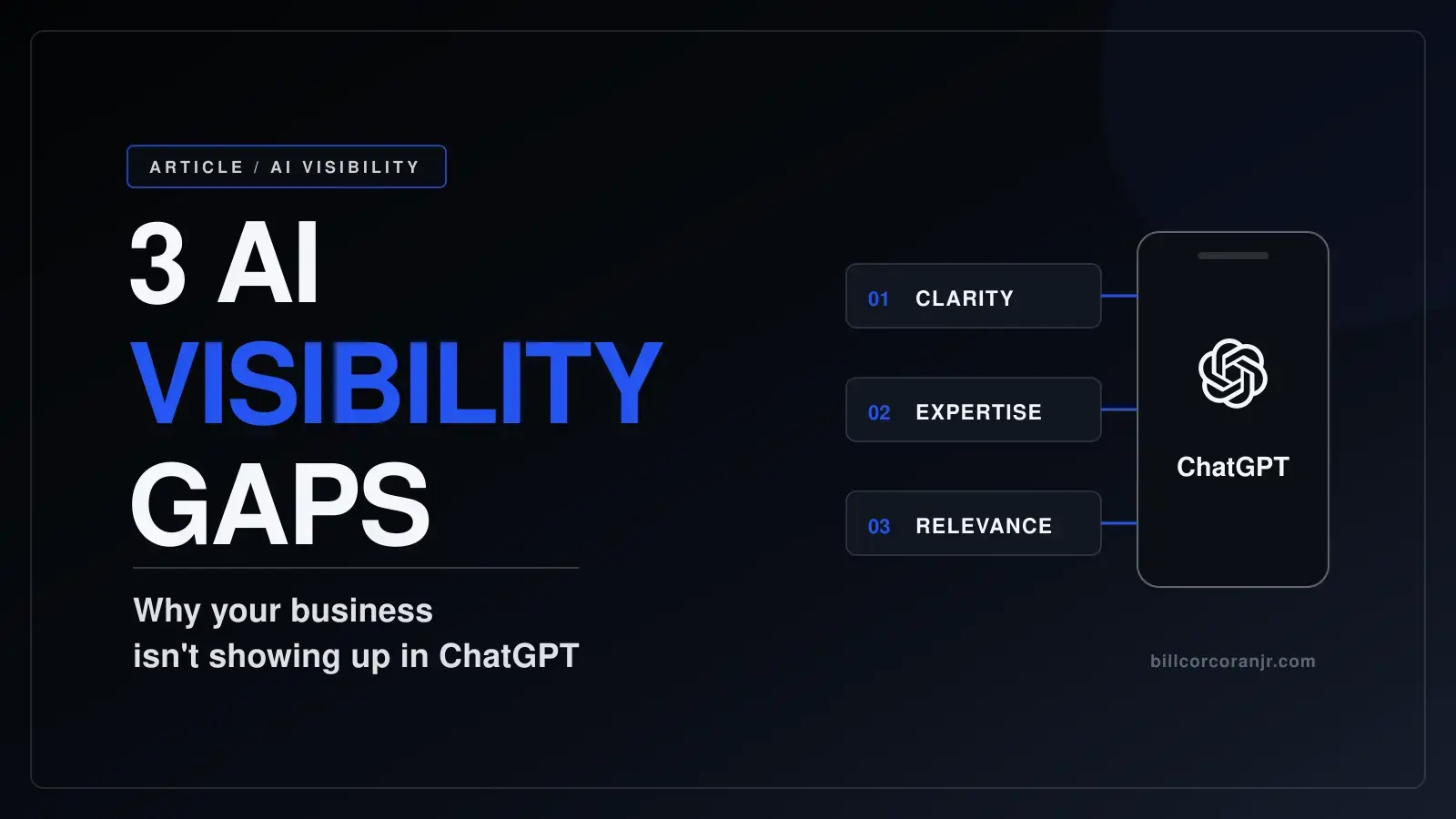
If your business isn’t showing up in ChatGPT, one or more of three visibility gaps may be getting in the way: ChatGPT cannot clearly understand what your company does, find enough public evidence of your expertise, or connect your business to the questions your customers are asking.
Those are three different problems, and each one requires a different fix. That is why publishing more content is not automatically the answer.
Technical problems can also limit visibility, and I cover those later in this article. But if your website is accessible, these three gaps are the right place to start.
What Does It Mean for a Business to Show Up in ChatGPT?
Showing up in ChatGPT can mean several different things.
ChatGPT might know your company exists when someone searches for it by name. It might use something you published as a source. It could describe your business accurately, include it while comparing possible solutions, or recommend it for a particular situation.
Those are related, but they are not the same.
The more important test is not whether ChatGPT recognizes your business after someone types its name. It is whether your business becomes part of the answer when people ask about the problems you solve, the topics you understand, and the decisions you help customers make.
There is no single switch that adds a business to every ChatGPT answer. Results can change based on the exact question, the context of the conversation, the information available online, and whether ChatGPT searches the web. OpenAI also says placement in its search results is not guaranteed.
If your business is consistently missing, start by looking at these three areas.
Reason 1: ChatGPT Does Not Clearly Understand What Your Business Does
You understand your business because you live inside it every day. Your employees understand it. Your customers and referral partners probably do too.
Someone encountering the company for the first time only has the information you have made public. ChatGPT is working from that public record too.
Many business websites never give a direct answer to basic questions:
- What does the company actually do?
- Who does it help?
- What problems does it solve?
- Where does it operate?
- Why would someone choose it instead of another option?
Instead, the website relies on broad claims about service, innovation, quality, or results. The language may sound polished, but it does not give a person or an AI system much useful context.
The problem gets worse when the company has changed over time. The website may describe an older version of the business while LinkedIn reflects the new direction. A Google Business Profile might use one category, YouTube might emphasize another, and third-party directories could still contain services or locations that are no longer accurate.
None of those descriptions has to be completely false to create confusion. They only need to be inconsistent enough that the full picture becomes difficult to assemble.
This is not about repeating an identical sentence everywhere. It is about making sure the facts and positioning support one clear explanation of the business.
How to Check Whether ChatGPT Understands Your Business
Review your homepage, primary service pages, Google Business Profile, LinkedIn presence, YouTube channel, and important directory listings as if you have never heard of the company.
Would you come away with one accurate explanation of what the business does, who it serves, and which problems it is qualified to solve?
If not, clarity is the first gap to address.
Reason 2: Your Real Expertise Is Not Visible Enough Online
Experienced business owners often know far more than their websites reveal.
They explain complicated decisions during sales calls. They warn customers about expensive mistakes. They know which option works in one situation but fails in another. They can explain costs, timing, risks, tradeoffs, and questions a buyer should ask before making a decision.
But much of that knowledge disappears as soon as the conversation ends.
It remains inside meetings, estimates, emails, presentations, internal documents, and years of personal experience. That knowledge may be extremely valuable, but it cannot help someone discover your business if it has never been captured and made publicly accessible.
Visible expertise does not mean filling a website with generic articles that could have been published by any competitor. More content is not automatically better evidence.
Useful expertise is specific. It includes your examples, experience, opinions, warnings, processes, and the distinctions you have learned from doing the work.
The format can vary. It might become an article, video, detailed service page, comparison, case study, or answer to a common customer question. For people who explain ideas more naturally by speaking, a recurring video or podcast can be an efficient way to capture that knowledge. The recording is only the source, though. The value comes from turning the answer into clear, searchable, connected information that people and AI systems can understand.
That is the reasoning behind Podcast-Powered AI Visibility™: use real human expertise as the source, then make that expertise useful and discoverable across the places people search.
How to Check Whether Your Expertise Is Visible Online
Think about the five questions you answer most often during sales calls or customer conversations.
Can someone find your best answer to each of those questions on your website today?
If the answer is no, you may have plenty of expertise without enough visible evidence of it.
Reason 3: Your Business Is Not Connected to the Questions Customers Ask
A business can have a clear website and a growing content library and still remain disconnected from the questions that matter.
That usually happens when the company publishes what it wants to announce instead of what customers are trying to understand.
Service pages, company news, event photos, awards, and general industry updates all have a purpose. But they may not answer questions such as:
- Should I repair this problem or replace the entire system?
- What should this type of project realistically cost?
- What is the difference between these two options?
- What warning signs should I look for before hiring someone?
- Which solution makes sense for a business our size?
These are not simply keyword variations. They are decisions.
People bring those decisions to Google, ChatGPT, YouTube, Gemini, Perplexity, and other discovery platforms. If your business has not published useful answers, the connection between your company and the subject may be weak.
A competitor with less real-world experience can sometimes appear more relevant because it has made its knowledge easier to find. It may have one focused comparison, a useful video, a detailed cost explanation, or several connected pages that address the question from different angles.
That does not prove the competitor is better at the work. It shows that the competitor has made its relevance more visible.
This is also why one enormous service page rarely solves the problem. No single page can thoroughly answer every comparison, concern, cost question, use case, and buying decision connected to a service.
The goal is to build a useful body of connected answers over time. One page addresses the basic question. Another explains a common mistake. Another compares two options. Another shows how the decision changes under different circumstances.
That is how content begins to reflect the actual depth of the business instead of becoming a collection of disconnected posts.
For a broader starting point, see these five ways to get your business found in AI search results.
How to Check Whether Your Content Answers Customer Questions
Look beyond the phrases used on your service pages.
What do customers ask before they know which solution they need? What are they comparing? What makes them hesitate? What do they misunderstand? What questions come up immediately before they call, request a quote, or choose a provider?
If your content does not address those decisions, relevance is the third gap.
Original Episode
Prefer the episode format?
The original episode covers the same three visibility gaps. Its page includes the video, audio links, and full transcript.
What Should You Fix First?
Do not begin by ordering a hundred new articles or publishing a pile of AI-generated content.
Start with three straightforward questions:
The order matters.
More content built on vague positioning creates more confusion. Clear positioning without visible expertise leaves the business making unsupported claims. Strong expertise that never addresses a customer’s real question can remain difficult to discover.
Identify the gap before choosing the fix.
Can Technical Issues Also Keep ChatGPT From Finding a Business?
Yes. Content and positioning are not the only possible causes.
A page still needs to be accessible and indexable. Important information should appear as visible text, not only inside graphics or scripts that some crawlers may not process reliably. A website, firewall, or content delivery network can also block the crawlers used by AI search systems.
For ChatGPT search specifically, OpenAI says websites should allow OAI-SearchBot and traffic from its published IP ranges. OAI-SearchBot affects eligibility for search results, while GPTBot is a separate control related to model training. You can review the distinction in OpenAI’s crawler documentation.
Google offers similar practical guidance for its AI features: allow crawling, make important information available in text, use descriptive internal links, and ensure structured data matches what visitors can actually see. Google also says there is no special AI schema or machine-readable file required to appear in AI Overviews or AI Mode. Its current guidance is available through Google Search Central.
These technical foundations matter, but they do not replace the three issues above. A perfectly crawlable website can still be vague, thin, or irrelevant to the question being asked.
How Do You Know Whether Your AI Visibility Is Improving?
Do not judge progress by asking ChatGPT one branded question and saving the first encouraging screenshot.
Start with a small group of meaningful questions tied to the problems your business solves and the decisions customers make. Record whether the business appears, how accurately it is described, which competitors appear, and which sources are being used. Repeat the same test over time.
One answer is an observation. Repeated results across meaningful questions are more useful evidence.
I have documented an example where a focused podcast episode ranked on Google and earned AI citations within 24 hours. That result was encouraging, but it was not a universal timeline or a guarantee. It was one measured result under specific conditions. You can review what happened and how the result was evaluated.
If you want to establish a more useful baseline, this guide explains how to measure AI visibility against competitors without relying on one prompt, one screenshot, or one unexplained score.
Why a Strong Reputation Is Not Enough for ChatGPT Visibility
Your business may already have the knowledge, experience, and customer trust needed to deserve attention.
The problem may be that the public information does not make those strengths clear enough to find, understand, or connect to the question someone is asking.
Start with clarity. Make real expertise visible. Answer the questions customers are already trying to solve. Then measure whether the pattern changes.
There is no secret formula that guarantees ChatGPT will cite or recommend a business. But these are meaningful gaps you can identify and improve.
Podcast-Powered AI Visibility™,
straight to your inbox.
Inbox-only breakdowns of the video podcast strategies Bill uses to get brands cited by AI, not just ranked on Google.
By subscribing, I acknowledge that I have read and understand the Privacy Policy
