
[fusion_scroll_progress animation_direction=”left” animation_speed=”0.3″ animation_delay=”0″ hide_on_mobile=”small-visibility,medium-visibility,large-visibility” sticky_display=”normal,sticky” background_color=”#043c92″ progress_color=”#1976f1″ height=”5″ position=”top” /]
How to Use Podcast Content to Get Your Business Found by ChatGPT
Turn your podcast expertise into useful website content that helps people and AI search tools find and understand your business.

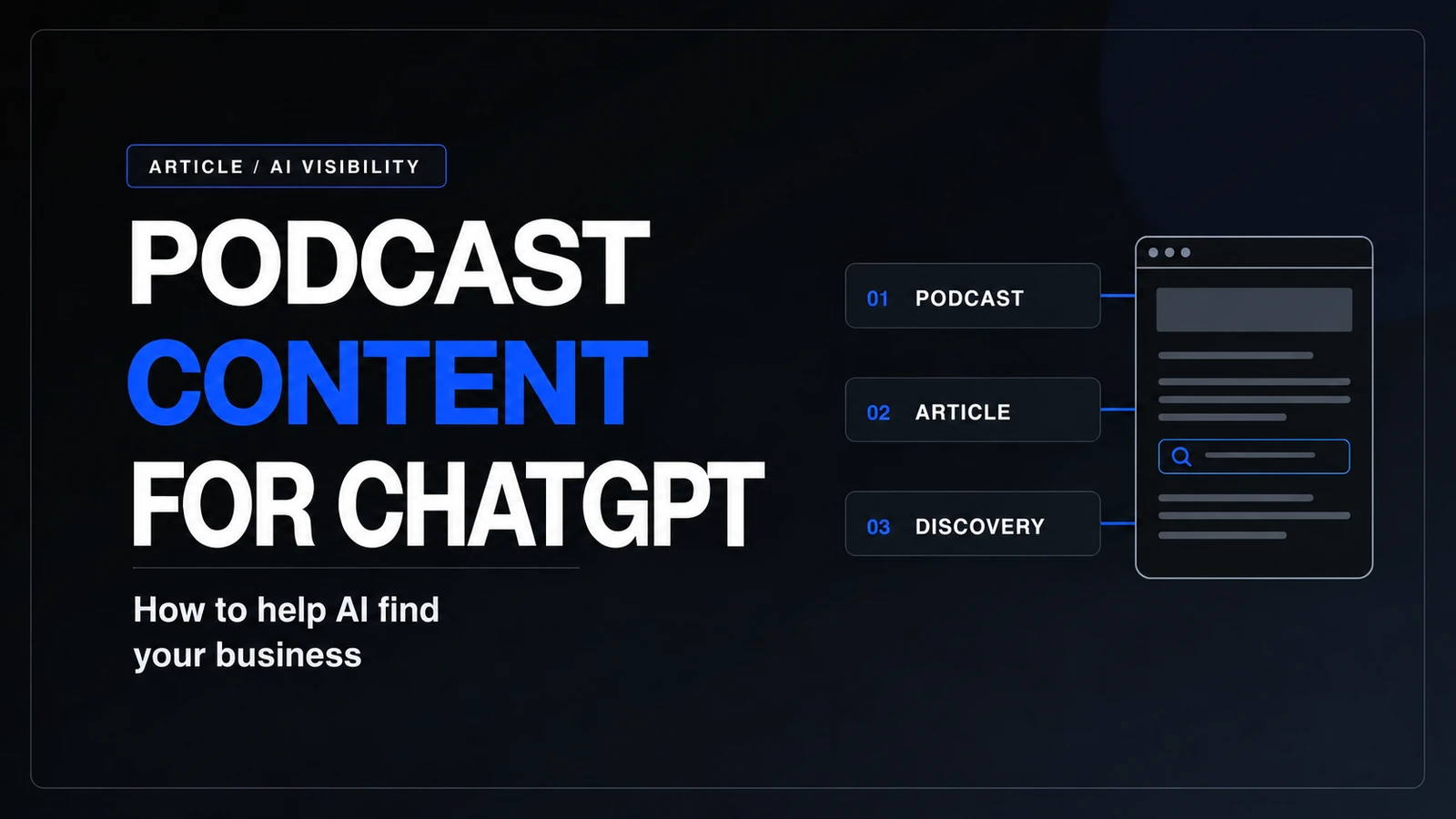
If you want to get your business found by ChatGPT, you need to publish useful answers to the questions your business knows how to answer.
A podcast is one of the most practical ways to do that.
Every episode gives you an opportunity to answer a real customer question, explain what you know in your own words, and publish that expertise under your name and business.
But recording the podcast is only the first step.
If you upload an audio episode to Spotify, publish the video on YouTube, write a two-sentence description, and move on, much of the value may remain buried inside the recording.
The episode also needs a useful page on your website. It needs a clear title, a strong written explanation, and an accurate transcript or detailed written version. It also needs enough context for people and AI systems to understand who is speaking, what the episode is about, and how it connects to your business.
That is the basic strategy.
Answer a question your customers already ask. Record it, publish it in formats people and machines can understand, and connect it to the rest of your expertise. Then watch whether your business begins appearing around that subject in ChatGPT, Google AI Overviews, Gemini, Perplexity, and traditional search results.
AI visibility is how easily tools like ChatGPT, Google AI Overviews, Gemini, and Perplexity can find, understand, and potentially show your business or expertise when someone asks a relevant question.
This cannot guarantee a citation or recommendation, but it gives these platforms more useful, accurate, first-party information to find and potentially use.
Key Takeaways
- A podcast can help your business get found by ChatGPT by putting your real expertise online in a useful, searchable format.
- Publishing the recording alone is not enough. Important episodes should also have dedicated pages on your website with meaningful written content.
- Clear titles, detailed explanations, accurate transcripts, and consistent information help people and machines understand what your business knows.
- Related episodes, articles, videos, and business pages should connect naturally instead of existing as isolated pieces of content.
- AI visibility should be measured across meaningful customer questions over time, not judged by one ChatGPT response or screenshot.
Can a Podcast Actually Help Your Business Show Up in ChatGPT?
Yes, but not simply because it is a podcast.
The value comes from the expertise inside the episode and how that expertise is published online.
ChatGPT does not sit in your sales meetings, listen to your customer calls, or hear the answers your team gives people every day. When ChatGPT searches the web for a current answer, it can only use information available through sources it can access.
For example, a financial advisor may explain what to consider before selling a company, while a roofer explains whether a damaged roof needs repair or replacement.
Those answers demonstrate real expertise, but private conversations disappear when they end.
A podcast captures those answers in a form that can keep working.
The next step is making sure the information does not remain trapped inside the recording.
Why Publishing the Podcast Alone Is Not Enough
Imagine someone records a useful episode, uploads it to podcast platforms and YouTube, then gives it a vague title and description.
Existing followers may listen, but people searching for the answer may never realize the episode contains what they need.
ChatGPT and other AI systems may encounter the same problem. The answer exists, but the title and surrounding information do not clearly explain what the episode covers.
Compare these two titles:
Some Thoughts on Retirement Planning
What Should a Business Owner Do Financially Before Selling a Company?
The second title immediately identifies the person the episode is for, the situation they are facing, and the question being answered.
That clarity matters everywhere the episode appears.
It matters on your website, YouTube, your podcast feed, and in Google search results.
It also matters when AI systems are trying to understand whether your content is relevant to someone’s question.
Clever titles can be memorable. Clear titles are findable.
Start With Questions Your Customers Are Already Asking
A strong business podcast should not begin with, “What should we post this week?”
Start with the customer.
What are they trying to understand?
What are they comparing?
What usually confuses them?
What do they ask before they hire someone?
What mistakes are they trying to avoid?
What question comes up during almost every sales call?
These are also the types of questions people bring to ChatGPT and Google.
Someone may ask ChatGPT:
- How do I know whether my roof needs to be replaced?
- What should I look for when choosing a financial advisor?
- What should a manufacturer consider before automating a production line?
- How long does it take to sell a business?
- What questions should I ask before hiring a marketing company?
If your business has a useful answer, that answer can become a podcast episode.
This does not mean finding a popular phrase and forcing an episode around it. The question still needs to matter to the audience and connect to something the business genuinely understands.
Human expertise comes first.
The search behavior helps you decide which parts of that expertise may be most useful to publish.
Turn Every Important Episode Into a Useful Website Page
YouTube, Spotify, and Apple Podcasts are important distribution channels. But your business should also have a first-party home for its most valuable episodes.
That means publishing a dedicated episode page on a website you control.
A useful episode page should quickly help someone understand:
- What question the episode answers
- Who is providing the answer
- What the person or business knows about the subject
- What the reader or viewer will learn
- Where to watch or listen
- Where to find the complete written information
- Which related resource may help them next
The page does not need to be complicated.
It could include the embedded video, a direct introduction, five key takeaways, several descriptive sections, an accurate transcript, relevant internal links, and clear information about the person or business behind the content.
Write enough to answer the question clearly, not to hit an arbitrary word count.
The better question is:
Does this page contain enough useful information for someone to understand the answer without having to guess what the episode is about?
If the answer is no, the page probably needs more than a video player and two sentences.
Transcripts Help, but They Are Not the Entire Strategy
A transcript makes an episode searchable, skimmable, quotable, and more accessible. It also gives the website page a written record of the discussion.
But a raw transcript should not be confused with a complete episode page.
Automatic transcription software can misspell names, confuse technical terms, misidentify companies, or create walls of text that are miserable to read.
Long sections should be separated into reasonable paragraphs. Speaker names should be accurate. Important topic changes can be organized under descriptive headings without changing what the person said.
For many episodes, the most useful approach is to provide both:
- A clear written explanation for someone who wants the answer quickly
- The complete transcript for someone who wants the full depth of the conversation
The written explanation gives the reader a direct path through the subject. The transcript preserves the detail, language, and context from the original episode.
Make It Obvious Who Is Behind the Answer
Getting information found is only part of the opportunity.
The information also needs to connect back to the right person and business.
An episode page should make the basics clear:
- The name of the show
- The episode title
- The host or participating expert
- The company connected to the content
- The publication date
- The main subject
- The video or audio episode
- The author of the written page
Businesses are often inconsistent across their website, YouTube channel, podcast platforms, social profiles, and business listings. Company names, titles, and roles may change from one platform to another, making it harder to connect an answer to the right source.
Clear, accurate, and consistent information makes it easier for people to understand the source. It also reduces ambiguity for search engines and AI systems trying to connect the content with the person or business behind it.
Structured data can reinforce this by describing the page, author, video, and other visible details in a standardized way. It should match what readers can already see.
Connect the Episode to the Rest of What Your Business Knows
One strong podcast episode can answer one important question.
A connected library can show the larger picture of what your business knows.
Suppose a financial advisor publishes an episode about preparing financially before selling a business.
That episode may naturally connect to:
- Another episode about taxes after a business sale
- An article about determining how much money someone needs to retire
- A page explaining how the firm works with business owners
- A video about common financial mistakes after a major liquidity event
- A biography showing the advisor’s relevant experience
Those links help a reader continue learning.
They also help search engines discover related pages and understand how the subjects connect.
Google recommends using internal links to help people and Google make sense of a website. It also says there is no magical ideal number of links a page should contain.
Add them when they help the reader understand the subject, answer a related question, or reach the next useful resource.
The goal is a connected body of expertise that makes sense as someone moves from one question, episode, or page to the next.
ChatGPT Is the Entry Point, but It Is Not the Only Opportunity
This article focuses on ChatGPT because that is where many business owners are beginning the conversation.
They want to know why their company is not appearing when someone asks for advice, compares providers, researches a problem, or requests a recommendation.
But the same work can support visibility beyond ChatGPT.
Google AI Overviews, Gemini, Perplexity, YouTube, and traditional search all offer additional ways for useful podcast content to be discovered.
Traditional Google search still matters because many of the fundamentals that help a webpage get crawled, indexed, and understood also support its eligibility for Google’s AI features.
Google says there are no additional technical requirements or special AI optimizations needed to appear in AI Overviews or AI Mode. Its existing recommendations still apply, including allowing crawling, making important content available in text, using helpful internal links, and ensuring structured information matches the visible page.
OpenAI also says that public websites can appear in ChatGPT search. Publishers who want their content available for summaries and snippets should make sure they are not blocking OpenAI’s search crawler.
You do not need to become an expert in every crawler. The larger point is simple: useful business information must be online in forms these platforms can access and understand.
Do Not Turn One Human Episode Into Fifty Pieces of AI Sludge
A good idea can go bad when a business turns one thoughtful episode into dozens of generic AI-generated articles, captions, summaries, and posts. More content does not automatically mean more useful content.
The value comes from the person’s experience, judgment, stories, examples, and ability to explain what they genuinely understand.
AI can help organize a transcript, support research, identify themes, create a first draft, or adapt an idea for another format.
Someone still needs to decide what is accurate, useful, relevant, and worth publishing.
My philosophy is simple: AI should support the content, not become the content. Use it to get more value from real expertise without stripping away the voice and judgment that made the original answer useful.
How Do You Know Whether the Strategy Is Working?
Publishing the content is not the end.
You also need to look at what happens after it goes online.
Look for meaningful signals: whether your business appears for relevant questions, whether AI platforms describe it accurately, whether your content appears as a source, how competitors compare, and whether people arrive from ChatGPT, Perplexity, Google, YouTube, or other platforms.
Do not judge the strategy by one result or a search for your company’s name. One screenshot is an observation; repeated visibility across meaningful customer questions begins to show a pattern.
I experienced the potential of this firsthand when one of my podcast episodes ranked first organically on Google for its exact topic and was cited by AI within 19 hours of publication.
That was meaningful, but it does not prove every episode will perform the same way or that one isolated change caused the result.
The episode had a focused subject, a clear title, a dedicated webpage, useful written information, and connections to content I had already published.
Where Podcast-Powered AI Visibility™ Fits
This broader idea is the foundation of the system I created, Podcast-Powered AI Visibility™.
At a high level, the system captures genuine human expertise through podcasting and turns it into searchable, connected content that people, search engines, and AI platforms can understand. The podcast is the source; AI visibility is the objective.
Podcast-Powered AI Visibility™ does not guarantee that any platform will cite or recommend a business. It is designed to improve the quality, clarity, structure, accessibility, and connectedness of the business’s information, then observe how visibility changes over time.
What Should You Do First?
Do not begin with a hundred-episode plan.
Begin with one important customer question.
Choose something your business understands well and your customers genuinely need help with.
Record a focused answer that includes your experience, examples, and point of view.
Give the episode a title that clearly explains the question.
Publish it on YouTube and the appropriate podcast platforms with accurate titles and descriptions.
Create a dedicated page on your website with the episode, a useful written explanation, exactly five key takeaways, descriptive headings, and an accurate transcript or detailed written version.
Connect it to a few genuinely relevant pages or episodes.
Make sure the page is available to search engines and AI search crawlers.
After publishing, monitor whether the content appears around the questions it answers and how AI platforms describe the subject and your business. Record what you observe without exaggerating what it proves, then use those findings to improve the next episode.
That is how a podcast becomes a growing library of real expertise that can help your business become easier to find, understand, trust, and potentially recommend.
Related Posts



October 14, 2026
October 14, 2026
[fusion_tb_pagination layout="text" preview_position="bottom" height="92" same_term="no" taxonomy="category" inverse_post_order="no" border_size="1" preview_height="90" preview_wrapper_width="500" preview_width="20" box_shadow="no" box_shadow_blur="0" box_shadow_spread="0" hide_on_mobile="small-visibility,medium-visibility,large-visibility" animation_direction="left" animation_speed="0.3" animation_delay="0" border_color="#043c92" text_color="#ffffff" /][fusion_tb_comments avatar="square" headings="show" heading_size="2" padding="40" hide_on_mobile="small-visibility,medium-visibility,large-visibility" animation_direction="left" animation_speed="0.3" animation_delay="0" heading_color="#ffffff" border_color="#043c92" link_color="#1976f1" text_color="#ffffff" meta_color="#babdc2" /]
